- Animals
- ›Chordates
- ›Vertebrates
- ›Birds
- ›Pelicans, Herons, Ibises, and Allies
- ›Herons, Egrets, and Bitterns
- ›Typical Herons and Egrets
- ›Calherodius
On eBird ↗
White-backed Night Heron
Live sightings near you, the range map, bar charts of when it is seen, and Macaulay Library photos and recordings.
White-backed Night Heron
Calherodius leuconotus
The white-backed night heron (Calherodius leuconotus) is a species of medium-sized heron in the family Ardeidae, found in sub-Saharan Africa.
From the article White-backed night heron on Wikipedia (CC BY-SA), quoted section by section
Description
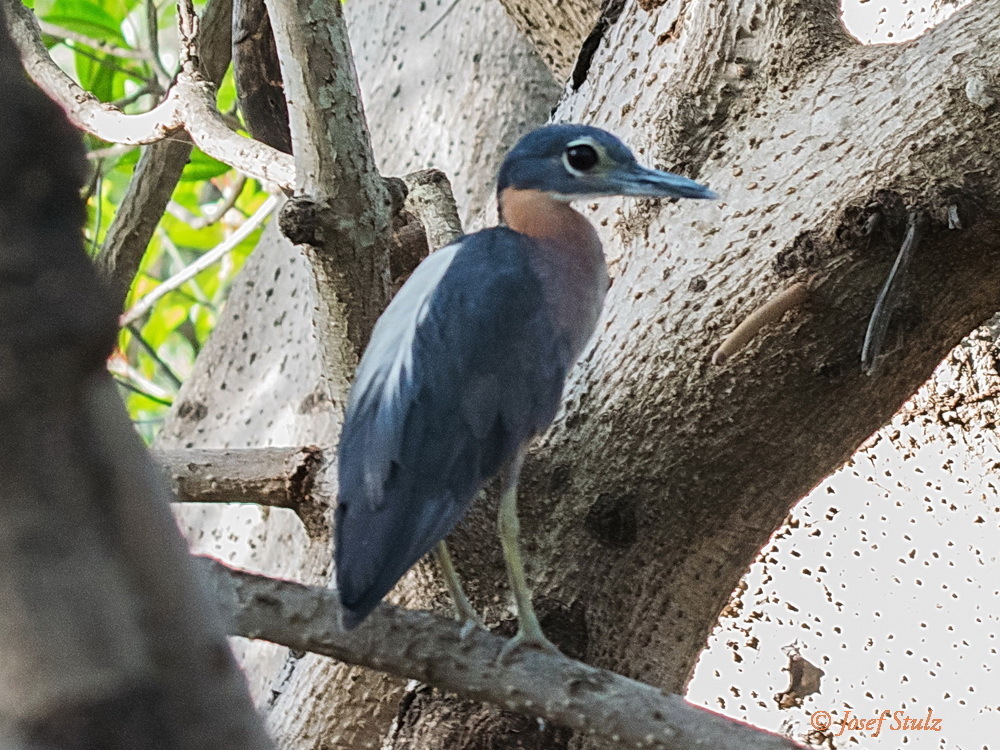
The white-backed night heron is 50–55 cm (20–22 in) in length with a black head and a short crest, or prominent feather display on the top of its head. The heron has large red eyes with white-ringed markings around them, and the lores, or the region behind the eye, are a pale yellow hue. The throat feathers are white, whereas the neck and breast are rufous, or a reddish-brown hue. There is a notable white triangular patch along the back formed by the white scapulars, or small feathers, on the shoulder of the bird. The belly feathers are a whitish-brown and the legs are yellow. An immature heron can be identified by its streaked breast and the white spots on the upper-wing coverts. Chicks are covered with olive-brown down.
Range & habitat
The white-backed night heron is located throughout central and southern Africa, with a range estimated at 20,900,000 km2 (8,100,000 sq mi). Its primary habitat is dense forests with neighboring waterways, particularly streams, lakes, mangroves and marshes.
Wikipedia: “Distribution and habitat”
What it does
The white-backed night heron can be found living individually or in pairs. Nocturnal by nature, they roost in the dense vegetation of marshes and forests during the daylight hours, often nesting high within the trees. Their nests are well-hidden, usually built in vegetation near water and sometimes in reedbeds, mangroves, rocks and caves. The nest is built resembling a platform of sticks or reeds, 25–30 cm (9.8–11.8 in) wide. They usually breed during the rainy season or early in the dry season. There are two to three greenish-white eggs in a clutch, and incubation lasts roughly 24 to 26 days. The chicks leave the nest after six to seven weeks. The white-backed night heron seems to be sedentary, but it has been observed in some circumstances to have migrated to locations with heavy rain. White-backed night herons are known foragers, meaning they search for food primarily along waterways. They have been observed to eat fish, amphibians, mollusks and insects. Though usually quiet, they let out a loud kroak call when alarmed and a taash call when disturbed.
Wikipedia: “Behavior and ecology”
Listen
Looking for field recordings…
Where it lives
Recorded sightings
—
geo-referenced records in GBIF, from museums, herbaria and field observers.
Drag the globe to turn it. Dots are where records exist, not a range map; darker means more records.
In the stacks
Searching the stacks…
Every page naming Calherodius leuconotus in the Biodiversity Heritage Library →
This page is assembled live from iNaturalist, GBIF, Wikipedia, the Source Library and the Internet Archive. It is not yet part of the hand-edited codex. iNaturalist taxon 1505859.