- Animals
- ›Chordates
- ›Vertebrates
- ›Birds
- ›Shorebirds and Allies
- ›Stone-curlews and Thick-knees
- ›Hesperoburhinus
On eBird ↗
Peruvian Thick-knee
Live sightings near you, the range map, bar charts of when it is seen, and Macaulay Library photos and recordings.
Peruvian Thick-knee
Hesperoburhinus superciliaris
The Peruvian thick-knee (Hesperoburhinus superciliaris) is a species of bird in the family Burhinidae. It is found in Chile, Ecuador, and Peru. Its natural habitats are subtropical or tropical dry shrubland, subtropical or tropical seasonally wet or flooded lowland grassland, and pastureland. It is a ground-dwelling bird and feeds on insects and small animals.
From the article Peruvian thick-knee on Wikipedia (CC BY-SA), quoted section by section
Description
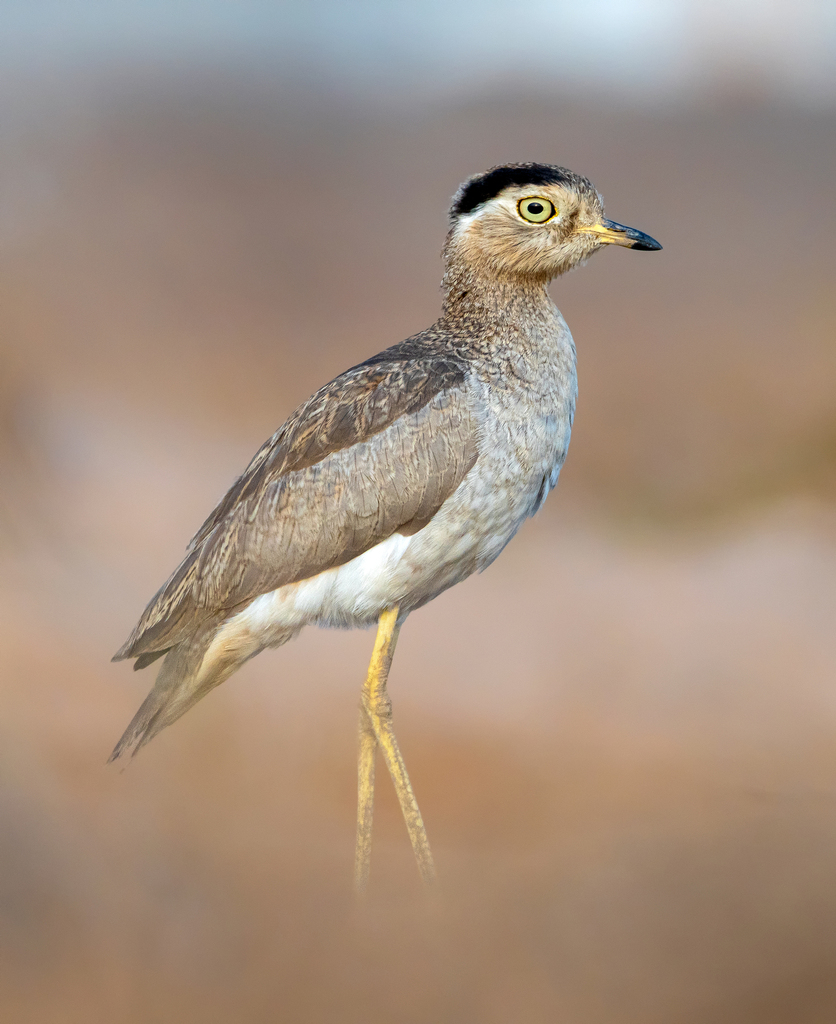
This medium-sized bird has brownish-grey plumage with brown streaks and spots. The underparts are white and the legs are yellow and long. There is a white streak through the eye with a black upper border. The short beak has a black tip. The length is about 40 cm (16 in).
Range & habitat
The Peruvian thick-knee is found in South America in the coastal strip between the Pacific Ocean and the Andes. Its range extends from northern Chile, through Peru to southern Ecuador. Its typical habitat is semi-desert areas, agricultural land, dry pasture or well-vegetated river valleys. It particularly favours open crops such as alfalfa or corn.
Wikipedia: “Distribution and habitat”
What it does
The Peruvian thick-knee is most active at night. The diet is not known but the bird moves about on the ground foraging, probably feeding on insects, small lizards and other small animals. It runs across the ground in a manner similar to an ostrich. It roosts in the open during the day, remaining motionless and difficult to spot as it is well-camouflaged by its brownish plumage. Its presence in an area may be most easily detected by its distinctive three-toed footprints in soft sand, and at night by its calls which are somewhat reminiscent of a lapwing (Vanellus sp.).
Little is known of the reproduction of this species but a nest containing two eggs has been observed in June on the Cerros de Naupe, a range of low mountains in Peru. The nesting site was on a dry, sparsely-vegetated slope with clumps of shrubs and cacti. The nest was a scrape in the ground with the area around it cleared of debris. The eggs were cream-coloured with blotches of tan and darker brown and measured approximately 53 by 39 millimetres (2.1 in × 1.5 in). One parent was incubating the eggs while the other stood in the shade a few metres away. Peruvian thick-knees are more likely to stay in large flocks year round in Chile than in Peru, where flocks increase after breeding. …
Wikipedia: “Behaviour”
Listen
Looking for field recordings…
Where it lives
Recorded sightings
—
geo-referenced records in GBIF, from museums, herbaria and field observers.
Drag the globe to turn it. Dots are where records exist, not a range map; darker means more records.
In the stacks
This page is assembled live from iNaturalist, GBIF, Wikipedia, the Source Library and the Internet Archive. It is not yet part of the hand-edited codex. iNaturalist taxon 1505526.