On eBird ↗
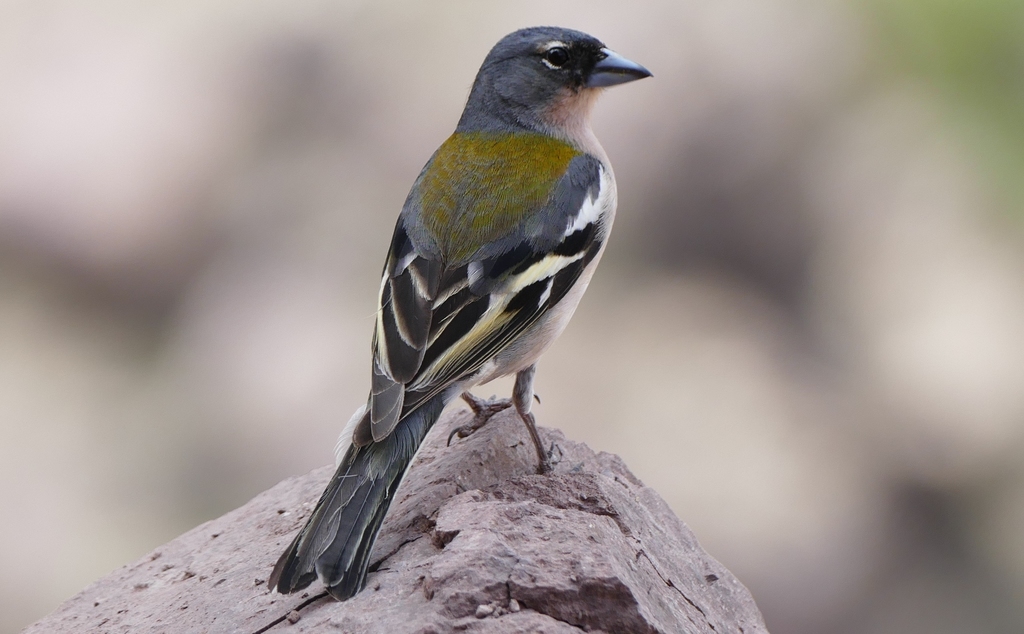
African Chaffinch
Live sightings near you, the range map, bar charts of when it is seen, and Macaulay Library photos and recordings.
African Chaffinch
Fringilla spodiogenys
The African chaffinch (Fringilla spodiogenys) is a species of passerine bird in the genus Fringilla. The African chaffinch is found from southern Morocco to northwestern Libya, and in Italy on the islands of Lampedusa and Pantelleria, off the Tunisian coast in the Strait of Sicily region; there is also an isolated population in northeastern Libya. It was formerly considered as two African subspecies of the Common chaffinch (Fringilla coelebs). Its habitat includes deciduous forests and lowlands, and during the nonbreeding season extends its habitat to open areas including weedy fields and olive groves.
The diet of the African chaffinch is similar to the Eurasian chaffinch, mostly eating small invertebrates and their larvae, as well as many flowers, seeds, and buds.
From the article African chaffinch on Wikipedia (CC BY-SA), quoted section by section
Range & habitat
The African chaffinch is found from southern Morocco to northwestern Libya, and in Italy on the islands of Lampedusa and Pantelleria, off the Tunisian coast in the Strait of Sicily; there is also an isolated population in northeastern Libya. The species is non-migratory and usually disperses only over short distances. The African chaffinch typically occurs in deciduous forests and Lowlands comprising a mix of trees such as maple (Acer), hornbeam (Carpinus), oak (Quercus), and pine (Pinus), alongside forest edges and clearings. In the Moroccan High Atlas it is found in Juniperus thurifera woods. During the non-breeding season, it extends its range to similar habitats and open agricultural areas, including weedy fields, stubble fields, olive groves, palm groves, and desert oases. There are a few accepted records of vagrant African chaffinches in northern Europe, in Sweden on 5 April 1998 and 5 May 2003, in Norway on 13 April 1998 and 12 April 2002, in the Netherlands on 4–5 April 2003, and in France on 19 April 2003. Two other reports, from England in 1994–1995 and the Netherlands in 1999, have not been accepted by the relevant national bird records committees.
Wikipedia: “Distribution and habitat”
What it does
The song is similar to the Eurasian chaffinch, but faster and more rhythmic, and lacking the flourish at the end. Its call sounds like a soft hwit sound singularly or in series or a high pitched wee. Sometimes these two calls are given together in a series.
Wikipedia: “Sound and vocal behaviour”
Listen
Looking for field recordings…
Where it lives
Recorded sightings
—
geo-referenced records in GBIF, from museums, herbaria and field observers.
Drag the globe to turn it. Dots are where records exist, not a range map; darker means more records.
In the stacks
Searching the stacks…
Every page naming Fringilla spodiogenys in the Biodiversity Heritage Library →
This page is assembled live from iNaturalist, GBIF, Wikipedia, the Source Library and the Internet Archive. It is not yet part of the hand-edited codex. iNaturalist taxon 1504820.