On eBird ↗
Rodrigues Starling
Live sightings near you, the range map, bar charts of when it is seen, and Macaulay Library photos and recordings.
Rodrigues Starling
Necropsar rodericanus
The Rodrigues starling (Necropsar rodericanus) is an extinct species of starling that was endemic to the Mascarene island of Rodrigues. Its closest relatives were the Mauritius starling and the hoopoe starling from nearby islands; all three are extinct and appear to be of Southeast Asian origin. The bird was only reported by French sailor Julien Tafforet, who was marooned on the island from 1725 to 1726. Tafforet observed it on the offshore islet of Île Gombrani. Subfossil remains found on the mainland were described in 1879, and were suggested to belong to the bird mentioned by Tafforet. There was much confusion about the bird and its taxonomic relations throughout the 20th century.
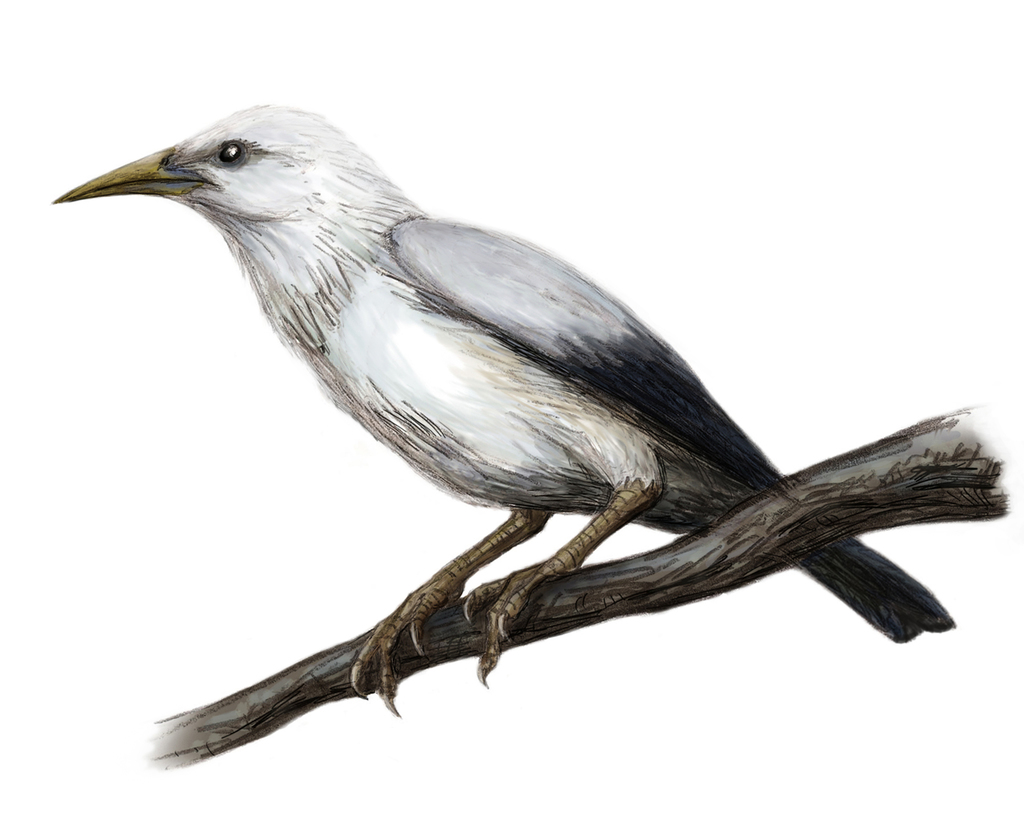
The Rodrigues starling was 25–30 centimetres (10–12 inches) long, and had a stout beak. It was described as having a white body, partially black wings and tail, and a yellow bill and legs. Little is known about its behaviour. Its diet included eggs and dead tortoises, which it processed with its strong bill. Predation by rats introduced to the area was probably responsible for the bird's extinction some time in the 18th century. It first became extinct on mainland Rodrigues, then on Île Gombrani, its last refuge.
From the article Rodrigues starling on Wikipedia (CC BY-SA), quoted section by section
Description
The Rodrigues starling was large for a starling, being 25–30 cm (10–12 in) in length. Its body was white or greyish white, with blackish-brown wings, and a yellow bill and legs. Tafforet's complete description of the bird reads as follows:
A little bird is found which is not common, for it is not found on the mainland. One sees it on the islet au Mât [Ile Gombrani], which is to the south of the main island, and I believe it keeps to that islet on account of the birds of prey which are on the mainland, as also to feed with more facility on the eggs of the fishing birds which feed there, for they feed on nothing else but eggs or turtles dead of hunger, which they well know how to tear out of their shells. These birds are a little larger than a blackbird [Réunion bulbul (Hypsipetes borbonicus)], and have white plumage, part of the wings and tail black, the beak yellow as well as the feet, and make a wonderful warbling. I say a warbling, since they have many and altogether different notes. We brought up some with cooked meat, cut up very small, which they eat in preference to seed. Tafforet was familiar with the fauna of Réunion, where the related hoopoe starling lived. He made several comparisons between the faunas of different locations, so the fact that he did not mention a crest on the Rodrigues starling indicates that it was absent. …
What it does
Little is known about the behaviour of the Rodrigues starling, apart from Tafforet's description, from which various inferences can be made. Tafforet reported that the pigeons and parrots on the offshore southern islets only came to the mainland to drink water, and Leguat noted that the pigeons only bred on the islets due to persecution from rats on the mainland; the starling may have also done this. Originally, the Rodrigues starling may have been widely distributed on Rodrigues, with seasonal visits to the islets. Tafforet's description also indicates that it had a complex song. Tafforet did not see any Rodrigues starlings on the mainland, but he stated that they could easily be reared by feeding them meat, which indicates that he brought young birds from a breeding population on Île Gombrani. Tafforet was marooned on Rodrigues during the summer and was apparently able to procure juvenile individuals; some other Rodrigues birds are known to breed at this time, so it is likely that the starling did the same.
Many other species endemic to Rodrigues became extinct after humans arrived, and the island's ecosystem is now heavily damaged. Before humans arrived, forests completely covered the island, but very little remains today. …
Wikipedia: “Behaviour and ecology”
Listen
Looking for field recordings…
Where it lives
Recorded sightings
—
geo-referenced records in GBIF, from museums, herbaria and field observers.
Drag the globe to turn it. Dots are where records exist, not a range map; darker means more records.
In the stacks
Searching the stacks…
Every page naming Necropsar rodericanus in the Biodiversity Heritage Library →
This page is assembled live from iNaturalist, GBIF, Wikipedia, the Source Library and the Internet Archive. It is not yet part of the hand-edited codex. iNaturalist taxon 15039.