On eBird ↗
Blue-and-white Mockingbird
Live sightings near you, the range map, bar charts of when it is seen, and Macaulay Library photos and recordings.
Blue-and-white Mockingbird
Melanotis hypoleucus
The blue-and-white mockingbird (Melanotis hypoleucus) is a species of bird in the Mimidae family. It is found in El Salvador, Guatemala, Honduras, and south-eastern Mexico. Its natural habitats are dry scrubland, woodland, second growth and forest edges at 1000–3000 m above sea-level.
From the article Blue-and-white mockingbird on Wikipedia (CC BY-SA), quoted section by section
Description
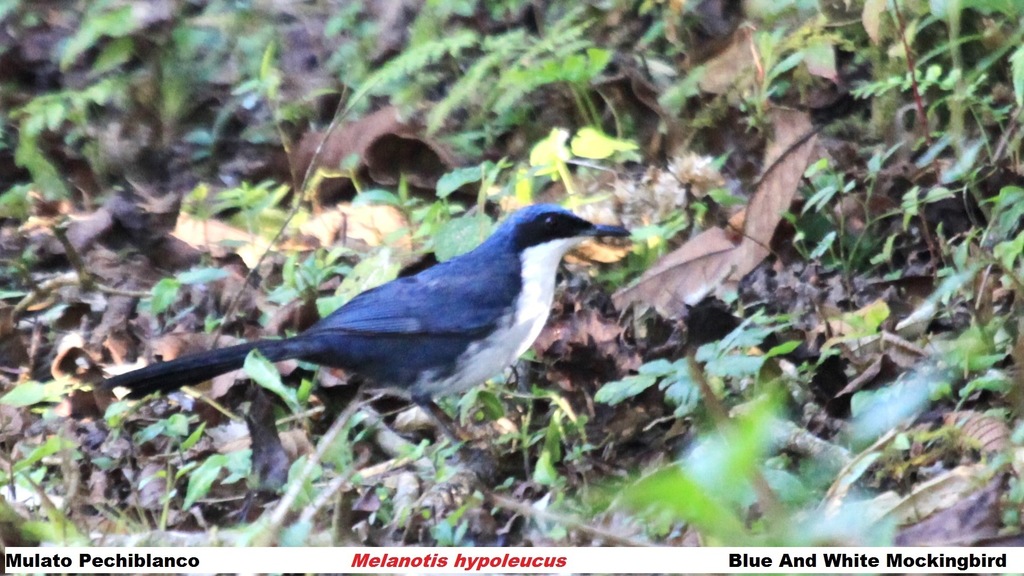
The blue-and-white mockingbird is 24.2 to 28 cm (9.5 to 11.0 in) long; 20 specimens had a mean mass of 68 g (2.4 oz). The adults' upperparts are a dull slate blue that is slightly brighter on the crown. The wings and tail are slaty black. A conspicuous black "mask" covers from the lores past the eye. The underparts are white darkening to bluish or slate gray on the flanks and vent area. The juvenile has a similar pattern but its upperparts are dull slaty gray instead of blue.
Range & habitat
The blue-and-white mockingbird is a year round resident of Mexico from south of the Isthmus of Tehuantepec through Guatemala to El Salvador and southern Honduras. It inhabits a variety of landscapes including the edges of humid evergreen forest, pine-oak forest, second growth, and humid and semi-arid scrublands. In elevation it ranges between 900 and 3,000 m (3,000 and 9,800 ft).
Wikipedia: “Distribution and habitat”
What it does
The blue-and-white mockingbird primarily forages on the ground, by sweeping aside leaf litter with its bill. Though its diet has not been fully documented, its primary food appears to be invertebrates and it also eats small fruits.
Wikipedia: “Feeding”
Listen
Looking for field recordings…
Where it lives
Recorded sightings
—
geo-referenced records in GBIF, from museums, herbaria and field observers.
Drag the globe to turn it. Dots are where records exist, not a range map; darker means more records.
In the stacks
Searching the stacks…
Every page naming Melanotis hypoleucus in the Biodiversity Heritage Library →
This page is assembled live from iNaturalist, GBIF, Wikipedia, the Source Library and the Internet Archive. It is not yet part of the hand-edited codex. iNaturalist taxon 15034.