On eBird ↗
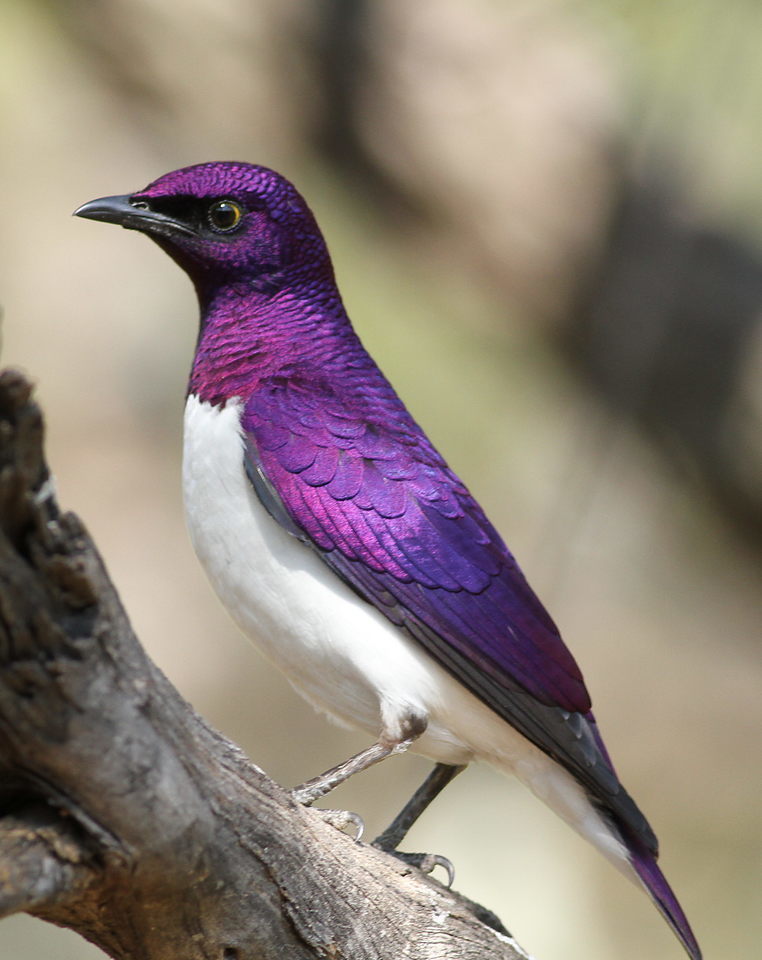
Violet-backed Starling
Live sightings near you, the range map, bar charts of when it is seen, and Macaulay Library photos and recordings.
Violet-backed Starling
Cinnyricinclus leucogaster
The violet-backed starling (Cinnyricinclus leucogaster), also known as the plum-coloured starling or amethyst starling, or Ndambamukula in the Venda language, is a relatively small species (17 cm) of starling in the family Sturnidae. It is the only member of the genus Cinnyricinclus. This strongly sexually dimorphic species is found widely in the woodlands and savannah forest edges of mainland sub-Saharan Africa. It is rarely seen on the ground, but instead found in trees and other locations away from the ground.
From the article Violet-backed starling on Wikipedia (CC BY-SA), quoted section by section
Description
The violet-backed starling is a sexually dimorphic species with adults reaching a length of about 18 cm (7 in). The male has an iridescent violet head and back, and pure white underparts. The female has a thrush-like appearance with brown, boldly-streaked upper parts and white, heavily-streaked underparts. Both sexes have yellow irises, and black bills and legs.
Range & habitat
The violet-backed starling is a common bird in Sub-Saharan Africa, occurring in most locations with the exception of the dense rainforest of the Congo Basin, and the more arid parts of southwestern Africa. It is found in open woodland, gallery forests, forest verges and clearings. In the Chyulu Hills of Kenya, it occurs at altitudes up to 2,100 m (6,900 ft).
Wikipedia: “Distribution and habitat”
What it does
The diet of the violet-backed starling includes fruits, seeds and arthropods. It sometimes hawks for insects in a manner similar to flycatchers. It largely feeds in the canopy, seldom foraging on the ground. The nest is usually located in a crevice in a tree within a few metres of the ground. Nesting material includes green leaves and dung. The female will incubate the clutch of two to four eggs, which are pale blue with reddish-brown spots, for 12–14 days. The male will help feed chicks until they fledge after about 21 days.
Wikipedia: “Behaviour”
Listen
Looking for field recordings…
Where it lives
Recorded sightings
—
geo-referenced records in GBIF, from museums, herbaria and field observers.
Drag the globe to turn it. Dots are where records exist, not a range map; darker means more records.
In the stacks
Searching the stacks…
Every page naming Cinnyricinclus leucogaster in the Biodiversity Heritage Library →
This page is assembled live from iNaturalist, GBIF, Wikipedia, the Source Library and the Internet Archive. It is not yet part of the hand-edited codex. iNaturalist taxon 15030.