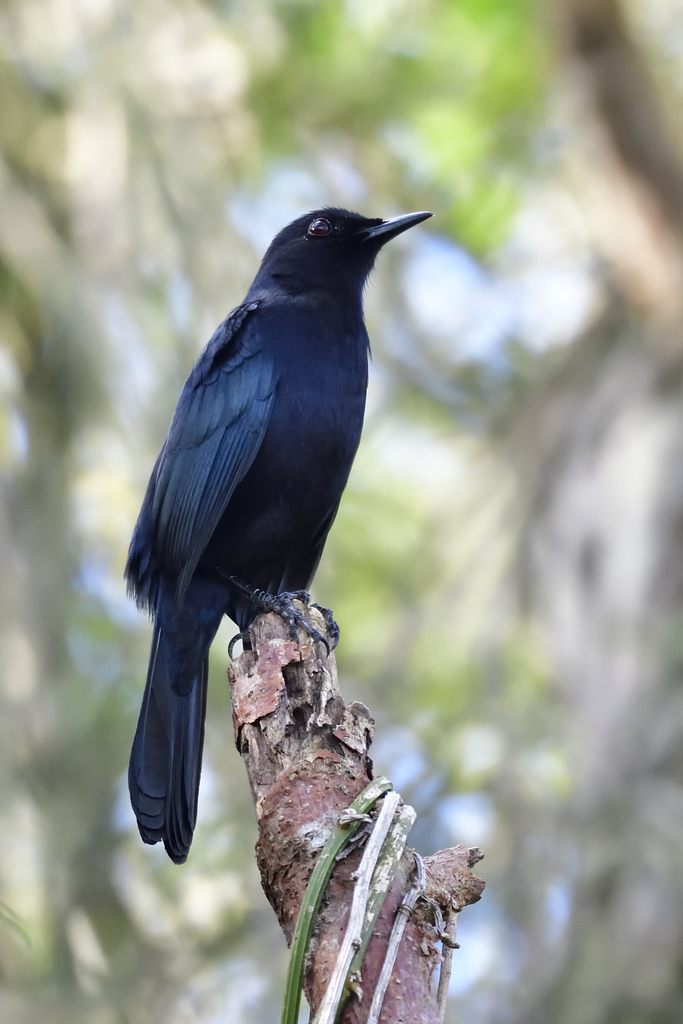
Melanoptila
The black catbird (Melanoptila glabrirostris) is a songbird species in the monotypic genus Melanoptila, part of the family Mimidae. At 19–20.5 cm (7.5–8.1 in) in length and 31.6–42 g (1.11–1.48 oz) in mass, it is the smallest of the mimids. Sexes appear similar, with glossy black plumage, black legs and bill, and dark brownish eyes. The species is endemic to the Yucatán Peninsula, and is found as far south as Campeche, northern Guatemala and northern Belize. Although there are historical records from Honduras and the US state of Texas, the species is not now known to occur in either location. It is found at low elevations in semi-arid to humid habitats ranging from shrubland and abandoned farmland to woodland with thick understory, and is primarily sedentary.
Although it is a mimid, the black catbird is not known to imitate any other species. Its song is a mix of harsh notes and clear flute-like whistles, with the phrases repeated. It builds a cup nest in low bushes or trees, and lays two bluish eggs. It is threatened by habitat loss, and has been assessed as near threatened by the International Union for Conservation of Nature.
1 branches of this genus, most-observed first · about 1 known species
See this branch on the Wheel of Life →
Where it lives
Recorded sightings
—
geo-referenced records in GBIF, from museums, herbaria and field observers.
Drag the globe to turn it. Dots are where records exist, not a range map; darker means more records.
In the stacks
Searching the stacks…
Every page naming Melanoptila in the Biodiversity Heritage Library →
This page is assembled live from iNaturalist, GBIF, Wikipedia, the Source Library and the Internet Archive. It is not yet part of the hand-edited codex. iNaturalist taxon 15017.