- Plants
- ›Vascular Plants
- ›flowering plants
- ›Dicots
- ›Legumes, Milkworts, and Allies
- ›Legumes
- ›Acacias, Mimosas, Mesquites, and Allies
- ›Neltuma
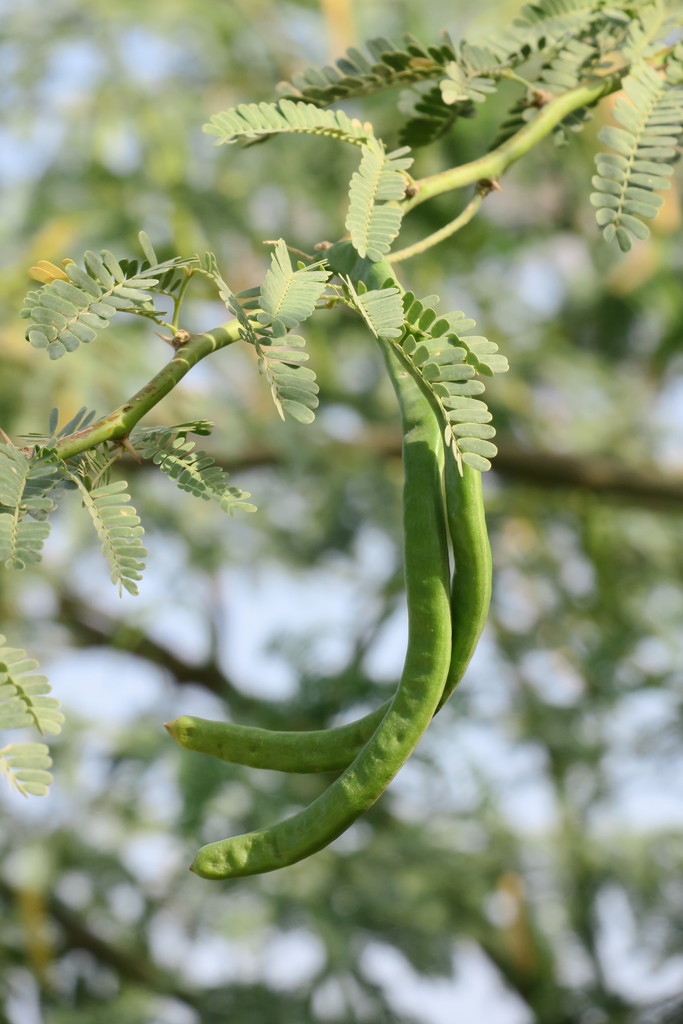
mesquite
Neltuma juliflora
Neltuma juliflora (Spanish: bayahonda blanca, Cuji in Venezuela, Trupillo in Colombia, Aippia in the Wayuunaiki language and long-thorn kiawe in Hawaii), formerly Prosopis juliflora, is a shrub or small tree in the family Fabaceae, a kind of mesquite. It is native to Mexico, South America and the Caribbean. It has become established as an invasive weed in Africa, India, Asia, Australia and elsewhere. It is a contributing factor to continuing transmission of malaria, especially during dry periods when sugar sources from native plants are largely unavailable to mosquitoes.
From the article Neltuma juliflora on Wikipedia (CC BY-SA), quoted section by section
Description
Growing to a height of up to 12 metres (39 feet), N. juliflora has a trunk diameter of up to 1.2 m (4 ft). Its leaves are deciduous, geminate-pinnate, light green, with 12 to 20 leaflets. Flowers appear shortly after leaf development. The flowers are in 5–10 centimetres (2–4 inches) long green-yellow cylindrical spikes, which occur in clusters of 2 to 5 at the ends of branches. Pods are 20 to 30 cm (8 to 12 in) long and contain between 10 and 30 seeds per pod. A mature plant can produce hundreds of thousands of seeds. Seeds remain viable for up to 10 years. The tree reproduces solely by way of seeds, not vegetatively. Seeds are spread by cattle and other animals, which consume the seed pods and spread the seeds in their droppings. Its roots are able to grow to a great depth in search of water similar to Prosopis species. The tree is said to have been introduced to Sri Lanka in the 19th century, where it is now known as vanni-andara, or katu andara in Sinhala. It is claimed that N. juliflora existed and was recognised even as a holy tree in ancient India, but this is most likely a confusion with the superficially similar Prosopis cineraria. The tree is believed to have existed in the Vanni and Mannar regions for a long time. This species has thorns in pairs at the nodes. …
At the table
The sweet pods are edible and nutritious, and have been a traditional source of food for indigenous peoples in Peru, Chile and California. Pods were once chewed during long journeys to stave off thirst. They can be eaten raw, boiled, dried and ground into flour to make bread, stored underground, or fermented to make a mildly alcoholic beverage. The species' uses also include forage, wood and environmental management. The plant possesses an unusual amount of the flavanol (-)-mesquitol in its heartwood. In the Macará Canton of Ecuador, N. juliflora can be found in dry forests where it is one of the species most frequently harvested for multiple forest products. The tree is a rich source of honey.[1][2]
Wikipedia: “Uses”
Toxicity
The seed pods contain neurotoxic alkaloids which are toxic when eaten excessively by livestock.
Wikipedia: “Potential toxicity”
In human culture
Names in and around Indian subcontinent, where the species is widely used for firewood and to make barriers, often compare it to similar trees and note its introduced status; thus in Hindi it is called angaraji babul, Kabuli kikar, vilayati babul, vilayati khejra or vilayati kikar. The angaraji and vilayati names mean they were introduced by Europeans, while Kabuli kikar (or keekar) means "Kabul acacia"; babul specifically refers to Acacia nilotica and khejra (or khejri) to Proposis. cineraria, both of which are native to South Asia.In Maharashtra it is known as "Katkali (काटकळी)". In Gujarati it is called gando baval (ગાંડો બાવળ- literally translating to "the crazy tree") and in Marwari, baavlia. In Kannada it is known as Ballaari Jaali (ಬಳ್ಳಾರಿ ಜಾಲಿ) meaning "Jaali", local name, abundant in and around Bellary district. In Tamil Nadu, in Tamil language it is known as seemai karuvel (சீமைக்கருவேலை), which can be analysed as சீமை ("foreign (or non-native)") + கருவேலை (Vachellia nilotica). Another Tamil name is velikathan (வேலிகாத்தான்), from veli (வேலி) "fence" and kathan (காத்தான்) "protector", for its use to make spiny barriers. In Andhra Pradesh and Telangana, in the Telugu language it is known as mulla tumma (ముల్ల తుమ్మ),sarkar tumma,"chilla chettu","Japan Tumma Chettu", "Seema Jaali", or "Kampa Chettu". In Malayalam, it is known as "Mullan". A vernacular. …
Wikipedia: “Etymology”
Where it lives
Recorded sightings
—
geo-referenced records in GBIF, from museums, herbaria and field observers.
Drag the globe to turn it. Dots are where records exist, not a range map; darker means more records.
In the old herbals & bestiaries

In the stacks
Searching the stacks…
Every page naming Neltuma juliflora in the Biodiversity Heritage Library →
This page is assembled live from iNaturalist, GBIF, Wikipedia, the Source Library and the Internet Archive. It is not yet part of the hand-edited codex. iNaturalist taxon 1493141.