On eBird ↗
Gray Thrasher
Live sightings near you, the range map, bar charts of when it is seen, and Macaulay Library photos and recordings.
Gray Thrasher
Toxostoma cinereum
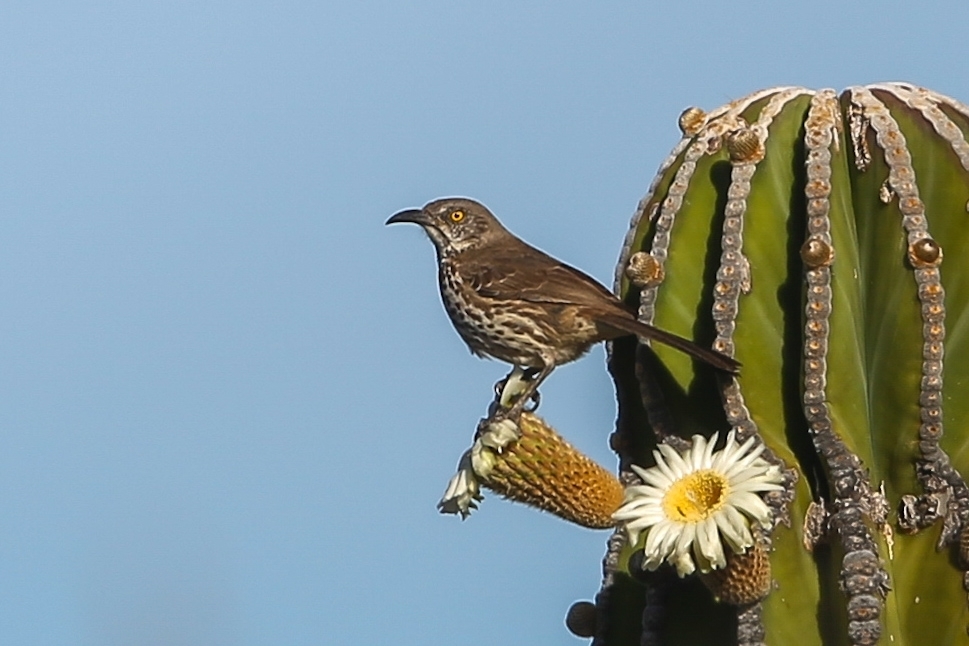
The gray thrasher (Toxostoma cinereum) is a medium-sized passerine bird belonging to the family Mimidae like the other thrashers. It is endemic to the Baja California peninsula in Mexico where it occurs from the tip of the peninsula north to 31°N on the west coast and 29°N on the east coast. It inhabits desert scrubland.
From the article Gray thrasher on Wikipedia (CC BY-SA), quoted section by section
Description
The gray thrasher is 21.4 to 25.0 cm (8.4 to 9.8 in) long. Four males weighed 58.6 to 69.8 g (2.07 to 2.46 oz) and a female 54.4 g (1.92 oz). It is gray-brown above with cinnamon tones on the rump. Its underparts are white with arrow-shaped black spots. The outer tail feathers have white tips. Its eyes are golden yellow. The subspecies are similar, with T. c. mearnsi being somewhat darker overall.
Range & habitat
The gray thrasher is found only in Mexico's Baja California, where its range extends from approximately north latitude 31°14' to its southern tip. On the east side of the peninsula, however, it is found only as far north as approximately 28°. There is a record of this species in the Famosa Slough, San Diego County, California. T. c. mearnsi occupies approximately the northern half of the range and the nominate subspecies the southern half. The gray thrasher inhabits arid and semi-arid landscapes. Most are open to semi-open with cacti, scrub, or scattered bushes and trees. In elevation it ranges from sea level to 1,500 m (4,900 ft).
Wikipedia: “Distribution and habitat”
What it does
The gray thrasher typically forages on the ground or low down in vegetation. Its diet is not well studied but is known to include arthropods and cactus fruits.
Wikipedia: “Feeding”
Listen
Looking for field recordings…
Where it lives
Recorded sightings
—
geo-referenced records in GBIF, from museums, herbaria and field observers.
Drag the globe to turn it. Dots are where records exist, not a range map; darker means more records.
In the stacks
Searching the stacks…
Every page naming Toxostoma cinereum in the Biodiversity Heritage Library →
This page is assembled live from iNaturalist, GBIF, Wikipedia, the Source Library and the Internet Archive. It is not yet part of the hand-edited codex. iNaturalist taxon 14909.