On eBird ↗
Cozumel Thrasher
Live sightings near you, the range map, bar charts of when it is seen, and Macaulay Library photos and recordings.
Cozumel Thrasher
Toxostoma guttatum
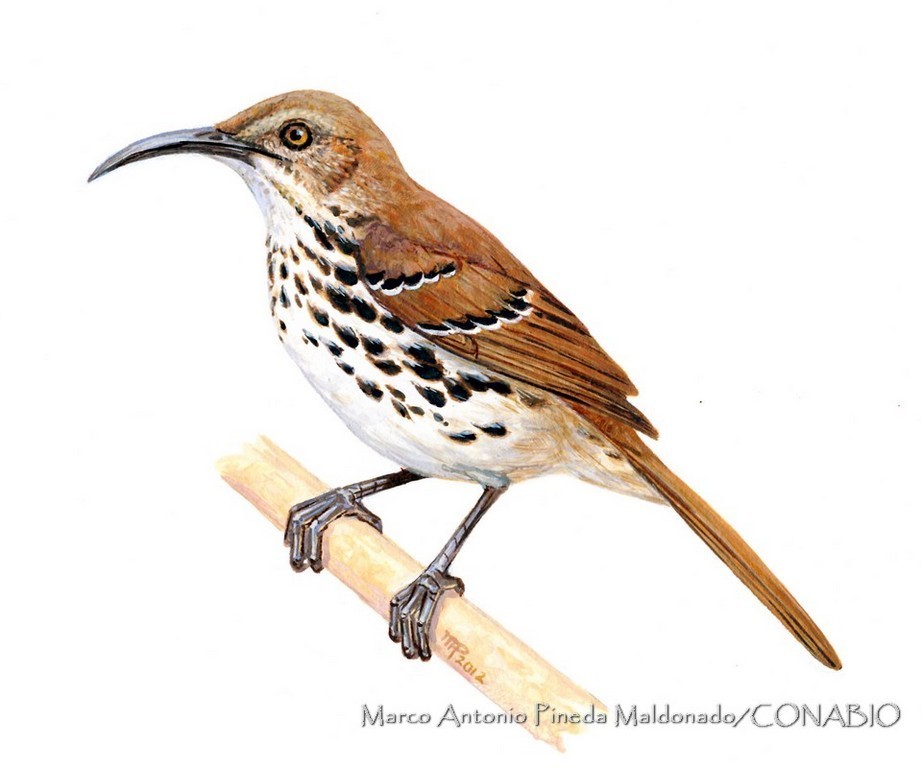
The Cozumel thrasher (Toxostoma guttatum) is a bird from the mockingbird family (Mimidae), which is endemic to the island of Cozumel off the Yucatán Peninsula, Mexico. It is believed to be the most critically endangered species of bird in Mexico – if it indeed still exists, which is probable but not certain.
This bird is closely related to the long-billed and brown thrashers. It has been generally described as shy, but there have been descriptions to the contrary. It was once abundant throughout Cozumel before two hurricanes greatly affected its numbers. Invasive species are also thought to have impacted the population of the thrasher.
From the article Cozumel thrasher on Wikipedia (CC BY-SA), quoted section by section
Description
The thrasher is 21.5 to 24 centimetres (8.5 to 9.4 in) in length. The adult has a brown crown, back, shoulders, and rump that becomes more red in its tint on its lower back and rump. Greater and lesser coverts are a warm brown with concealed white tips, preceded with a black bar. Primaries and secondaries are grayish-brown with warm rufous-brown outer webs. The rectrices are also have a warm brown color. The lores and ear-coverts are a mottled grey brown. The chin and throat are an off-white color with a blackish partial malar stripe. The chest is a buffy-white in color with stark black teardrop shaped spots. The belly is off-white, and the flanks have larger black spots. Its vent is buffy and an underwing that is buffy-white with darker markings. The iris is yellow, the bill is grayish-brown, and the legs are brown with a dull tint. Juveniles' plumage have not been recorded, but presumably is similar in development to adulthood like the long-billed and brown thrasher.
Similar species. The Cozumel thrasher is similar in appearance to the long-billed thrasher (Toxostoma longirostre, 26.5–29 centimetres or 10.4–11.4 inches in length), but is smaller, darker in color, has a blacker bill, and the markings are more sharply defined. No other thrasher species coexist on the island, but the Cozumel thrasher may be confused with the migratory wood thrush (Hylocichla mustelina). …
Range & habitat
The distribution of the thrasher is restricted to Isla Cozumel which is 45 km long and 20 km wide. The habitat preferences for the thrasher is thought to be in low and medium deciduous and semi-deciduous forests. It may have once been most abundant in forest edges adjacent to clearings.
Wikipedia: “Distribution and habitat”
What it does
The thrasher is predominately terrestrial and elusive and as with all members of the genus Toxostoma, it may resort to running instead of flying when startled. Ornithologists Ludlow Griscom and Raymond A. Paynter, Jr. had noted its secretive behavior, but James Bond did not. The song is described as a rich varied warbling, slightly scratchy with little repetition. Bond described its alarm note being similar to the brown thrasher.
Wikipedia: “Behavior and ecology”
Listen
Looking for field recordings…
Where it lives
Recorded sightings
—
geo-referenced records in GBIF, from museums, herbaria and field observers.
Drag the globe to turn it. Dots are where records exist, not a range map; darker means more records.
In the stacks
Searching the stacks…
Every page naming Toxostoma guttatum in the Biodiversity Heritage Library →
This page is assembled live from iNaturalist, GBIF, Wikipedia, the Source Library and the Internet Archive. It is not yet part of the hand-edited codex. iNaturalist taxon 14901.