On eBird ↗
Crissal Thrasher
Live sightings near you, the range map, bar charts of when it is seen, and Macaulay Library photos and recordings.
Crissal Thrasher
Toxostoma crissale
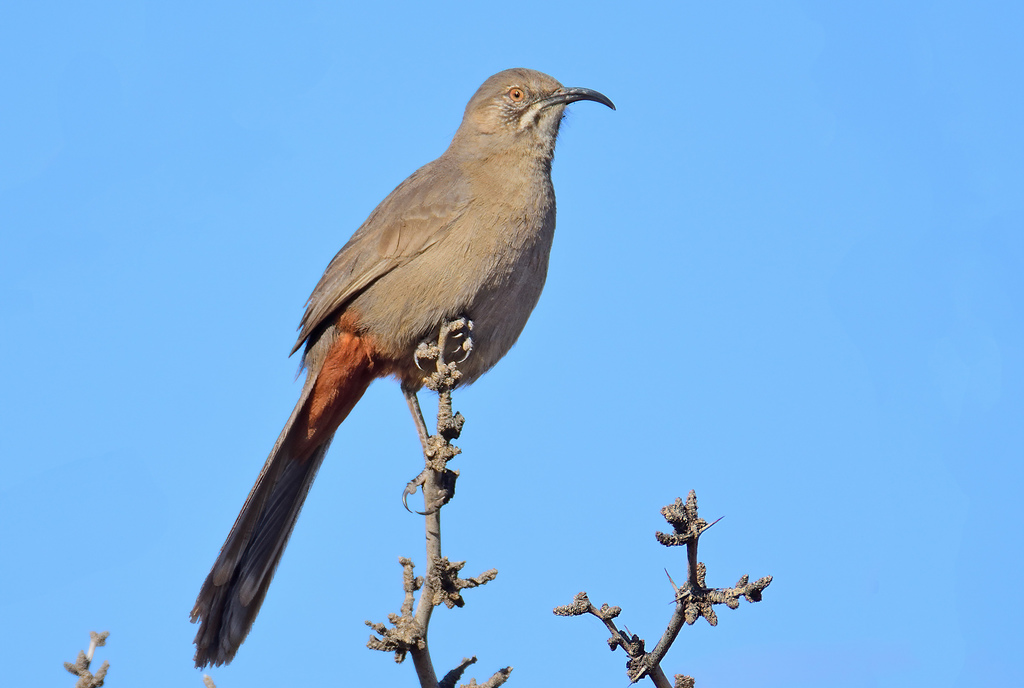
The crissal thrasher (Toxostoma crissale) is a large thrasher found in the Southwestern United States (western Texas, southern New Mexico, southern Arizona, southeastern California, extreme southern Nevada, and extreme southwestern Utah) to central Mexico.
From the article Crissal thrasher on Wikipedia (CC BY-SA), quoted section by section
Description
The bird grows to 32 centimetres (13 in), and has a deeply curved bill. The eyes are dull yellow. Bird expert Roger Tory Peterson described its singing as sweeter and less spasmodic than other thrashers. It can be found near desert streams in dense underbrush, mesquite thickets, willows, scrub oak, high elevations in manzanita, and in the low desert near canyon chaparral. The bird seldom flies in the open. As such, the crissal thrasher rarely flies, preferring to walk or run around its territory and will mostly run for cover when disturbed by a potential predator. The bird's name is derived from the characteristic bright coloring, in contrast to the balance of its plumage, of the area between its tail and vent—a region known as the crissum.
What it does
The species is an omnivore, eating both insects and spiders, and seeds and fruits. The crissal thrasher is mainly a ground feeder, using its long bill to probe for its prey amongst the leaf litter, particularly under shrubs.
Wikipedia: “Diet”
In human culture
In the early years of the study of the birds of western North America, this species was confused with the California thrasher (Toxostoma redivivum), to which it is closely related. Descriptions of T. redivivum in John Cassin's 1856 book Illustrations of the Birds of California, Texas, Oregon, British, and Russian America led later ornithologists to conclude that at least three of the birds described were actually the crissal thrasher. When an army surgeon working in New Mexico sent Cassin specimens of a bird that he believed to be the California thrasher, Cassin sent the specimens to Spencer Baird at the Smithsonian Institution. Baird determined that it was not a California thrasher and published his findings in 1858, identifying the crissal thrasher as a new species. Printer's errors in Baird's 1858 publication led to longstanding confusion and contention over the naming of the crissal thrasher. As printed, Baird's publication identified the new species as Toxostoma dorsalis, because the printer had switched the species name of the new thrasher with the species name of a new junco species, Junco dorsalis. Baird arranged for the error to be corrected, recording the name as T. crissalis the following month. Thereafter, the T. crissalis name was accepted and used until 1920, when ornithologist Harry Oberholser published a note asserting that T. …
Wikipedia: “History”
Listen
Looking for field recordings…
Where it lives
Recorded sightings
—
geo-referenced records in GBIF, from museums, herbaria and field observers.
Drag the globe to turn it. Dots are where records exist, not a range map; darker means more records.
In the stacks
Searching the stacks…
Every page naming Toxostoma crissale in the Biodiversity Heritage Library →
This page is assembled live from iNaturalist, GBIF, Wikipedia, the Source Library and the Internet Archive. It is not yet part of the hand-edited codex. iNaturalist taxon 14890.