On eBird ↗
Algerian Nuthatch
Live sightings near you, the range map, bar charts of when it is seen, and Macaulay Library photos and recordings.
Algerian Nuthatch
Sitta ledanti
The Algerian nuthatch or Kabyle nuthatch (Sitta ledanti) is a species of bird in the nuthatch family Sittidae. It is a medium-sized nuthatch, measuring between 11.5 cm (4.5 in) and 12.5 cm (4.9 in). The upperparts are bluish-grey. The male can be distinguished from the female by the black front of its crown. The species is sedentary; it feeds on arthropods in summer and on seeds in winter. The breeding season takes place around May–June. The nest, built in a hole of tree, shelters a laying of three or four eggs, brooded by the female. The chicks are fed by both parents.
The Kabyle nuthatch is the only bird species endemic to Algeria, where it now inhabits only certain coniferous and broadleaf forests in the Kabylia region in the north of the country. Its scientific name pays tribute to Jean-Paul Ledant, a Belgian amateur naturalist who discovered the bird in October 1975 and named it "la Sittelle Kabyle" (the Kabyle nuthatch); the description of the bird was made by the French ornithologist Jacques Vielliard. The news of this discovery greatly surprised the ornithological world and received international media coverage. The Algerian nuthatch is closely related to Krüper's nuthatch (Sitta krueperi). The bird has only a limited and relict range, threatened by fire, erosion and human action; the species is therefore considered "endangered" by the International Union for Conservation of Nature.
From the article Algerian nuthatch on Wikipedia (CC BY-SA), quoted section by section
Description
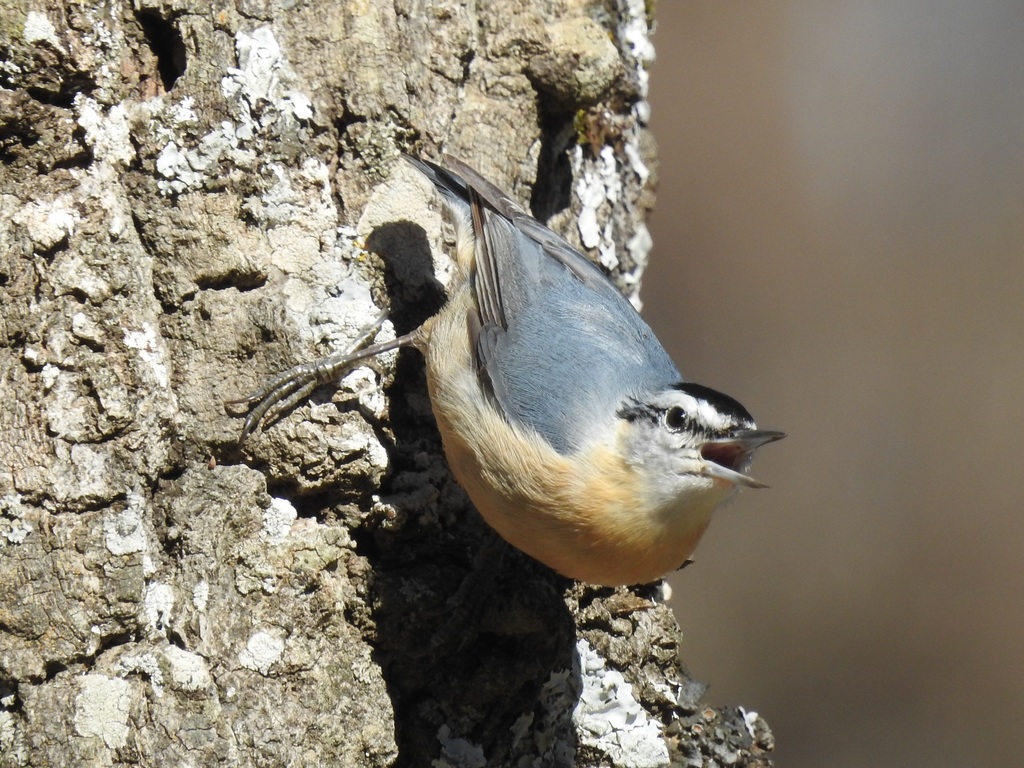
The Algerian nuthatch is a medium-sized nuthatch; it measures between 11.5 cm (4.5 in) and 12.5 cm (4.9 in), and weighs about 18 grams (0.63 oz). The upperparts are overall bluish grey; the tail has a small subterminal white band bordered with beige. The belly is washed with light salmon-beige up to the undertail coverts; the latter are grey at their base. The male has a black forehead and a dark eyestripe, separated from the crown by a broad, sharp white supercilium. In females, the crown and eyestripe are the same grey as the back, with the front of the crown sometimes darker (when the plumage is worn), but not as dark as in males. In both sexes, the sides of the head and the throat are white. The iris are brown-black, the legs lead-grey and the bill bluish-grey. The juvenile plumage is similar to that of the female, but duller and with an inconspicuous supercilium; after leaving the nest, bill growth and pigmentation of the bill and legs are incomplete. Within its range, the Kabyle nuthatch cannot be confused with any other bird. The closest nuthatch geographically is the Eurasian nuthatch (Sitta europaea) which inhabits Europe widely and some localities in the Moroccan Rif mountains; this species is larger than the Algerian, has no black on the crown and has orange-buff (or white for some subspecies) underparts tending to orange around the rump. …
Range & habitat
The Algerian nuthatch is the only bird endemic to Algeria. It inhabits certain areas of Kabylia, where it has been recorded in five localities isolated from each other by deforested areas unsuitable for its survival. It was first discovered on Mount Babor, only about 20 km2 (7.7 sq mi) from the Mediterranean coast. Its optimal habitat covers only 2.5 km2 (0.97 sq mi), and the area is home to only 80 pairs according to a 1985 estimate. Then in June 1989 it was found in Guerrouch, within the Taza National Park, which has a larger population of around 350 individuals. Smaller numbers were discovered in 1990 in two other localities near this park, in Tamentout and Djimla. In the spring of 2018, a new breeding site was discovered in Ghabet Ezzen, between the communes of Chahna and Oudjana in the Jijel province. On 24 September of the same year, two amateur ornithologists, Karim Haddad and Larbi Afoutni, went to the site; about twenty individuals were observed and photographed in the Lerabaa forest. The bird could be present in other oak groves of Petite Kabylie, but has not been documented yet. The Algerian nuthatch lives in oak forests between 350 m (1,150 ft) and 1,120 m (3,670 ft) altitude and in mixed forests of oak, Italian maple (Acer opalus subsp. obtusatum), and mixed coniferous forests up to the 2,004 m (6,575 ft) summit of Jebel Babor. …
Wikipedia: “Distribution and habitat”
At the table
The Algerian nuthatch's diet has not been extensively studied. It varies according to the season. In summer, it feeds mainly on insects (mainly caterpillars and beetles) and spiders that it finds by surveying the trunks and branches of oak trees. In winter, insects are scarce and the Algerian nuthatch feeds on coniferous seeds which provide a constant supply. They generally feed alone, but may form mixed feeding flocks outside the breeding season.
Wikipedia: “Food”
Listen
Looking for field recordings…
Where it lives
Recorded sightings
—
geo-referenced records in GBIF, from museums, herbaria and field observers.
Drag the globe to turn it. Dots are where records exist, not a range map; darker means more records.
In the stacks
Searching the stacks…
Every page naming Sitta ledanti in the Biodiversity Heritage Library →
This page is assembled live from iNaturalist, GBIF, Wikipedia, the Source Library and the Internet Archive. It is not yet part of the hand-edited codex. iNaturalist taxon 14838.