On eBird ↗
White-browed Nuthatch
Live sightings near you, the range map, bar charts of when it is seen, and Macaulay Library photos and recordings.
White-browed Nuthatch
Sitta victoriae
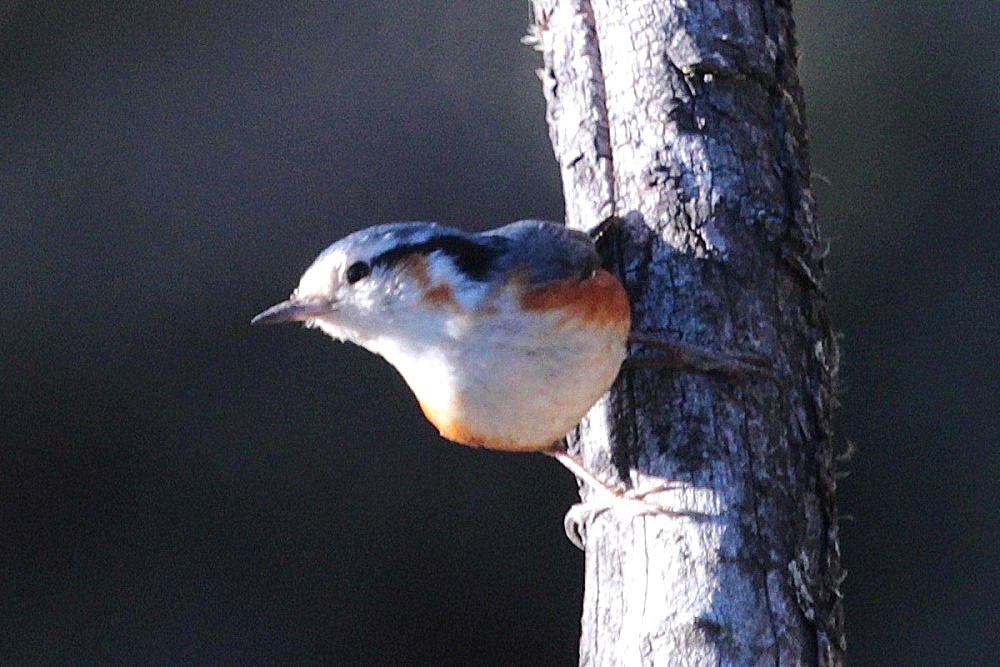
The white-browed nuthatch (Sitta victoriae), also known as the Victoria nuthatch, is a species of bird in the family Sittidae. It is a small nuthatch, measuring 11.5 cm (4.5 in) in length and without sexual dimorphism. Like many other nuthatches, the upperparts are greyish blue, contrasting with white underparts on the throat, cheeks, and breast and orange on the flanks, belly, and lower abdomen. Its white supercilium makes it easy to distinguish it from the white-tailed nuthatch (S. himalayensis), which is a close species in the systematic and geographical sense. Little is known about its ecology, but it feeds on small insects found among bark and lichens, and breeding occurs around April.
The white-browed nuthatch is endemic to Nat Ma Taung, also known as Mount Victoria, in the southern Chin Hills of Myanmar. It inhabits old oak groves at high elevations, generally above 2,600 m (8,500 ft). The population poorly known but is estimated to be a few thousand individuals. It threatened by habitat destruction by fire and human pressure. For these reasons, the International Union for the Conservation of Nature considers the bird to be an "endangered species."
From the article White-browed nuthatch on Wikipedia (CC BY-SA), quoted section by section
Description
The white-browed nuthatch is a small nuthatch, measuring 11.5 cm (4.5 in) in length. The folded wing measures 68–73 mm (2.7–2.9 in) for the male, 67–69 mm (2.6–2.7 in) for the female. The tail is 36–37 mm (1.4–1.5 in), the beak is 15–16 mm (0.59–0.63 in), and the tarsus is 14–16 mm (0.55–0.63 in). The weight is not known, but the Chinese nuthatch and the red-breasted nuthatch, which are also 11.5 cm (4.5 in) in length, average 11.3 grams (0.40 oz) and 8–12.7 grams (0.28–0.45 oz), respectively. The upperparts are dull bluish-grey. The underparts are white from the throat and lower chest, but the belly is orange, with the underside and undertail light red and the flanks darker. It has a white forehead, eyebrows, and lore, and a black line at the back of the eye, thickening backwards on the nape. The cheeks are as white as the throat but the back of the cheek is orange, with a white patch on the parotic coverts. No sexual dimorphism was found, and the juveniles could be distinguished by the lighter orange-red flanks. The bill is black at the tip and slate grey otherwise; the culmen and lower mandible are iris red-brown or dark brown, paler. The thighs are grey, and the legs are dull, yellowish-brown, or olive-brown. The white-browed nuthatch can be confused with the white-tailed nuthatch, which can inhabit the same areas but which is rare where white-browed nuthatch lives. …
Range & habitat
The white-browed nuthatch is endemic to western Myanmar. It is currently found on Nat Ma Taung in the southern part of the Chin Hills, at nearly 3,070 m (10,070 ft), and 22 km (14 mi) further northwest in the spring of 1995 near Mindat. The white-browed nuthatch avoids the pure pine forests of Pinus kesiya and is found instead in lichen-covered old oak forests of the alpine level. Thus, it was observed at an altitude of over 2,600 m (8,500 ft) in 1940 and over 2,700 m (8,900 ft) in the spring of 1995. However, during the description of the species in 1904, Rippon reported that he collected six birds between 2,285–2,745 m (7,497–9,006 ft) altitude from 22 March to 30 April; there could therefore be seasonal altitudinal dispersion, with the birds leaving the higher altitudes during winter. The white-browed nuthatch habitat consists mainly of Quercus semecarpifolia oaks, covered with epiphytic plants, lichens, mosses, orchids, and ferns.
Wikipedia: “Distribution and habitat”
At the table
The nuthatch is usually seen alone or in pairs. It feeds on small insects which it usually finds in the epiphytes growing on the oaks, or in hollows in the bark. It generally explores the outer branches, but can also prospect on the branches more inside the tree or on the trunk. The plant species prospected are Quercus semecarpifolia half the time, but Rhododendron arboreum is also exploited, as well as, to a lesser extent, Lyonia ovalifolia, Lithocarpus dealbatus, Pinus kesiya, and Alnus nepalensis.
Wikipedia: “Food”
Listen
Looking for field recordings…
Where it lives
Recorded sightings
—
geo-referenced records in GBIF, from museums, herbaria and field observers.
Drag the globe to turn it. Dots are where records exist, not a range map; darker means more records.
In the stacks
Searching the stacks…
Every page naming Sitta victoriae in the Biodiversity Heritage Library →
This page is assembled live from iNaturalist, GBIF, Wikipedia, the Source Library and the Internet Archive. It is not yet part of the hand-edited codex. iNaturalist taxon 14835.