On eBird ↗
Corsican Nuthatch
Live sightings near you, the range map, bar charts of when it is seen, and Macaulay Library photos and recordings.
Corsican Nuthatch
Sitta whiteheadi
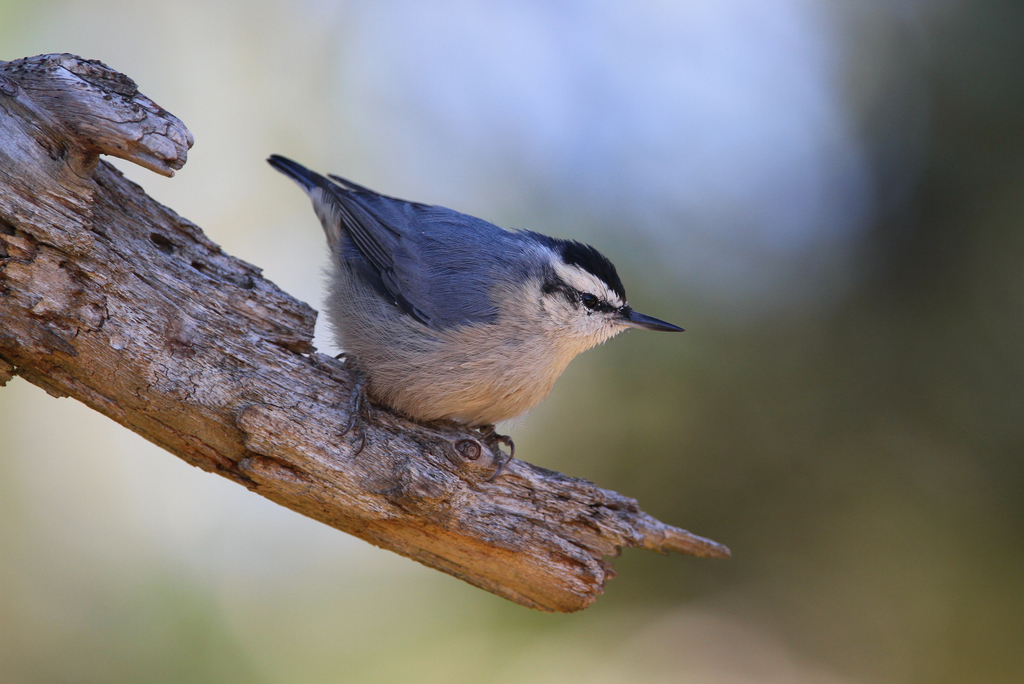
The Corsican nuthatch (Sitta whiteheadi) is a species of bird in the nuthatch family Sittidae. It is a relatively small nuthatch, measuring about 12 cm (4.7 in) in overall length. The upperparts are bluish-grey, the underparts greyish-white. The male is distinguished from the female by its entirely black crown. The species is sedentary, territorial and not very shy. It often feeds high in Corsican pines (Pinus nigra var. corsicana, syn. P. nigra subsp. laricio), consuming mainly pine seeds, but also catching some flying insects. The breeding season takes place between April and May; the nest is placed in the trunk of an old pine, and the clutch has five to six eggs. The young fledge 22 to 24 days after hatching.
The Corsican nuthatch is found only on the island of Corsica, where it populates the old forests of high-altitude Corsican pines, descending lower in winter. Its scientific name comes from John Whitehead, the ornithologist who brought the bird to the attention of the scientific community in 1883. The Corsican nuthatch is closely related to the Chinese nuthatch (S. villosa) and the red-breasted nuthatch (S. canadensis). It is threatened by loss of nesting sites and habitat fragmentation, with an estimated population size of about 2,000 individuals, possibly in moderate decline. Due to the small population size and the limited range, the conservation status of the Corsican nuthatch is classed as "vulnerable" by the International Union for Conservation of Nature.
From the article Corsican nuthatch on Wikipedia (CC BY-SA), quoted section by section
Range & habitat
The Corsican nuthatch is the only species of bird endemic to Corsica, and even to metropolitan France. Its range covers the majority of the island, which is very mountainous. This bird is found from the Tartagine-Melaja forest in the north to the Ospedale forest in the south, but it is particularly abundant in the Monte Cinto, Monte Rotondo, Monte Renoso and Monte Incudine Massifs. There are also two isolated populations, one in Castagniccia in the northeast of the island, and another in the Cagna forest in the south. The Corsican nuthatch favours Corsican pine (Pinus nigra var. corsicana) forests interspersed with clearings; their Mediterranean climate habitat is fairly dry in the summer (three weeks to two months of drought) and experiences heavy rainfall and/or snow in the winter (total 800–1,800 mm (31–71 in) per year). This nuthatch is sedentary; it generally lives in deep valleys between 1,000 m (3,300 ft) and 1,500 m (4,900 ft) above sea level between April and October, but can be found from 750–1,800 m (2,460–5,910 ft), although the more open forests at higher elevations are less suitable. It descends lower in winter, and may then inhabit mixed forests of Corsican and maritime pines (Pinus pinaster) or forests of silver fir (Abies alba); however, its stand indices are significantly lower than in pure Corsican pine forests. …
Wikipedia: “Distribution and habitat”
What it does
Like all nuthatches, the Corsican nuthatch can move head down along branches, and is rarely found on the ground. It is a territorial bird and is not shy. It lives in monogamous pairs evolving all year long on the same territory of three to ten hectares, the two birds of the couple defending it from intruders, of the same species or of another. The home range, the area where the birds generally live within their territory, varies in size, depending on the season and age of the birds, but especially on the cone production of the pines.
Food and feeding. The Corsican nuthatch consumes mainly pine seeds, but also small insects in summer. From March to November, small arthropods (adult insects and their larvae, spiders) represent the main part of its diet; it catches them in flight but more generally in the trees; it makes a quarter of its captures in flight, from a lookout post, and exploits the rest of the time the substrates provided by the trees. In spring and summer, it is more likely to be found in the treetops, foraging high up in the foliage of pine trees, at the end of branches, like a tit; in autumn, however, it searches for food along the trunks and on large branches, and may also form mixed feeding flocks with other small passerines outside the breeding season. …
Wikipedia: “Behaviour and ecology”
In human culture
The Corsican nuthatch is sometimes referred to as Whitehead's nuthatch, and it also has a variety of local names in the Corsican language, such as pichjarina, pichja sorda or furmicula, and capinera, used at least in Corte. The species remains relatively unknown to the public. The regional natural park of Corsica has published a small comic strip on the bird, and the "Corsican ornithological group" (GOC) has chosen the species as its logo, represented in a very refined form. In the forest of Aïtone, near Évisa, the National Forestry Office has created a "nuthatch trail", which is one of the places where the species can be more easily observed.
Wikipedia: “In culture”
Listen
Looking for field recordings…
Where it lives
Recorded sightings
—
geo-referenced records in GBIF, from museums, herbaria and field observers.
Drag the globe to turn it. Dots are where records exist, not a range map; darker means more records.
In the stacks
Searching the stacks…
Every page naming Sitta whiteheadi in the Biodiversity Heritage Library →
This page is assembled live from iNaturalist, GBIF, Wikipedia, the Source Library and the Internet Archive. It is not yet part of the hand-edited codex. iNaturalist taxon 14832.