On eBird ↗
Pygmy Nuthatch
Live sightings near you, the range map, bar charts of when it is seen, and Macaulay Library photos and recordings.
Pygmy Nuthatch
Sitta pygmaea
The pygmy nuthatch (Sitta pygmaea) is a tiny songbird, about 10 cm (4 inches) long and about 10 grams in weight. It ranges from southern British Columbia south through various discontinuous parts of the western U.S. (northwest U.S., Sierra Nevada range, southern Rockies, etc.), to central Mexico. It is usually found in pines (especially ponderosa pines), Douglas-firs, and other conifers. Pygmy nuthatches clamber acrobatically in the foliage of these trees, feeding on insects and seeds; less often they creep...
From the article Pygmy nuthatch on Wikipedia (CC BY-SA), quoted section by section
Description
The pygmy nuthatch is 9–11 cm (3.5–4.3 in) long and with a wingspan of 19.7 cm (7.8 in), and weighs 9.3–11.4 g (0.33–0.40 oz). It ranges from southern British Columbia south through various discontinuous parts of the western U.S. (northwest U.S., Sierra Nevada range, southern Rockies, etc.), to central Mexico. It is usually found in pines (especially ponderosa pine), douglas-fir, and other conifers. Pygmy nuthatches clamber acrobatically in the foliage of these trees, feeding on insects and seeds; less often they creep along limbs or the trunk like bigger nuthatches. Pygmy nuthatches nest in cavities in dead stubs of conifers, lining the bottom of the cavity with pine cone scales, plant fibers, and other soft plant and animal materials. They may fill cracks or crevices around the entrance with fur; the function of this behavior is unknown. The female lays 4–9 eggs, which are white with fine reddish-brown spotting. She does most of the incubation, which lasts about 16 days. The young leave the nest about 22 days after hatching. This species is highly gregarious. A nesting pair may have other birds as helpers. Outside the breeding season, they wander in noisy flocks. It also roosts communally; over 100 birds have been seen huddled in a single tree cavity.
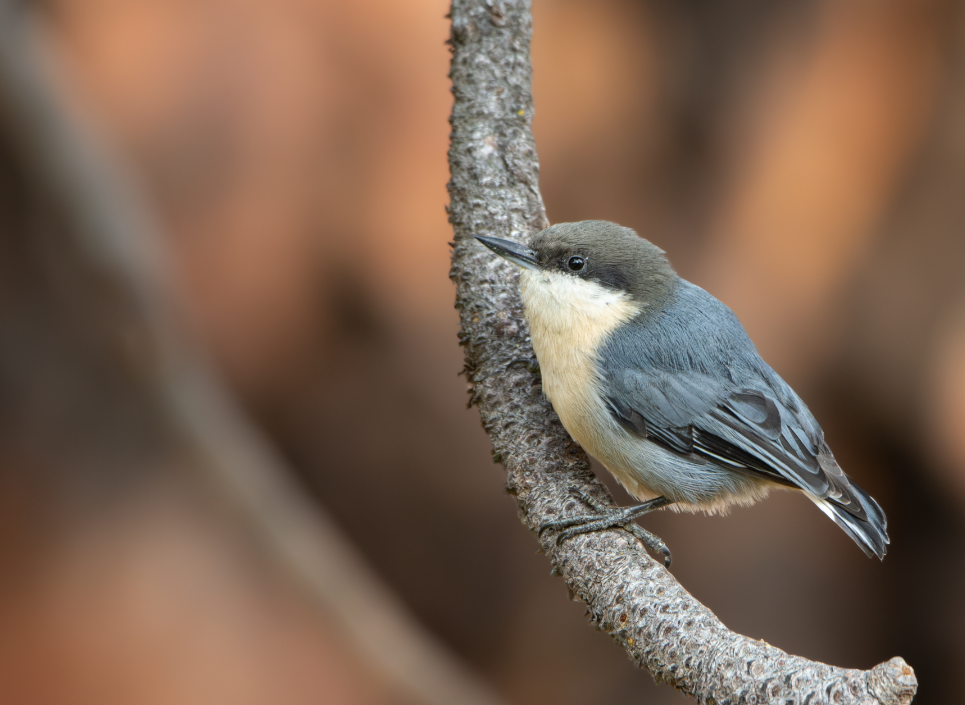
All plumages are similar, with a warm gray cap, blue-gray upper-parts, and whitish underparts. …
In human culture
The pygmy nuthatch features prominently in the climax of the 2000 film Charlie's Angels, in which Cameron Diaz's character, Natalie, discovers the location of the villains' fortress by identifying the call of the pygmy nuthatch, which she says only live in Carmel, California. The bird shown however is not a pygmy nuthatch, which in any case is found in a much wider range; the film imposter is a Venezuelan troupial and the call is of a fox sparrow.
Wikipedia: “In popular culture”
Listen
Looking for field recordings…
Where it lives
Recorded sightings
—
geo-referenced records in GBIF, from museums, herbaria and field observers.
Drag the globe to turn it. Dots are where records exist, not a range map; darker means more records.
In the stacks
Searching the stacks…
Every page naming Sitta pygmaea in the Biodiversity Heritage Library →
This page is assembled live from iNaturalist, GBIF, Wikipedia, the Source Library and the Internet Archive. It is not yet part of the hand-edited codex. iNaturalist taxon 14816.