- Animals
- ›Arthropods
- ›Hexapods
- ›Insects
- ›Winged and Once-winged Insects
- ›Beetles
- ›Water, Rove, Scarab, Long-horned, Leaf, and Snout Beetles
- ›Cucujiform Beetles
- ›Snout and Bark Beetles
- ›True Weevils
- ›Curculioninae
- ›Curculionini
- ›Curculio
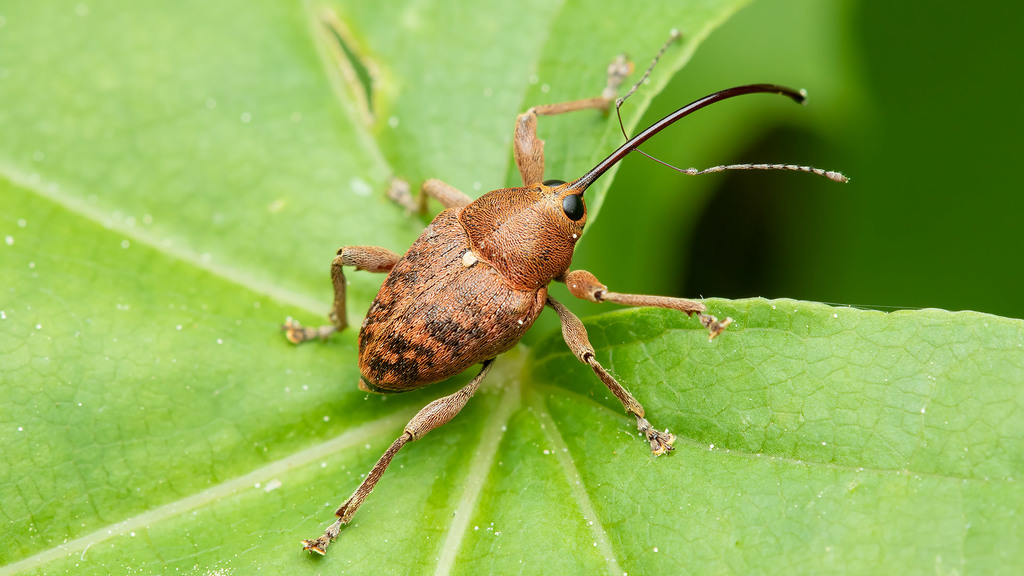
acorn weevil
Curculio glandium
Curculio glandium, commonly known as the acorn weevil, is a species of European carpophagus weevil in the genus Curculio, the acorn and nut weevils. It eats by a rostrum, an elongated snout, that is used for piercing.
From the article Curculio glandium on Wikipedia (CC BY-SA), quoted section by section
Description
Curculio glandium is a member of the genus Curculio, which comprises seed beetles. All members of Curculio have characteristically long rostrums and ovipositors, an adaptation that specifically developed by their reliance on seeds for food and reproduction. Male/female differentiation can be determined using the rostrum as the female's is longer. In female acorn weevils, their rostrums are around the size of their body or larger, while males have a rostrum around two thirds of that size. The larvae are short, and cylindrical in shape, and move by means of ridges on the underside of the body. Adults can reach a length of 4 to 8 mm (0.16 to 0.31 in).
What it does
Curculio glandium eggs are deposited in acorns by the adult weevil chewing channels into the fruit. The eggs are then released using an ovipositor, a long, narrow organ featured in female weevils. These do not reach the acorn's embryo and are healed by the plant, sealing the holes and protecting the eggs from parasites. Upon hatching, either one or two larvae consume the fruit. While they may eat the entirety of the acorn, the larvae typically do not consume the embryo itself. After the acorn drops to the gound, Curculio glandium larvae emerge from the acorn and burrow into the soil, where they live for 1-2 years before pupating and emerging as adults. The larvae are freeze avoidant, preventing their internal body fluids from freezing during the winter.
Wikipedia: “Life cycle”
Listen
Looking for field recordings…
Where it lives
Recorded sightings
—
geo-referenced records in GBIF, from museums, herbaria and field observers.
Drag the globe to turn it. Dots are where records exist, not a range map; darker means more records.
In the stacks
Searching the stacks…
Every page naming Curculio glandium in the Biodiversity Heritage Library →
This page is assembled live from iNaturalist, GBIF, Wikipedia, the Source Library and the Internet Archive. It is not yet part of the hand-edited codex. iNaturalist taxon 148145.