On eBird ↗
Sapayoa
Live sightings near you, the range map, bar charts of when it is seen, and Macaulay Library photos and recordings.
Sapayoa
Sapayoa aenigma
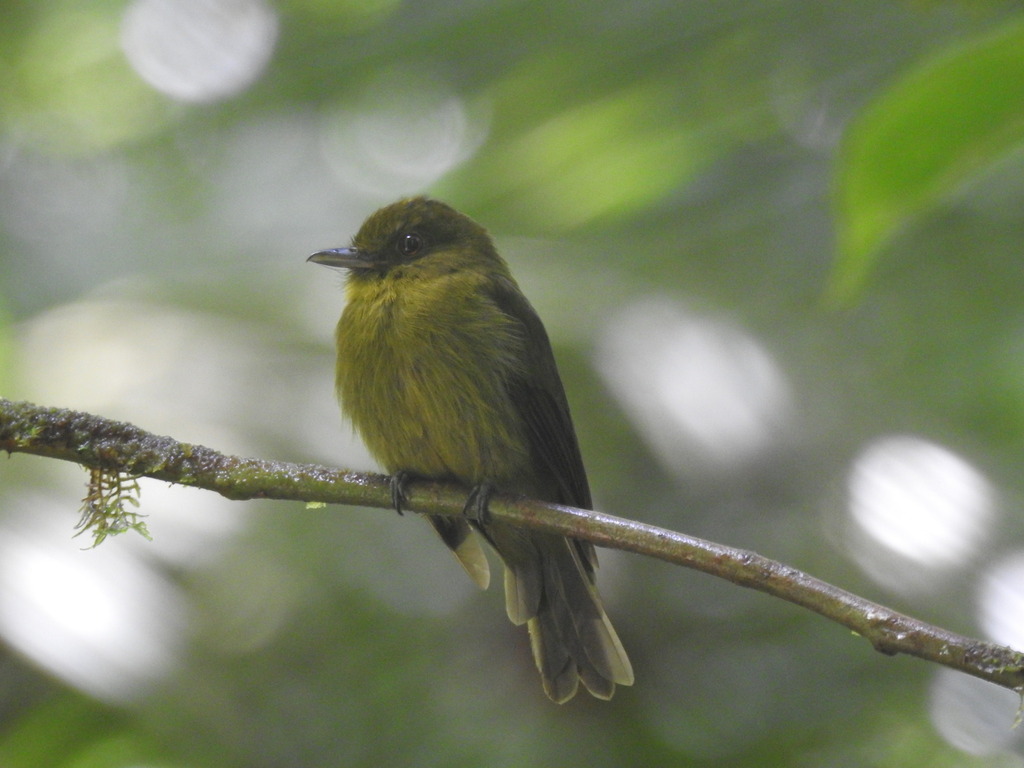
The sapayoa or broad-billed sapayoa (Sapayoa aenigma) is a suboscine passerine found in lowland rainforests in Panama and north-western South America. As the epithet aenigma ("the enigma") implies, its relationships have long been elusive. It is easy to overlook, but appears to be common in a wide range and is not considered threatened by the IUCN.
From the article Sapayoa on Wikipedia (CC BY-SA), quoted section by section
Description
The sapayoa is 13.5 to 15 cm (5.3 to 5.9 in) long and weighs about 21 g (0.74 oz). Its head and upperparts are olive with a dusky tinge to the wings and tail. It throat and belly are a yellower olive. Its bill is wide and black with rictal bristles around it. Its iris is dull reddish brown and its legs are gray. Males have a yellow stripe on the crown.
Range & habitat
The sapayoa is found from the Panama Canal Zone south through western Colombia into extreme northwestern Ecuador. It inhabits humid forest from the understory to the mid-level, and often occurs in ravines and near watercourses. In elevation it ranges as high as 1,200 m (3,900 ft) in Colombia but only to 500 m (1,600 ft) in Ecuador.
Wikipedia: “Distribution and habitat”
What it does
The sapayoa typically feeds by perching for long periods between sallies to catch insects on the wing or from foliage. It also feeds on small fruits. It often joins mixed-species feeding flocks.
Wikipedia: “Feeding”
Listen
Looking for field recordings…
Where it lives
Recorded sightings
—
geo-referenced records in GBIF, from museums, herbaria and field observers.
Drag the globe to turn it. Dots are where records exist, not a range map; darker means more records.
In the stacks
Searching the stacks…
Every page naming Sapayoa aenigma in the Biodiversity Heritage Library →
This page is assembled live from iNaturalist, GBIF, Wikipedia, the Source Library and the Internet Archive. It is not yet part of the hand-edited codex. iNaturalist taxon 14798.