On eBird ↗
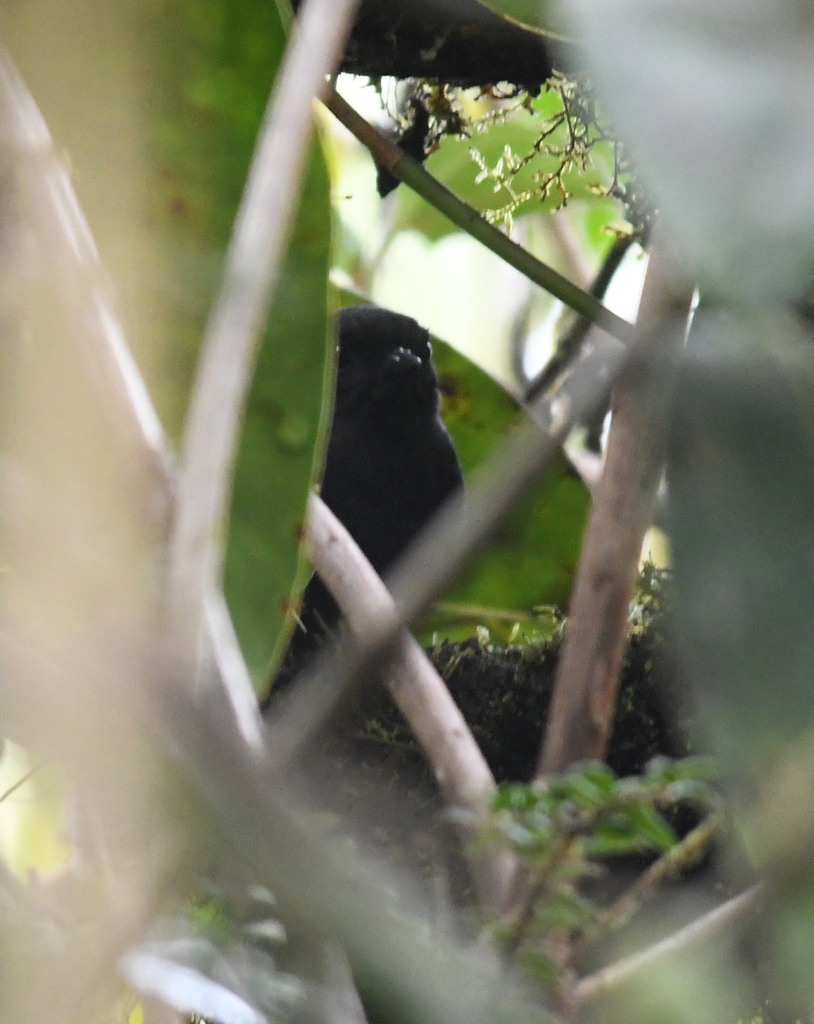
Long-tailed Tapaculo
Live sightings near you, the range map, bar charts of when it is seen, and Macaulay Library photos and recordings.
Long-tailed Tapaculo
Scytalopus micropterus
The long-tailed tapaculo (Scytalopus micropterus) is a species of bird in the Rhinocryptidae family. It is found in the eastern Andes of Colombia, Ecuador and far northern Peru.
From the article Long-tailed tapaculo on Wikipedia (CC BY-SA), quoted section by section
Description
The long-tailed tapaculo is one of the larger species of genus Scytalopus, and, compared to other Scytalopus species, its tail is relatively long. It is 13.5 cm (5.3 in) long overall and males weigh from 27 to 32.5 g (0.95 to 1.15 oz). Otherwise the long-tailed tapaculo has few distinctive morphological features: The male's plumage is drab, primarily dark gray with russet brown flanks that are barred with black. The female is similar but even drabber. The long-tailed tapaculo's song typically begins with a series of single notes, but quickly turns into a series of couplets [1]. Its alarm call is a descending series.
Range & habitat
The long-tailed tapaculo occurs along the east slopes of the Andes from Colombia south to northern Peru. There it inhabits humid shrubby areas along streams and forest edges. In most of its range it is found between 1,250 and 2,300 m (4,100 and 7,550 ft), but in Peru is limited to elevations between 1,650 and 1,950 m (5,410 and 6,400 ft).
Wikipedia: “Distribution and habitat”
What it does
Like other cloud forest tapaculos, the long-tailed tapaculo forages on or near the ground for small invertebrates.
Wikipedia: “Feeding”
Listen
Looking for field recordings…
Where it lives
Recorded sightings
—
geo-referenced records in GBIF, from museums, herbaria and field observers.
Drag the globe to turn it. Dots are where records exist, not a range map; darker means more records.
In the stacks
Searching the stacks…
Every page naming Scytalopus micropterus in the Biodiversity Heritage Library →
This page is assembled live from iNaturalist, GBIF, Wikipedia, the Source Library and the Internet Archive. It is not yet part of the hand-edited codex. iNaturalist taxon 14770.