- Animals
- ›Arthropods
- ›Hexapods
- ›Insects
- ›Winged and Once-winged Insects
- ›Beetles
- ›Water, Rove, Scarab, Long-horned, Leaf, and Snout Beetles
- ›Staphyliniform Beetles
- ›Rove, Ant-like stone, and Carrion Beetles
- ›Rove Beetles
- ›Burying and Carrion Beetles
- ›Nicrophorini
- ›Nicrophorus
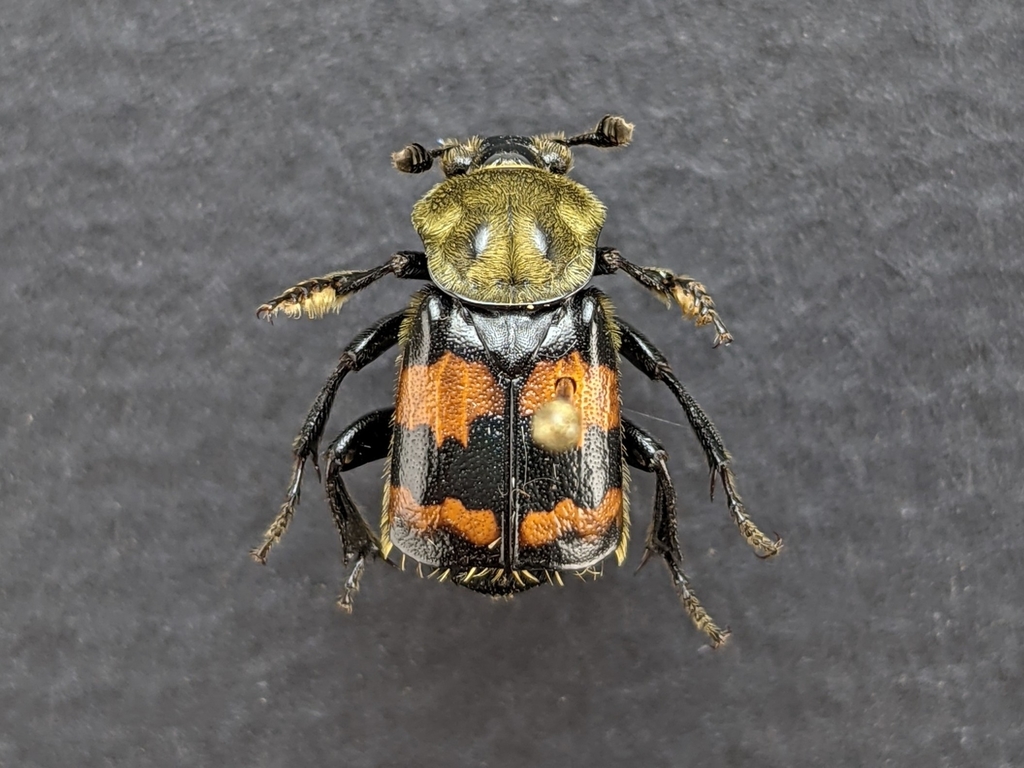
Tomentose Burying Beetle
Nicrophorus tomentosus
Nicrophorus tomentosus (gold-necked carrion beetle or tomentose burying beetle) is a species of burying beetle that was described by Friedrich Weber in 1801. The beetle belongs to the family Silphidae which are carrion beetles. The beetles have sensitive antennae that contain olfactory organs. Thus, the beetle can locate dead animals (carcass), and then as the name suggests, can bury them. However, unlike other burying beetles, N. tomentosus does not completely bury these brood carcasses. They instead dig a shallow hole under the carcass and cover it with leaf litter. Recognition of these beetles can be distinguished by its black color with orange markings on the wing covers (elytra).
From the article Nicrophorus tomentosus on Wikipedia (CC BY-SA), quoted section by section
Description
There are several characteristics that differentiate Silphidae from other families. One characteristic is that N. tomentosus is about 11.2–19.0 millimeters in length. It also has a pair of striations on its fifth abdominal tergum. They also have a very large scutellum which can sometimes be as wide as its head. The segments of its antennae are all black, clubbed at the ends, and contain olfactory organs. The flight pattern of N. tomentosus is similar to that of a bumble bee. Its elytral epipleuron is completely black except for symmetrical orange splotches. The pronotum is also covered with a thick patch of golden yellow setae which sets it apart from other nicrophorus in its genus.
Range & habitat
N. tomentosus are found in areas where there are carcasses. Carcasses can range anywhere from dead rodents to birds. Thus, forests, woodlands, shrub land, and sandy prairies are common areas where these beetles predominately thrive. The distribution of N. tomentosus is worldwide. However, in the western hemisphere it is located in the United States excluding the southeast region, and southern Canada that is east of the Rocky Mountains. N. tomentosus are seasonal. Thus they are only found in the months May through October, primarily in the months of July and August.
Wikipedia: “Habitat and distribution”
What it does
The mating of the male and female N. tomentosus can begin anytime after a food source is found and buried. Mating is not particular to the carcass and can take place anywhere around it. When the eggs are laid they are then deposited into the nearby soil at a time at least twelve hours from the discovery of the carcass. Once the eggs hatch, after about four days, the larvae move towards the carcass to a feeding hole that was made by the parents. Both parents then feed the larvae regurgitated food for about six to eight days when the larvae are fully developed. The fully developed N. tomentosus then repeat the cycle after locating a new carcass and mate. Recently, N. tomentosus was found to be one of at least two burying beetles which can breed in the forest canopy.
Wikipedia: “Life cycle”
Listen
Looking for field recordings…
Where it lives
Recorded sightings
—
geo-referenced records in GBIF, from museums, herbaria and field observers.
Drag the globe to turn it. Dots are where records exist, not a range map; darker means more records.
In the stacks
Searching the stacks…
Every page naming Nicrophorus tomentosus in the Biodiversity Heritage Library →
This page is assembled live from iNaturalist, GBIF, Wikipedia, the Source Library and the Internet Archive. It is not yet part of the hand-edited codex. iNaturalist taxon 147457.