- Animals
- ›Chordates
- ›Vertebrates
- ›Ray-finned Fishes
- ›Spiny-rayed fishes
- ›Butterflyfishes, Angelfishes, and Allies
- ›Seabreams and Porgies
- ›Diplodus
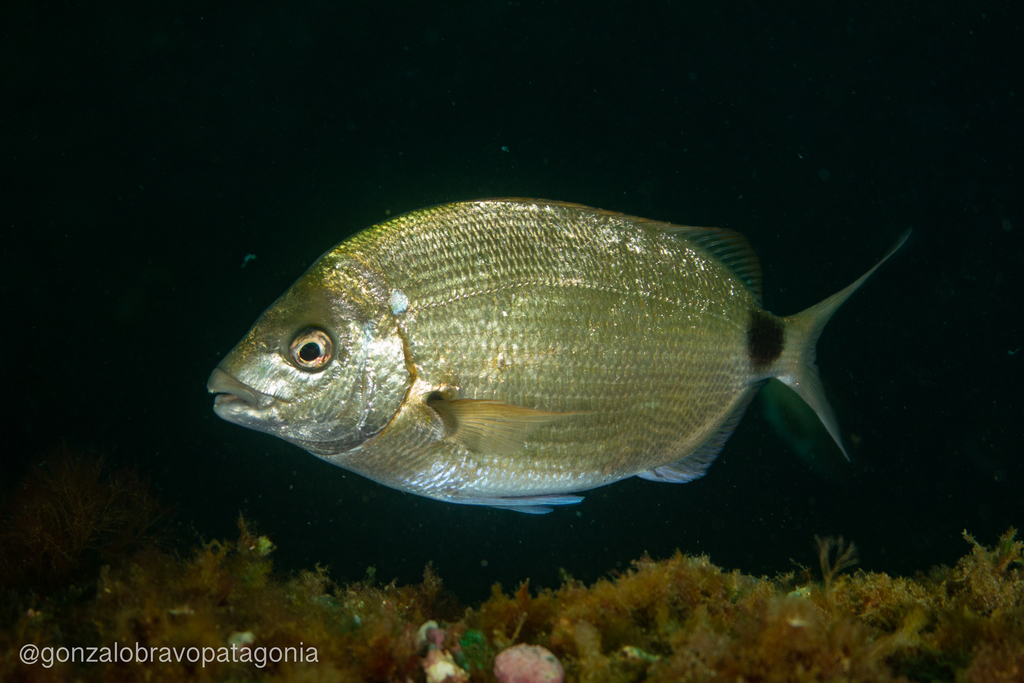
South American Silver Porgy
Diplodus argenteus
Diplodus argenteus, the silver porgy, is an ocean-going species of sparid fish (seabream/porgies). It is also called the South American silver porgy and the white bream in Uruguay, plus the silver seabream and the sargo, though the latter three names are also used for other fish species as well.
From the article Diplodus argenteus on Wikipedia (CC BY-SA), quoted section by section
Description
As its name suggests, this D. argenteus' silvery coloration (often with a yellowish tint on the scales and fins) is a significant characteristic of its appearance. In addition to its main coloring, there are nine dark, narrow bars that can be faintly visible on the anterior portion of its body (especially in younger individuals, as they fade with age), there is also a large, black blotch on the caudal peduncle, and the opercular membrane is also very dark in color. The silver porgy's dorsal fin is made up of 12 spines, and 13–15 soft rays; it's anal fin consists of only three spines, but 12–14 soft rays. Mature silver porgies achieve about 20–23 cm (7.9–9.1 in) in length, while the maximum known length for this species is 37.8 cm (1.24 ft) in length.
Range & habitat
The silver porgy is known primarily from the western Atlantic Ocean, where it can be found in the waters of southern Florida as well as the Antilles and Bahamas. Along the coast of South America, it is known from coasts of Colombia and Venezuela to Argentina – as far south as the coast of northern Patagonia. They are also found in the Bay of Campeche, which is part of the Gulf of Mexico.
Adult silver porgies usually inhabit clear but turbulent waters over rocky or coral bottoms, especially on unsheltered coasts that are heavily affected by surf. Juveniles, on the other hand, can be found in much shallower water, such as in pools between rocks, though mid-sized individuals up to 10 cm (3.9 in) can be also found in beds of seagrass from the genus Thalassia.
Wikipedia: “Distribution and habitat”
In human culture
The genus name, Diplodus, means "double toothed", a description which was not well-explained, but may have been done in reference to the species' two types of teeth: incisor-like and molar-like, or to the double incisor-like tooth shape common to this genus. The species name argenteus comes from the Latin word for silver, a reference to the fish's coloration.
Wikipedia: “Etymology”
Where it lives
Recorded sightings
—
geo-referenced records in GBIF, from museums, herbaria and field observers.
Drag the globe to turn it. Dots are where records exist, not a range map; darker means more records.
In the stacks
Searching the stacks…
Every page naming Diplodus argenteus in the Biodiversity Heritage Library →
This page is assembled live from iNaturalist, GBIF, Wikipedia, the Source Library and the Internet Archive. It is not yet part of the hand-edited codex. iNaturalist taxon 147117.