On eBird ↗
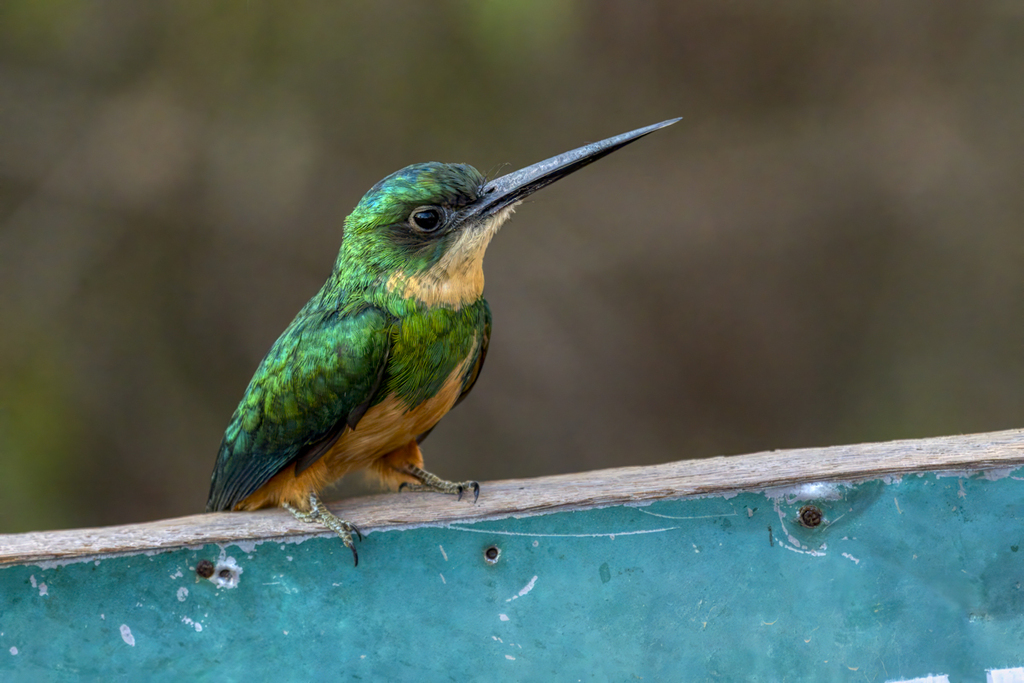
Rufous-tailed Jacamar
Live sightings near you, the range map, bar charts of when it is seen, and Macaulay Library photos and recordings.
Rufous-tailed Jacamar
Galbula ruficauda
The rufous-tailed jacamar (Galbula ruficauda) is a bird in the family Galbulidae that breeds in the tropical New World in southern Mexico, Central America and South America as far south as southern Brazil and Ecuador.
From the article Rufous-tailed jacamar on Wikipedia (CC BY-SA), quoted section by section
Description
Like other jacamars they are elegant, brightly coloured birds with long bills and tails. The rufous-tailed jacamar is typically 25 cm (10 in) long with a 5 cm (2 in) long black bill. The subspecies G. r. brevirostris has, as its name implies, a shorter bill. This bird is metallic green above, and the underparts are mainly orange, including the undertail, but there is a green breast band. Sexes differ in that the male has a white throat, and the female a buff throat; she also tends to have paler underparts. The race G. r. pallens has a copper-coloured back in both sexes.
At the table
This insectivore hunts from a perch, sitting with its bill tilted up, then flying out to catch flying insects. One commonly preyed upon insect is the social wasp Agelaia vicina. Other insect prey include flies, beetles, bees, dragonflies, and butterflies. Further, the bird distinguishes between edible and unpalatable butterflies mainly according to body shape.
Wikipedia: “Food and foraging”
Listen
Looking for field recordings…
Where it lives
Recorded sightings
—
geo-referenced records in GBIF, from museums, herbaria and field observers.
Drag the globe to turn it. Dots are where records exist, not a range map; darker means more records.
In the stacks
Searching the stacks…
Every page naming Galbula ruficauda in the Biodiversity Heritage Library →
This page is assembled live from iNaturalist, GBIF, Wikipedia, the Source Library and the Internet Archive. It is not yet part of the hand-edited codex. iNaturalist taxon 1468.