- Animals
- ›Arthropods
- ›Hexapods
- ›Insects
- ›Winged and Once-winged Insects
- ›Butterflies and Moths
- ›Owlet Moths and Allies
- ›Cutworm Moths and Allies
- ›Cutworms and Dart Moths
- ›Xylenini
- ›Antitypina
- ›Antitype
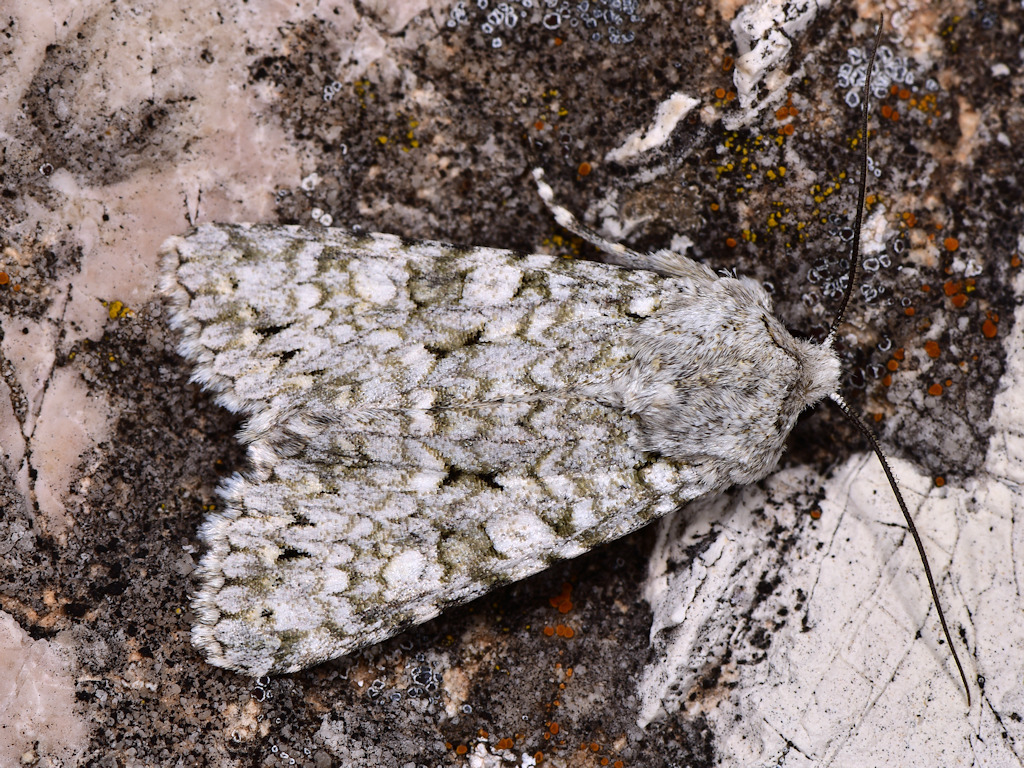
Grey Chi
Antitype chi
The grey chi (; Antitype chi) is a moth of the family Noctuidae. The species was first described by Carl Linnaeus in his 1758 10th edition of Systema Naturae. It is distributed throughout Europe, although it is not present in southern Spain and Greece, as well as northern Fennoscandia. It is also found across the Palearctic including Central Asia, to the Russian Far East but not in Japan.
This species has grey forewings speckled with black markings which vary in intensity (with the female generally more heavily marked than the male). There is usually a bold cross-shaped black mark in the centre of the wing which has been likened to the Greek letter chi (Χ) and gives the species its common name. The hindwings are white in the male, dirty grey in the female.
From the article Grey chi on Wikipedia (CC BY-SA), quoted section by section
At the table
Artemisia - mugwort Convallaria - lily-of-the-valley Helianthus - Jerusalem artichoke Lactuca - lettuce Lathyrus - meadow vetchling Lychnis - campion Ribes - blackcurrant Rumex Salix - willow Saxifraga - saxifrage Sedum - stonecrop Silene - campion Sonchus - sow thistle Taraxacum - dandelion Triglochin Urtica - stinging nettle Viburnum - guelder rose See.
Wikipedia: “Recorded food plants”
Listen
Looking for field recordings…
Where it lives
Recorded sightings
—
geo-referenced records in GBIF, from museums, herbaria and field observers.
Drag the globe to turn it. Dots are where records exist, not a range map; darker means more records.
In the stacks
Searching the stacks…
Every page naming Antitype chi in the Biodiversity Heritage Library →
This page is assembled live from iNaturalist, GBIF, Wikipedia, the Source Library and the Internet Archive. It is not yet part of the hand-edited codex. iNaturalist taxon 146701.