- Animals
- ›Chordates
- ›Vertebrates
- ›Reptiles
- ›Snakes and Lizards
- ›Lizards
- ›Iguanas and Allies
- ›Iguanas, Anoles, and Allies
- ›Iguanas and Chuckwallas
- ›Cyclura
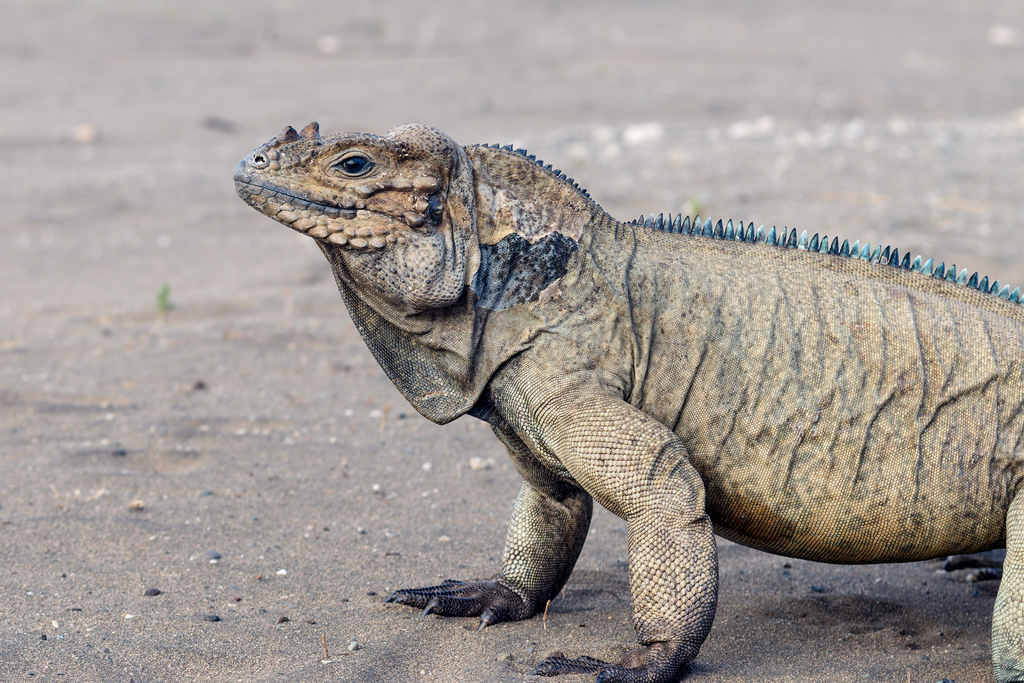
Rhinoceros Iguana
Cyclura cornuta
The rhinoceros iguana (Cyclura cornuta) is an endangered species of iguana that is (habituated) endemic to the Caribbean island of Hispaniola (shared by Haiti and the Dominican Republic) and its surrounding islands. A large lizard, they vary in length from 60 to 136 centimetres (24 to 54 in), and skin colours range from a steely grey to a dark green and even brown. Their name derives from the bony-plated pseudo-horn or outgrowth which resembles the horn of a rhinoceros on the iguana's snout. It is known to coexist with the Ricord's iguana (C. ricordii); the two species are the only taxa of rock iguana to do so.
From the article Rhinoceros iguana on Wikipedia (CC BY-SA), quoted section by section
Description
The rhinoceros iguana, like other members of the genus Cyclura, is a large-bodied, heavy-headed lizard with strong legs and a vertically flattened tail. A crest of pointed horned scales extends from the nape of their neck to the tip of their tail. Their color is a uniform gray to brown drab. Most adults weigh 4.56 to 9 kilograms (10.1 to 19.8 lb). Like all reptiles, rhinoceros iguanas are cold-blooded, meaning they need external sources to heat themselves; they move as the sun shifts in order to get an optimal internal temperature. These iguanas are characterized by the growth of bony prominent tubercles on their snouts which resemble horns. Males possess an adipose pad in the form of a "helmet" on the occipital region of the head, and a large dewlap. This species, like other species of Cyclura, is sexually dimorphic; males are larger than females, and have more prominent dorsal crests and "horns" in addition to large femoral pores on their thighs, which are used to release pheromones.
Wikipedia: “Anatomy and morphology”
Range & habitat
Ranging in scattered locations throughout Hispaniola (in both Haiti and the Dominican Republic), populations are stable only on Isla Beata and the extreme of the Barahona Peninsula, inside Jaragua National Park. There are moderately dense populations in the southeastern region of Haiti and its offshore islands, including the brackish lake of Étang Saumâtre, as well as the Dominican hypersaline Lake Enriquillo and its lake island, Isla Cabritos. Populations in Haiti are even more endangered due to deforestation, poaching for bushmeat, and human clearing practices. Though not restricted to one single habitat, the iguanas are found most abundantly in scrub woodlands of the Hispaniolan dry forests (characterized by xeric, rocky terrain of eroded limestone with minimal flora), coastal terraces, lowlands of the mainland, plus several offshore islands and small cays, all with slightly different habitat types. The favored biome of the rhinoceros iguana to live within is one that receives very little rain and has few trees or shrubs. True to the name "rock" iguana, they favor rather barren landscapes with smooth, large boulder formations and rocky outcrops for basking on, with adequate crevices and sheltered areas for retreating into. They will immediately flee into the rocks and crevasses to hide from predators such as humans, birds of prey, feral dogs and cats. …
Wikipedia: “Distribution and habitat”
What it does
Rhinoceros iguanas, like most members of Cyclura, are usually docile and well-tempered. As with many lizard species, "head-bobbing" is a commonly observed form of communication used by the rhinoceros iguana. Males, especially, appear to "nod" their heads toward one another as an assertion of dominance, or announcing their "ownership" of an area. It is oftentimes a warning to not come any closer, as well as to communicate (with females) their desire to mate. At times, this form of body language is directed at humans (by both wild and captive iguanas) as a warning, or as a sort of "greeting" to their human caretaker(s). The females (more or less) only nod their heads to ward off incessant advances from males, and female-to-female head bobbing is infrequent, though not nonexistent.
In general, rhinoceros iguanas (especially captive bred individuals) are among the most docile and human-tolerant of reptiles; some iguanas appear to desire human attention, seeming to enjoy being petted as much as a domestic dog or cat would. Even with this overall docility, levels of human tolerance can vary greatly from iguana to iguana, season to season, and even day by day. Iguanas are highly in-tune with their surroundings, being particularly sensitive to atmospheric and energetic nuances. A normally friendly iguana may have "mood swings", or show a desire to be left alone, for unknown reasons. …
Wikipedia: “Behaviour”
Where it lives
Recorded sightings
—
geo-referenced records in GBIF, from museums, herbaria and field observers.
Drag the globe to turn it. Dots are where records exist, not a range map; darker means more records.
In the stacks
Searching the stacks…
Every page naming Cyclura cornuta in the Biodiversity Heritage Library →
This page is assembled live from iNaturalist, GBIF, Wikipedia, the Source Library and the Internet Archive. It is not yet part of the hand-edited codex. iNaturalist taxon 146565.