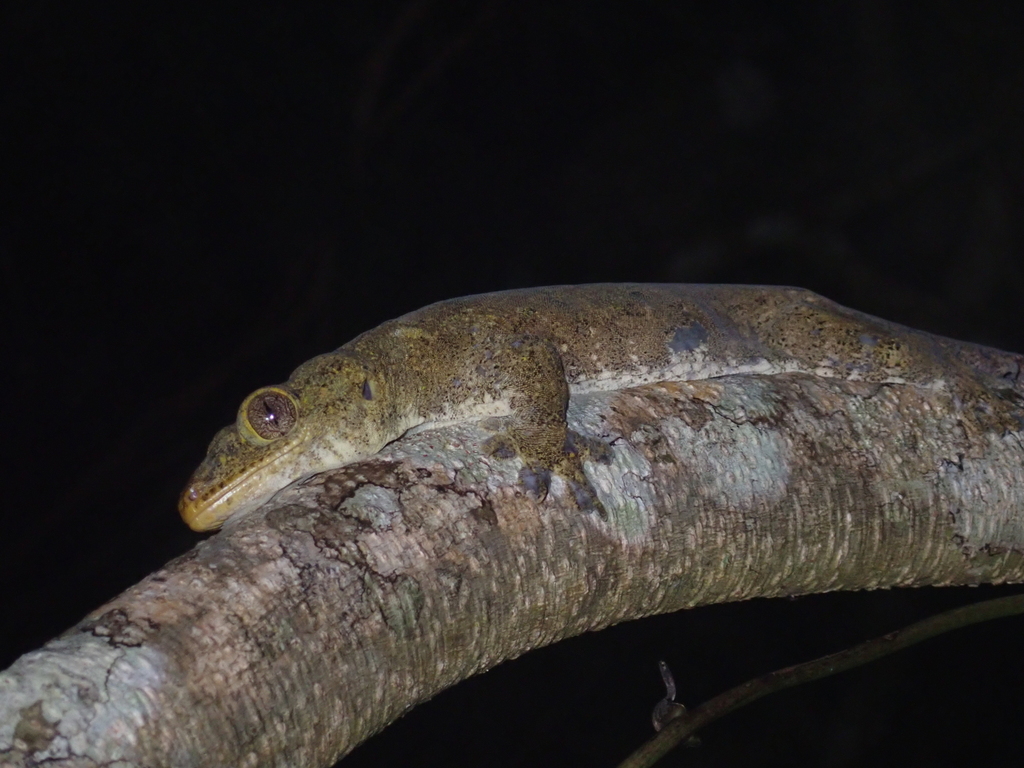
Western Giant Stump-toed Gecko
Gehyra georgpotthasti
Gehyra georgpotthasti is a species of web-toed gecko, found on several Melanesian and Polynesian islands.
From the article Gehyra georgpotthasti on Wikipedia (CC BY-SA), quoted section by section
Description
A large, stoutly built gecko. The size from snout to vent is 112 millimetres (4.4 in), plus the tail length of 75 mm (3.0 in). It has a brown color with five dark brown saddle patches between forelimbs and base of tail. The ventral side is light brown with a yellow hue. Iris is brown. The color can vary by showing yellow, reddish and olive elements. The tail has five to six dark bands, which are especially distinct in juveniles and less distinct on adults. Males grow larger than females and have precloacal-femoral pores. Like most geckos, they are oviparous, i.e. reproduce by laying eggs. The diet includes bananas which is unusual for Gehyras. Some specimens show green-coloured muscle tissue when the skin is damaged. The species was described in 2012, as distinct from G. vorax.
What it does
The species is generally arboreal and nocturnal, occupying habitats in rainforest and along beaches. Often found on coconut trees.
== References ==
Wikipedia: “Behaviour”
Where it lives
Recorded sightings
—
geo-referenced records in GBIF, from museums, herbaria and field observers.
Drag the globe to turn it. Dots are where records exist, not a range map; darker means more records.
In the stacks
Searching the stacks…
Every page naming Gehyra georgpotthasti in the Biodiversity Heritage Library →
This page is assembled live from iNaturalist, GBIF, Wikipedia, the Source Library and the Internet Archive. It is not yet part of the hand-edited codex. iNaturalist taxon 146127.