- Animals
- ›Chordates
- ›Vertebrates
- ›Reptiles
- ›Snakes and Lizards
- ›Lizards
- ›Iguanas and Allies
- ›Dragons and Chameleons
- ›Chameleons
- ›Madagascar Leaf Chameleons
- ›Brookesia
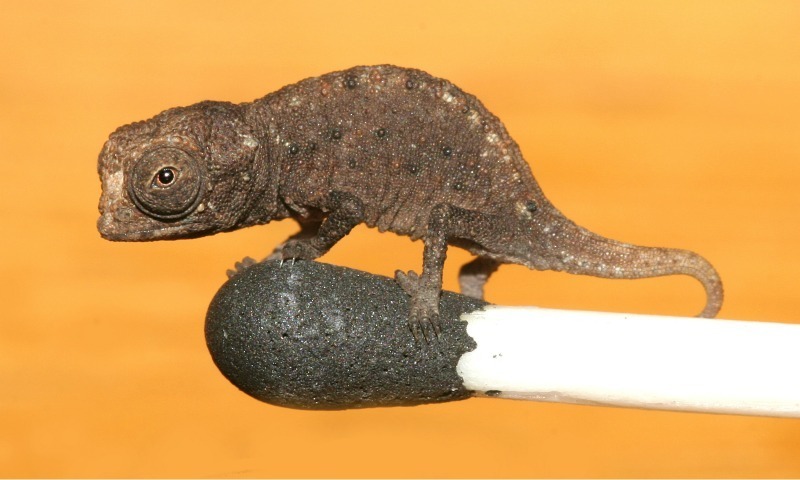
Nosy Hara Leaf Chameleon
Brookesia micra
Brookesia micra, also known as the Nosy Hara leaf chameleon, is a species of small chameleon from the islet of Nosy Hara in Antsiranana, Madagascar. At the time of its discovery, it was the smallest known chameleon and among the smallest reptiles, until the 2021 discovery of the even smaller B. nana. Adult B. micra can grow up to 29 mm (1.1 in) in length.
From the article Brookesia micra on Wikipedia (CC BY-SA), quoted section by section
Description
The males of Brookesia micra reach a maximum snout-vent length of 16 mm (0.63 in), and the total body length of both of the sexes is less than 30 mm (1.2 in), ranking it among the smallest amniote vertebrates found anywhere in the world. Compared to Brookesia minima, B. micra has a shorter tail and a larger head. Adults of B. micra also have orange tails, as opposed to an inconspicuous brown one. The size of the lizard may be linked to its habitat, due to insular dwarfism.
Range & habitat
Brookesia micra, together with three other species, were found in north Madagascar in 2005. This species was discovered on a small, uninhabited island in the Nosy Hara archipelago off the coast of Madagascar. They typically reside in leaf litter during the day, and climb up into tree branches as high as 10 cm (3.9 in) at night to sleep. B. micra habitats are most prevalent in areas with tsingy (i.e., limestone karst), potentially because of the moisture it provides, the protection from predators, and/or that it is the most abundant ecological feature of the area. High altitudes (500-700 meters) and sloped ground (due to higher levels of water shedding) were additional features that were common in B. micra habitats, while leaf litter was not found to be a very important characteristic of their habitats. B. micra lives in an area subject to illegal logging, which may make the species "sensitive to habitat destruction", according to researcher Jorn Köhler. Due to the highly specific nature of B. micra's habitat, the species would be at high risk for extinction if habitat destruction were to occur.
Wikipedia: “Distribution and habitat”
In human culture
The specific epithet of B. micra is a derivation of the Latin form of the Greek word "μικρός" (mikros), which means either "tiny" or "small" and refers to the small body size.
Wikipedia: “Etymology”
Where it lives
Recorded sightings
—
geo-referenced records in GBIF, from museums, herbaria and field observers.
Drag the globe to turn it. Dots are where records exist, not a range map; darker means more records.
In the stacks
Searching the stacks…
Every page naming Brookesia micra in the Biodiversity Heritage Library →
This page is assembled live from iNaturalist, GBIF, Wikipedia, the Source Library and the Internet Archive. It is not yet part of the hand-edited codex. iNaturalist taxon 145979.