On eBird ↗
Himalayan Bulbul
Live sightings near you, the range map, bar charts of when it is seen, and Macaulay Library photos and recordings.
Himalayan Bulbul
Pycnonotus leucogenys
The Himalayan bulbul (Pycnonotus leucogenys), or white-cheeked bulbul, is a species of songbird in the bulbul family found in Central and South Asia.
From the article Himalayan bulbul on Wikipedia (CC BY-SA), quoted section by section
Description
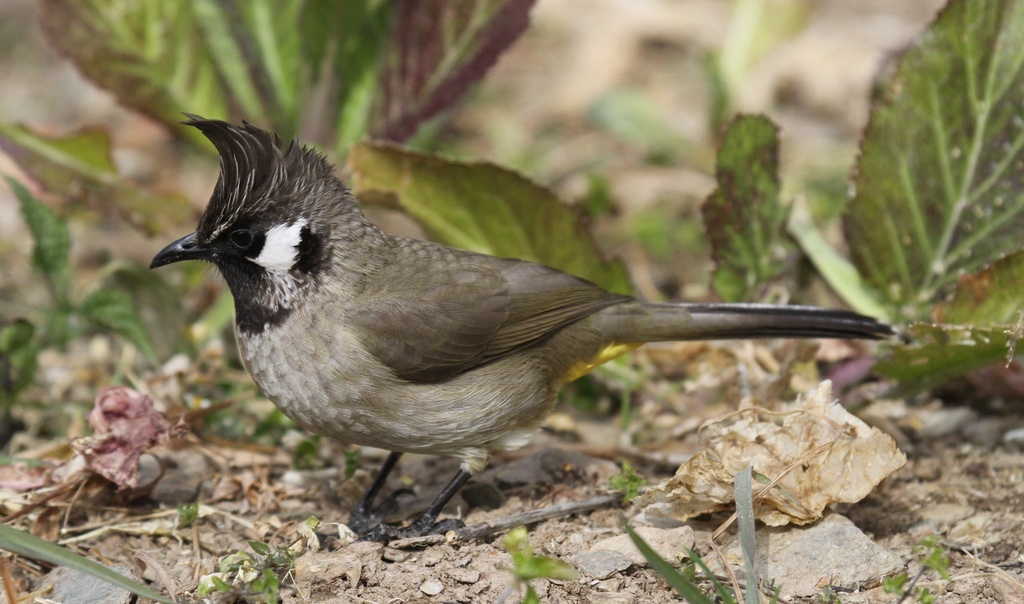
The Himalayan bulbul is about 18 cm in length, with a wingspan of 25.5–28 cm and an average weight of 30 g. Its head, throat, and crest are black and white. The back, side, and lengthy tail are brown, the underside is pale yellow. Sexes have similar plumage. The song is a beautiful 4-part whistle, which resembles an accelerated oriole whistle.
Range & habitat
The species occurs in the northern regions of the Indian subcontinent and some adjoining areas. It is found predominantly in Kashmir and near the Himalayas. The Himalayan bulbul frequents forests and shrubland and also comes into gardens and parks.
Wikipedia: “Distribution and habitat”
What it does
The Himalayan bulbul feeds on insects and other small invertebrates, as well as berries, fruits, seeds, buds and nectar. Nests are usually built in bushes or low branches, are cup-shaped, and made of stems, roots and twigs. The female usually lays three eggs, which are incubated for 12 days. The chicks leave the nest when they are 9–11 days old. There may be up to three broods raised per year. During breeding, adults become very territorial.
Wikipedia: “Behaviour and ecology”
Listen
Looking for field recordings…
Where it lives
Recorded sightings
—
geo-referenced records in GBIF, from museums, herbaria and field observers.
Drag the globe to turn it. Dots are where records exist, not a range map; darker means more records.
In the stacks
Searching the stacks…
Every page naming Pycnonotus leucogenys in the Biodiversity Heritage Library →
This page is assembled live from iNaturalist, GBIF, Wikipedia, the Source Library and the Internet Archive. It is not yet part of the hand-edited codex. iNaturalist taxon 14592.