On eBird ↗
Regent Bowerbird
Live sightings near you, the range map, bar charts of when it is seen, and Macaulay Library photos and recordings.
Regent Bowerbird
Sericulus chrysocephalus
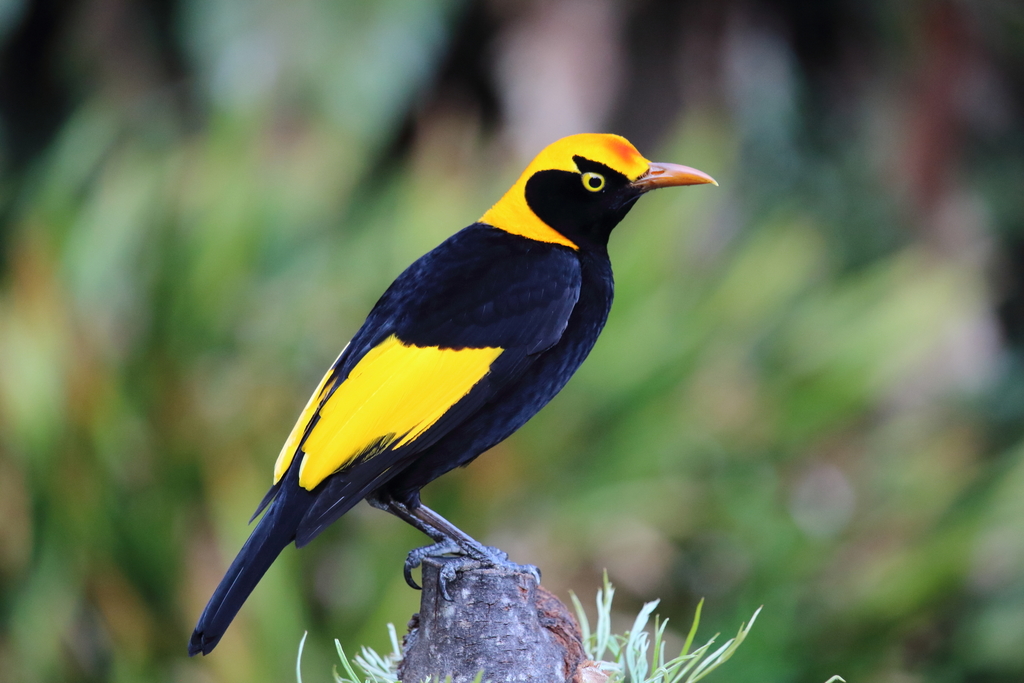
The regent bowerbird (Sericulus chrysocephalus) is a medium-sized, up to 25 cm long, sexually dimorphic bowerbird. The male bird is black with a golden orange-yellow crown, mantle and black-tipped wing feathers. It has yellow bill, black feet and yellow iris. The female is a brown bird with whitish or fawn markings, grey bill, black feet and crown. The name commemorates a prince regent of the United Kingdom.
From the article Regent bowerbird on Wikipedia (CC BY-SA), quoted section by section
Range & habitat
An Australian endemic, the regent bowerbird is distributed to rainforests and margins of eastern Australia, from central Queensland to New South Wales. A rare natural intergeneric hybrid between the regent bowerbird and the satin bowerbird is known as Rawnsley's bowerbird.
Wikipedia: “Habitat”
What it does
All male bowerbirds build bowers, which can be simple ground clearings or elaborate structures, to attract female mates. Regent bowerbirds in particular are known to mix a muddy greyish blue or pea green "saliva paint" in their mouths which they use to decorate their bowers. The male builds an avenue-type bower consisting of two walls of sticks, decorated with shells, seeds, leaves and berries. Regents will sometimes use wads of greenish leaves as "paintbrushes" to help spread the substance, representing one of the few known instances of tools used by birds. The female builds a saucer-shaped nest made of twigs measuring 30 cm high and 15–20 cm wide often away from the bower.
Wikipedia: “Behaviour”
Listen
Looking for field recordings…
Where it lives
Recorded sightings
—
geo-referenced records in GBIF, from museums, herbaria and field observers.
Drag the globe to turn it. Dots are where records exist, not a range map; darker means more records.
In the stacks
Searching the stacks…
Every page naming Sericulus chrysocephalus in the Biodiversity Heritage Library →
This page is assembled live from iNaturalist, GBIF, Wikipedia, the Source Library and the Internet Archive. It is not yet part of the hand-edited codex. iNaturalist taxon 14547.