On eBird ↗
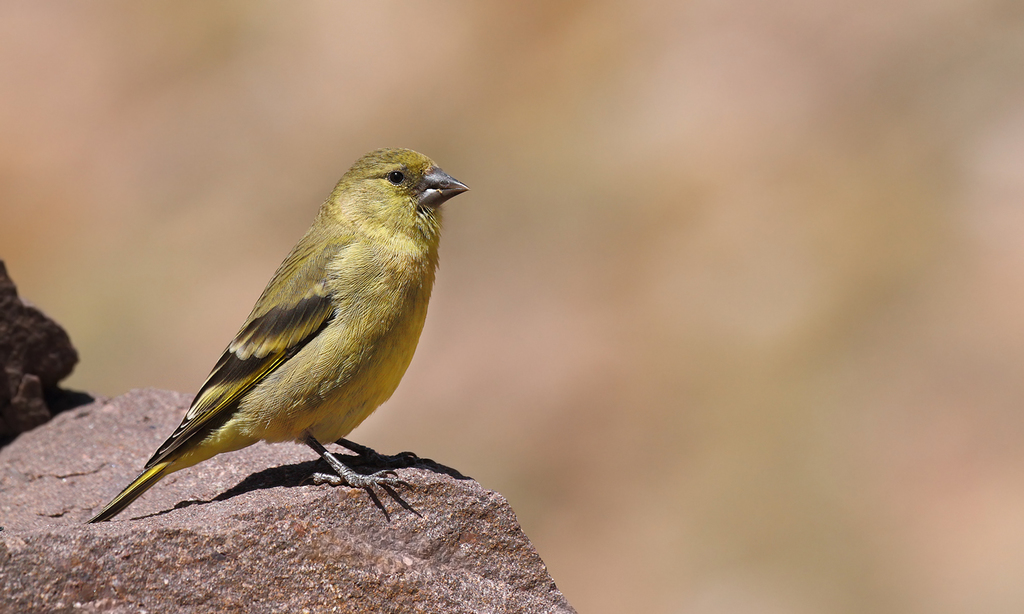
Thick-billed Siskin
Live sightings near you, the range map, bar charts of when it is seen, and Macaulay Library photos and recordings.
Thick-billed Siskin
Spinus crassirostris
The thick-billed siskin (Spinus crassirostris) is a species of finch in the family Fringillidae. Found in Argentina, Bolivia, Chile, and Peru, its natural habitats are subtropical or tropical moist montane forests and subtropical or tropical high-altitude shrubland.
From the article Thick-billed siskin on Wikipedia (CC BY-SA), quoted section by section
Description
The thick-billed siskin is one of the larger members of genus Spinus and has the eponymous thick bill. It is 12.5 to 14 cm (4.9 to 5.5 in) long and weighs about 19 g (0.67 oz). The species is sexually dimorphic. Adult males of the nominate subspecies have a black head, neck, and throat with a thin yellow band around its lower edge. Their back and scapulars are olive-yellow with indistinct darker streaks. Their rump is greenish yellow and their uppertail coverts somewhat yellower. Their tail is mostly black with wide yellow edges at the bases of all feathers but the innermost. Their wings' median and greater coverts are blackish brown with yellow or yellowish green tips. Their primary coverts and flight feathers are mostly black. Their primaries and secondaries have wide yellow bases and the ends of the secondaries have light buff edges. Their tertials have thin pale or whitish buff edges and tips. Their breast and flanks are bright yellow, often with a greenish tinge on the flanks. Their belly to undertail coverts are bright yellow or yellowish buff. Adult females have a dark gray head and nape and a grayish olive chin and throat. Their upperparts are mostly green or greenish olive with buff flecks and an olive-yellow wash on the rump. Their tail and wings are much like the male's but with less yellow. Their breast is dingy yellow and their belly to undertail coverts off-white. …
Range & habitat
The thick-billed siskin has a disjunct distribution. Subspecies S. c. amadoni is the more northerly of the two. It is found from Ancash Department in northwestern Peru south to extreme northern Chile and east into northwestern Bolivia. The possible third subspecies occurs in the northern half of that range. The nominate subspecies is found in southern Bolivia, northwestern Argentina, and central Chile. The species primarily inhabits Polylepis woodlands and shrublands and also brushy hillsides and areas with stunted trees. In elevation it ranges between 3,000 and 4,800 m (9,800 and 15,700 ft) overall and 3,600 and 4,600 m (11,800 and 15,100 ft) in Peru.
Wikipedia: “Distribution and habitat”
What it does
In the breeding season the thick-billed siskin feeds almost entirely on the seeds, buds, and shoots of Polylepis. It apparently has a more varied diet in the non-breeding season, which may be spent away from the Polylepis zone. It forages in pairs and small flocks during the breeding season and in larger flocks after it; the latter may include other species of siskin. It forages acrobatically in trees and often hangs upside down on thin branches.
Wikipedia: “Feeding”
Listen
Looking for field recordings…
Where it lives
Recorded sightings
—
geo-referenced records in GBIF, from museums, herbaria and field observers.
Drag the globe to turn it. Dots are where records exist, not a range map; darker means more records.
In the stacks
Searching the stacks…
Every page naming Spinus crassirostris in the Biodiversity Heritage Library →
This page is assembled live from iNaturalist, GBIF, Wikipedia, the Source Library and the Internet Archive. It is not yet part of the hand-edited codex. iNaturalist taxon 145315.