On eBird ↗
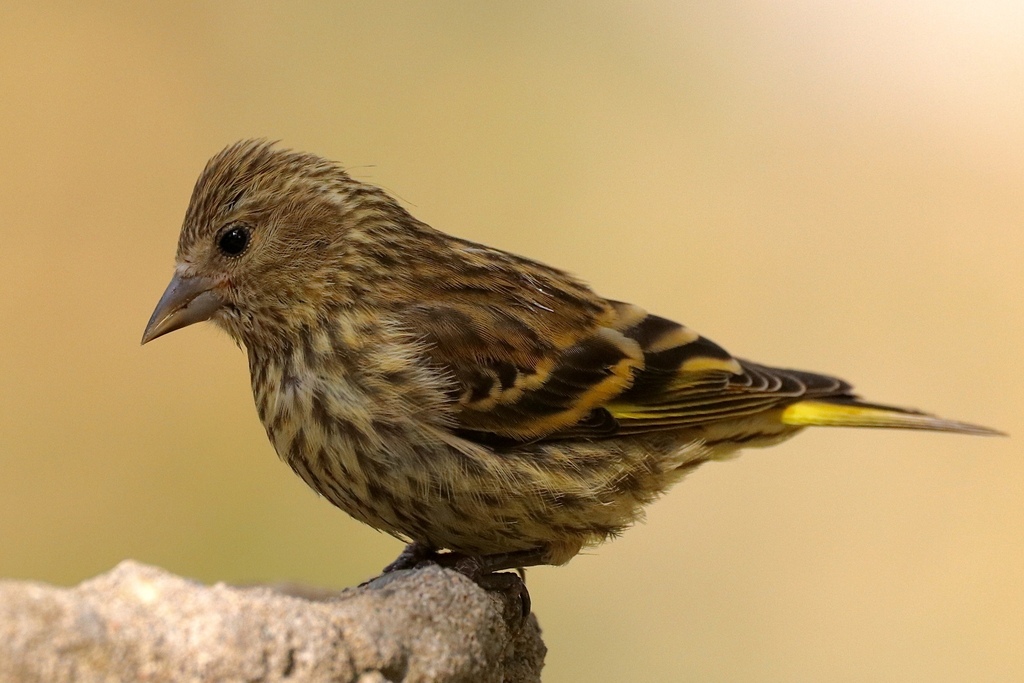
Pine Siskin
Live sightings near you, the range map, bar charts of when it is seen, and Macaulay Library photos and recordings.
Pine Siskin
Spinus pinus
The pine siskin (Spinus pinus) is a North American bird in the finch family. It is a migratory bird with an extremely sporadic winter range.
The pine siskin is currently listed as a species of Least Concern on the IUCN Red List.
From the article Pine siskin on Wikipedia (CC BY-SA), quoted section by section
Description
These birds are fairly small, being around the same size as the widespread American goldfinch. In both sexes, total length can range from 11–14 cm (4.3–5.5 in), with a wingspan of 18–22 cm (7.1–8.7 in) and a weight of 12–18 g (0.42–0.63 oz). Adults are brown on the upperparts and pale on the underparts, with heavy streaking throughout. They have short, forked tails. Their bills are conical like most finches but are more elongated and slender than those of other co-occurring finches. Variably, pine siskins have yellow patches on their wings and tails, which may also consist of white streaks on the wings. Although they can be confused by the more inexperienced for other finches or even American sparrows, pine siskins are distinguished by their heavy streaking, relatively slender bills, notched tail, yellow or whitish patches on the wings and smallish size.
Separation from the Eurasian siskin. The pine siskin in its typical morph is a drab bird, whereas the Eurasian siskin (a bird the species does not naturally co-exist with), in many plumages, is much brighter. Adult male Eurasian siskins are bright green and yellow with a black cap, and an unstreaked throat and breast; the pine siskin does not have a corresponding bright plumage. …
Range & habitat
Their breeding range spreads across almost the entirety of Canada, Alaska, and to a more variable degree, across the western mountains and northern parts of the United States. As their name indicates, the species occurs mostly as a breeder in open conifer forests. Northern pine forests support the majority of the species' breeding population. However, stands of ornamental conifers or deciduous trees may support nesting birds in partially developed parks, cemeteries, and suburban woodlands. While they favor feeding in open forest canopies where cone seeds are abundant, they'll forage in habitats as diverse as deciduous forests and thickets, meadows, grasslands, weedy fields, roadsides, chaparral, and backyard gardens and lawns. They flock to backyard feeders offering small seeds. Indeed some flocks can be large, with 20-30 birds lining up to eat from the same feeder. Mineral deposits can lure them to otherwise unattractive habitats like winter road beds that are salted to melt snow and ice. The nest is well-hidden on a horizontal branch of a tree, often a conifer. Migration by this bird is highly variable, probably related to food supply. Large numbers may move south in some years; hardly any in others. …
Wikipedia: “Distribution and habitat”
What it does
These birds forage in trees, shrubs and weeds. They mainly eat seeds, plant parts and some insects. In winter, they often feed in mixed flocks including American goldfinches and redpolls. Small seeds, especially thistle, red alder, birch, and spruce seeds, make up the majority of the pine siskin's diet. In a part of their esophagus called the crop, the species can store up to 10% of their body weight in seeds overnight, providing extra food on cold days. They will alternately eat the young buds of willows, elms and maples, and the soft stems and leaves of weeds and even young garden vegetables. They glean the seeds of grass, dandelions, chickweed, sunflowers and ragweed. Bird feeders often attract pine siskins, where they may eat fragments of heavy-shelled seeds, such as black oil sunflowers, left behind by heavier-billed bird species. In summer, they will eat insects, especially aphids, as well as a few spiders and grubs, which they then feed to the young as a protein-rich food that contributes to their growth. By winter, even first-year siskins predominantly eat seeds. Pine siskins can survive in very cold temperatures. The Metabolic rates of this species are typically 40% higher than those of a "normal" songbird of their size. When temperatures plunge as low as −70 °C (−94 °F), they can accelerate that rate up to five times normal for several hours. …
Wikipedia: “Feeding”
Listen
Looking for field recordings…
Where it lives
Recorded sightings
—
geo-referenced records in GBIF, from museums, herbaria and field observers.
Drag the globe to turn it. Dots are where records exist, not a range map; darker means more records.
In the stacks
Searching the stacks…
Every page naming Spinus pinus in the Biodiversity Heritage Library →
This page is assembled live from iNaturalist, GBIF, Wikipedia, the Source Library and the Internet Archive. It is not yet part of the hand-edited codex. iNaturalist taxon 145304.