On eBird ↗
Eurasian Siskin
Live sightings near you, the range map, bar charts of when it is seen, and Macaulay Library photos and recordings.
Eurasian Siskin
Spinus spinus
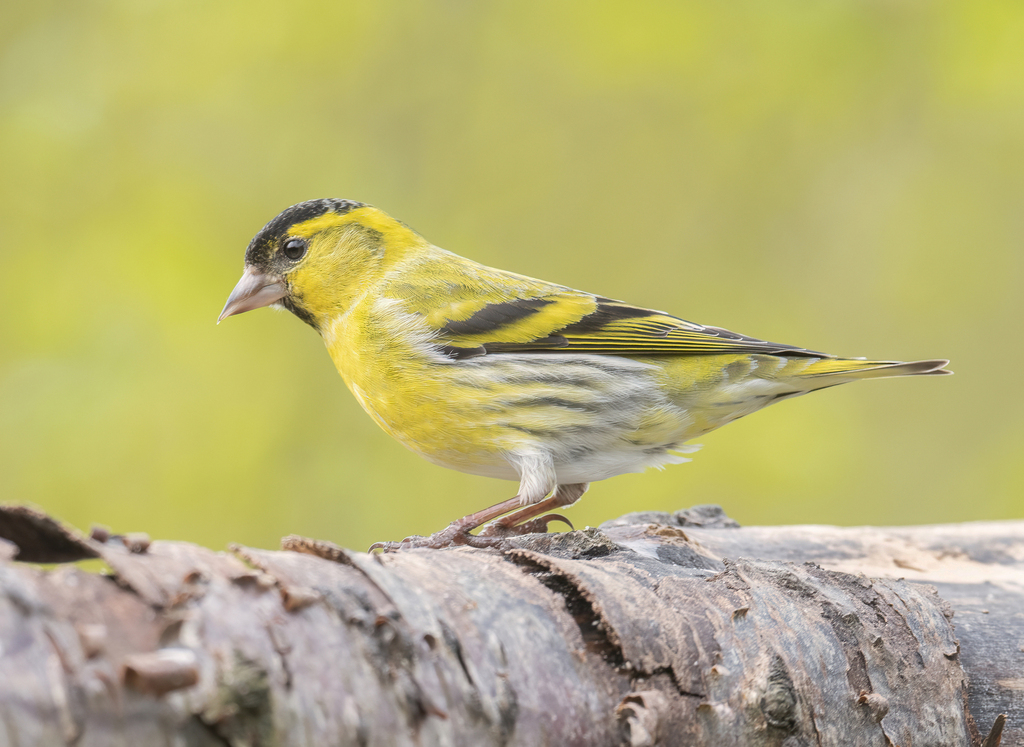
The Eurasian siskin (Spinus spinus) is a small passerine bird in the finch family Fringillidae. It is also called the European siskin, common siskin or just siskin. Other (archaic) names include black-headed goldfinch, barley bird and aberdevine. It is very common throughout Europe and Eurosiberia. It is found in forested areas, both coniferous and mixed woodland where it feeds on seeds of all kinds, especially of alder and conifers.
It can be distinguished from similar finches by its plumage colour. Its upperparts are greyish green and its underparts are grey-streaked white. Its wings are black with a striking yellow wing bar and its tail is black with yellow sides. The male has a predominantly yellow face and breast with a neat black cap. The female and young birds have a greyish-green head and no cap. It is a trusting, sociable and active bird. Its song is a pleasant mix of tweets and trills.
From the article Eurasian siskin on Wikipedia (CC BY-SA), quoted section by section
Description
The siskin is a small, short-tailed bird, 11–12.5 centimetres (4.3–4.9 in) in length with a wingspan that ranges from 20 to 23 centimetres (7.9 to 9.1 in). It weighs between 12 and 18 grams (0.42 and 0.63 oz). The bird shows sexual dimorphism. The male has a greyish-green back, a yellow rump, yellow sides to the tail with a black tip, black wings with a distinctive yellow wing stripe, a yellowish breast that becomes whiter and striped towards the cloaca, a black bib (or chin patch) and two yellow auriculas and a black cap on its head. The amount of black on the bib varies greatly between males, and the size of the bib has been linked to dominance within a flock. The plumage of the female is more olive-coloured than that of the male. Its cap and auriculas are greenish with a white bib and a slightly striped, whitish-yellow rump. The young have a similar colouration to the females, with drab colours and a more subdued plumage. The shape of the siskin's beak is determined by its feeding habits. Although slender, it is strong, enabling it to reach between the scales of spruce cones and alder fruit to access the seeds on which it feeds. …
Range & habitat
This species can be found across the greater part of Eurosiberia and the north of Africa. Its breeding area is separated into two zones, both on each side of the Palearctic realm: the eastern coast of Asia and the central and northern part of Europe. These birds can be found throughout the year in Central Europe and in some mountain ranges in the south of the continent. They are also present in northern Scandinavia and Russia, and they overwinter in the Mediterranean basin and the area around the Black Sea. In China, they breed in the Khingan Mountains of Inner Mongolia and in Jiangsu province, and spend winter in Tibet, Taiwan, the valleys of the lower Yangtse River and the south east coast. The Eurasian siskin is occasionally seen in North America. There is also a similar and closely related North America counterpart, the pine siskin (Spinus pinus). Their seasonal distribution is also characterised by their anomalous migration pattern. Every few years they migrate southwards in larger numbers, greatly augmenting the overwintering populations in the Iberian Peninsula. This event has been the subject of various theories; one suggests that it occurs in the years when Norway spruce produces abundant seeds in central and northern Europe, causing populations to increase. Another theory is that greater migration occurs when the preferred food of alder or birch seed fails. …
Wikipedia: “Distribution and habitat”
What it does
They are very active and restless birds. They are also very social, forming small cohesive flocks especially in autumn and winter. They are fairly trusting of humans, it being possible to observe them from a short distance. During the breeding season, however, they are much more timid, solitary and difficult to observe. For this reason there is a German legend which says that siskins guard a magic stone in their nests that makes them invisible. It is one of the few species which has been described as exhibiting "allofeeding"' behaviour, this is where subordinates (of the same sex) regurgitate food for the dominant members of the group, which creates a strong cohesion in the flocks and implies a hierarchical structure within the group.
Feeding. The siskin is primarily a granivore, though its diet varies depending on the season. It primarily feeds in trees and avoids doing so on the ground. The diet is based primarily on the seeds of both coniferous (especially spruce and larch, as well as species planted in gardens such as Lawson's cypress) and broadleaf trees such as birch and, above all, alder, focusing on species with seeds 2–3 mm long. They also visit cultivated areas and pasture, where they join with other finches in eating the seeds of various Asteraceae such as thistles, dandelions, Artemisia, knapweeds and other herbaceous plants, such as St. …
Wikipedia: “Behaviour and ecology”
In human culture
The name siskin is derived from an adaptation of the German dialect words sisschen, zeischen, which are diminutive forms of Middle High German (zîsec) and Middle Low German (ziseke, sisek) words, with cognates in Slavic languages, such as Czech čížek; these names are all of onomatopoeic origin, derived from the bird's calls. The name is first recorded in written English in 1544 in William Turner's Avium praecipuarum, quarum apud Plinium et Aristotelem mentio est, brevis et succincta historia.
Wikipedia: “Etymology”
Listen
Looking for field recordings…
Where it lives
Recorded sightings
—
geo-referenced records in GBIF, from museums, herbaria and field observers.
Drag the globe to turn it. Dots are where records exist, not a range map; darker means more records.
In the stacks
Searching the stacks…
Every page naming Spinus spinus in the Biodiversity Heritage Library →
This page is assembled live from iNaturalist, GBIF, Wikipedia, the Source Library and the Internet Archive. It is not yet part of the hand-edited codex. iNaturalist taxon 145303.