On eBird ↗
Desert Finch
Live sightings near you, the range map, bar charts of when it is seen, and Macaulay Library photos and recordings.
Desert Finch
Rhodospiza obsoleta
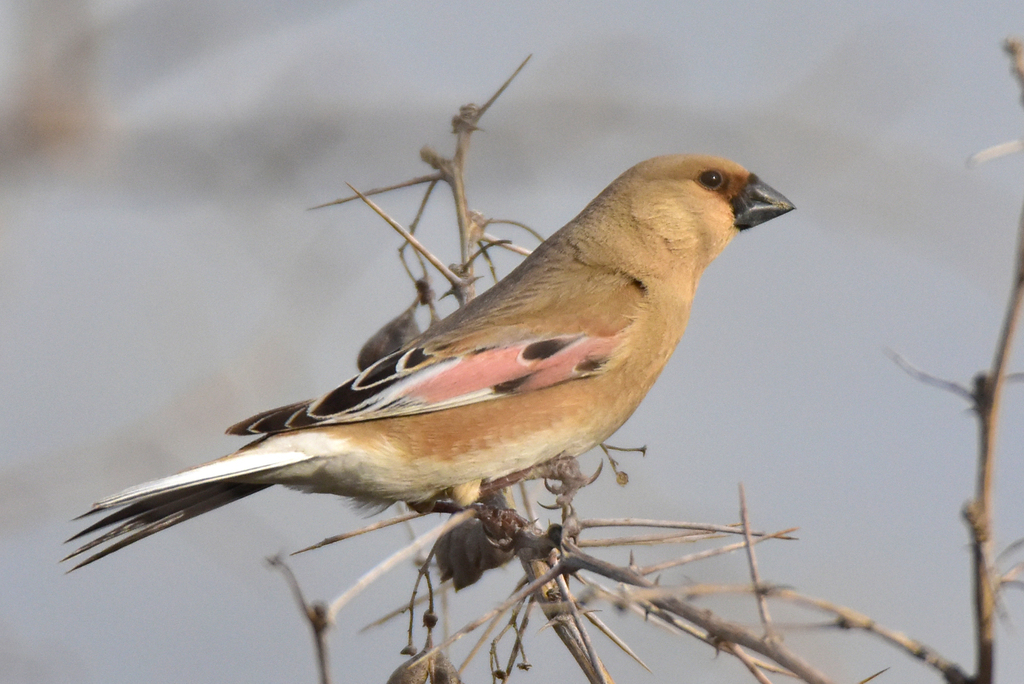
The desert finch (Rhodospiza obsoleta), sometimes called Lichtenstein's desert finch, is a large brown true finch found in southern Eurasia. Its taxonomy is confused, and it has formerly been placed in Fringilla, Bucanetes, Carduelis and Rhodopechys.
From the article Desert finch on Wikipedia (CC BY-SA), quoted section by section
Description
It has an average wingspan of 26 centimetres (10 in). It has a stout black bill, black and white remiges and rectrices, and a slash of rosy-pink on each wing. The female is more dull in color than the male, but other than that the adult sexes are similar in color pattern.
What it does
The desert finch is indeed a desert resident in areas where water is readily available, but it can also be found in low mountains and foothills, and in cultivated valleys. This species does not migrate except locally. The desert finch congregates near rural and remote human settlements, and the well-watered orchard in otherwise arid land is an ideal habitat. It can be found in feeding in large flocks of its own species or mixed finch flocks. It feeds on seeds and the occasional insect. Nesting occurs in trees in the spring, often in fruit trees in orchards, and the female lays and incubates 4 to 6 pale green, lightly speckled eggs.
Wikipedia: “Ecology”
Listen
Looking for field recordings…
Where it lives
Recorded sightings
—
geo-referenced records in GBIF, from museums, herbaria and field observers.
Drag the globe to turn it. Dots are where records exist, not a range map; darker means more records.
In the stacks
Searching the stacks…
Every page naming Rhodospiza obsoleta in the Biodiversity Heritage Library →
This page is assembled live from iNaturalist, GBIF, Wikipedia, the Source Library and the Internet Archive. It is not yet part of the hand-edited codex. iNaturalist taxon 145293.