On eBird ↗
Sierra Nevada Brushfinch
Live sightings near you, the range map, bar charts of when it is seen, and Macaulay Library photos and recordings.
Sierra Nevada Brushfinch
Arremon basilicus
The Sierra Nevada brushfinch (Arremon basilicus) is a Near Threatened species of bird in the family Passerellidae, the New World sparrows. It is endemic to Colombia.
From the article Sierra Nevada brushfinch on Wikipedia (CC BY-SA), quoted section by section
Description
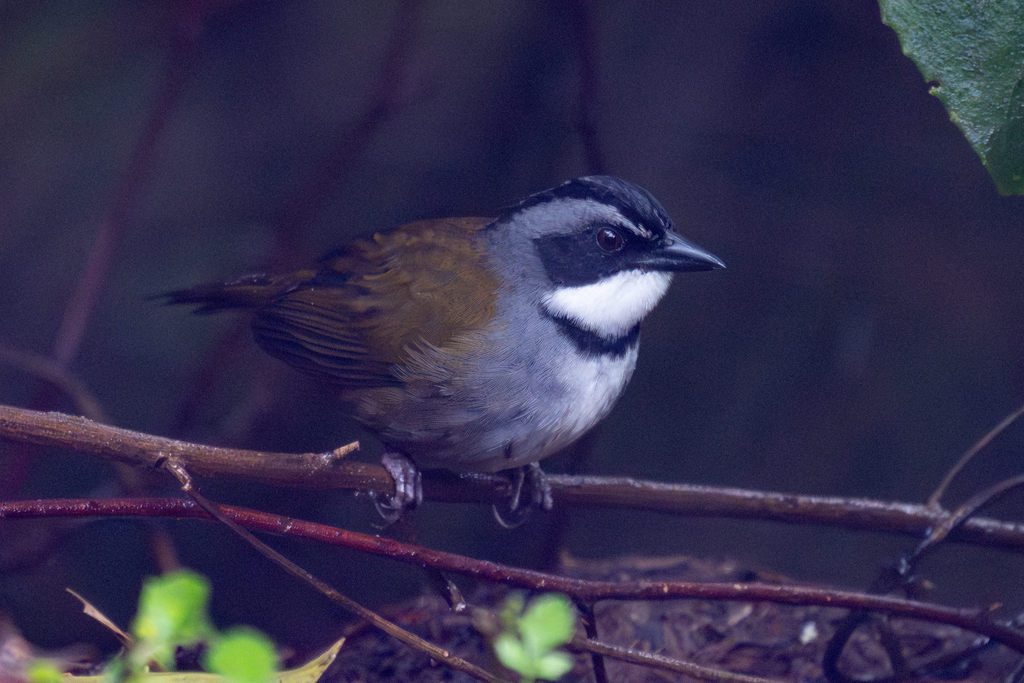
The Sierra Nevada brushfinch is about 19 cm (7.5 in) long. The sexes have the same plumage. Adults have a black crown with a gray stripe in the middle, a gray supercilium that extends to the nape and continues behind the ear coverts. The rest of their face is black. Their upperparts, wings, and tail are olive-green. Their throat is white with a narrow black band below it. The center of their breast and belly is white and their sides, flanks, and vent are brownish olive. They have a dark chestnut-brown iris, a black bill, and blackish legs and feet. Juveniles have an unstriped dusky head with browner upperparts than adults and pale brownish underparts with dark brown streaks.
Range & habitat
The Sierra Nevada brushfinch is found only in the isolated Sierra Nevada de Santa Marta in far northern Colombia. It inhabits humid montane forest where it favors the undergrowth at the edges. In elevation it ranges between 600 and 2,800 m (2,000 and 9,200 ft).
Wikipedia: “Distribution and habitat”
What it does
The Sierra Nevada brushfinch's diet has not been studied. It forages singly and in pairs. It forages on the ground, usually under vegetative cover, pushing aside leaf litter with its bill.
Wikipedia: “Feeding”
Listen
Looking for field recordings…
Where it lives
Recorded sightings
—
geo-referenced records in GBIF, from museums, herbaria and field observers.
Drag the globe to turn it. Dots are where records exist, not a range map; darker means more records.
In the stacks
Searching the stacks…
Every page naming Arremon basilicus in the Biodiversity Heritage Library →
This page is assembled live from iNaturalist, GBIF, Wikipedia, the Source Library and the Internet Archive. It is not yet part of the hand-edited codex. iNaturalist taxon 145284.