On eBird ↗
Grace's Warbler
Live sightings near you, the range map, bar charts of when it is seen, and Macaulay Library photos and recordings.
Grace's Warbler
Setophaga graciae
Grace's warbler (Setophaga graciae) is a small New World warbler that specializes in pine woods.
From the article Grace's warbler on Wikipedia (CC BY-SA), quoted section by section
Description
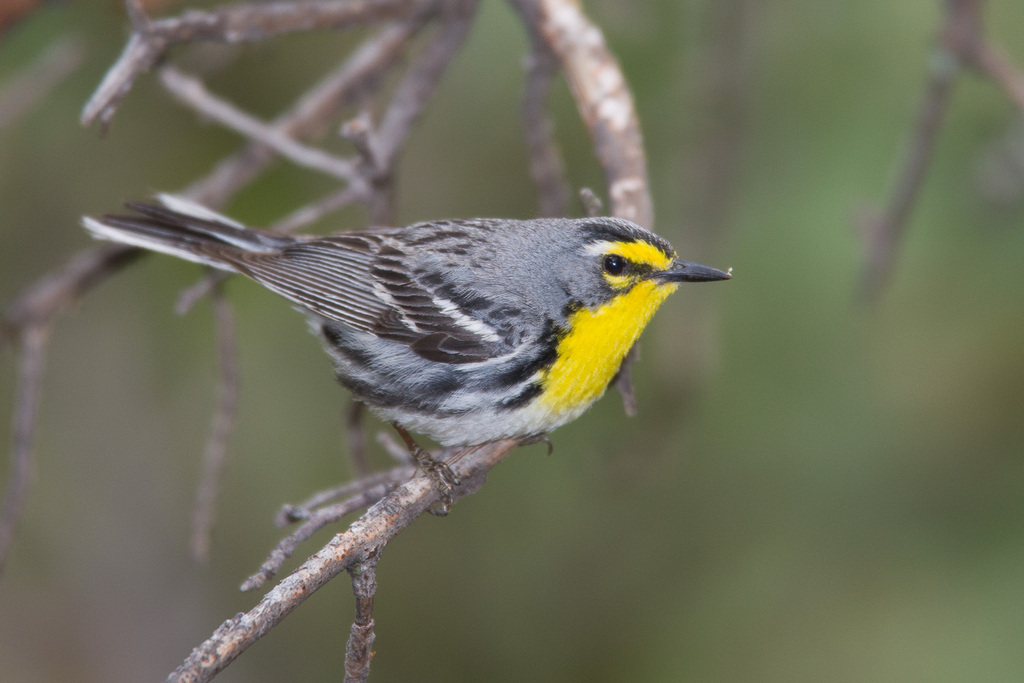
Grace's warbler is a small bird, 11–13 cm long. It is mostly gray on top, with broken black streaks across the back and flanks and two white bars on the wings. The throat and breast are a vibrant yellow, and the rest of the underparts are white. It has a yellow half-eye ring under the eye and a long yellow "eyebrow" stripe that starts at the base of the beak and runs above the eye, fading to white after it passes the eye.
Range & habitat
Grace's warblers breed from the south-western United States to Nicaragua and winter in their breeding range from north-eastern Sinaloa and north-western Durango south. They are almost always found in pine forests, even in migration, though at the northern end of their range (in southern Nevada and Utah and southwestern Colorado) they occur in spruce-fir forest. They prefer open, "parklike" woods, and in some areas such as northern Arizona they prefer an understory of Gambel's oak. In the United States and northern Mexico they typically occur at altitudes of 1,800 to 2,700 meters (5,900 to 8,900 ft)); farther south they may occur as low as 250 m. They are common in some localities, and in areas of the Mosquitia of Nicaragua where the only tree is the Caribbean pine, Grace's warblers may be the only bird seen. Grace's Warbler is represented by four subspecies, including the nominate. Setophaga graciae (S. F. Baird, 1865). Southern Nevada, southern Utah, southwestern Colorado, northern New Mexico, and western Texas south through eastern Sonora and western Chihuahua. Setophaga graciae yaegeri (A. R. Phillips & Webster, 1961). West-central Mexico from southern Sinaloa, Durango, and Zacatecas south to Jalisco and Colima. Setophaga graciae remota (Griscom, 1935). …
Wikipedia: “Distribution and habitat”
What it does
Like the vast majority of warblers, Grace's warbler eats only insects and spiders, as far as is known from limited studies. It forages mostly high in pine trees (86% of its foraging time in a study in Arizona was in pines, but it foraged in oaks more in Mexico where olive warblers also occur). It catches its food from the bases of needle clusters and the upper bark of branches no thicker than its body. It will often hover to inspect pine cones for insect larvae. In Arizona it seldom flies to catch insects, but in Nicaragua it often does.
Wikipedia: “Feeding”
Listen
Looking for field recordings…
Where it lives
Recorded sightings
—
geo-referenced records in GBIF, from museums, herbaria and field observers.
Drag the globe to turn it. Dots are where records exist, not a range map; darker means more records.
In the stacks
Searching the stacks…
Every page naming Setophaga graciae in the Biodiversity Heritage Library →
This page is assembled live from iNaturalist, GBIF, Wikipedia, the Source Library and the Internet Archive. It is not yet part of the hand-edited codex. iNaturalist taxon 145253.