On eBird ↗
St. Lucia Warbler
Live sightings near you, the range map, bar charts of when it is seen, and Macaulay Library photos and recordings.
St. Lucia Warbler
Setophaga delicata
The Saint Lucia warbler (Setophaga delicata) is a species of bird in the Parulidae family. It is endemic to Saint Lucia. It was once considered a subspecies of the Adelaide's warbler.
From the article Saint Lucia warbler on Wikipedia (CC BY-SA), quoted section by section
Description
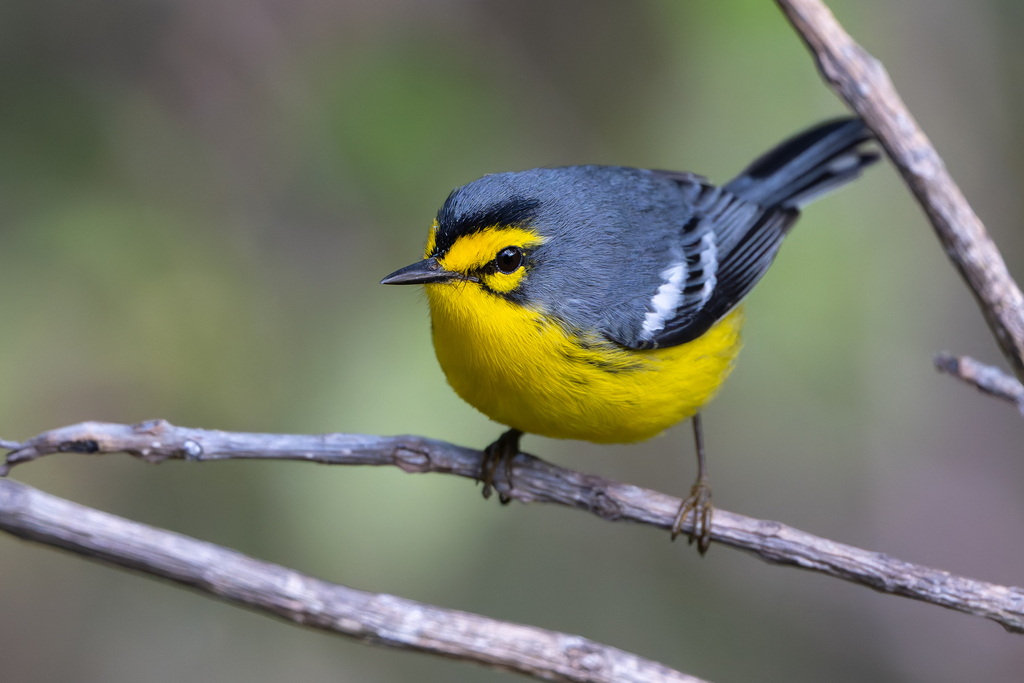
The St. Lucia warbler is 12.5 cm (4.9 in) long. Adult males have a slate- to plumbeous gray forehead and crown with a thin black streak below them, a wide rich lemon yellow supercilium to behind the eye, a yellow arc below the eye, and slate- to plumbeous gray ear coverts with a black line under and behind them. Their upperparts are slate- to plumbeous gray. Their wings are mostly black or dusky with slate-gray edges on the flight feathers and large white tips on the median and greater coverts that show as two wing bars. Their tail is black or dusky with gray feather edges and progressively more white at the end from the fourth to the outermost feathers. Their cheeks, chin, throat, breast, and belly are rich lemon yellow with an olive tinge on the sides and flanks; their undertail coverts are white. Adult females are paler gray above and much paler yellow below than males. Their black under-crown stripe and wing bars are narrower. Both sexes have a black iris, a dusky brown bill, and light grayish brown legs and feet.
Range & habitat
The St. Lucia warbler is found on the island of Saint Lucia in the Lesser Antilles. It inhabits almost all of the available landscapes, shunning only the driest scrub forest. It is found in both primary and secondary deciduous, semi-deciduous, and humid evergreen forests. Though it does not give numbers, a field guide says it is a bird of mid- to high-elevation forests. There are also three twentieth century records from the island of Martinique, which is just north of Saint Lucia.
Wikipedia: “Distribution and habitat”
What it does
The St. Lucia warbler feeds primarily on insects and includes smaller numbers of other arthropods including spiders in its diet. It occasionally feeds on fruit. Though it favors the forest understory up to about 8 m (25 ft) it will forage in the canopy as high as 28 m (90 ft). "They use 'flycatching', 'leaf-snatching', and 'leaf-gleaning' techniques in roughly equal proportions."
Wikipedia: “Feeding”
In human culture
The genus Setophaga is Greek for "moth eater". The specific epithet delicata is Latin and means "dainty", "nice", or "delicate".
Wikipedia: “Etymology”
Listen
Looking for field recordings…
Where it lives
Recorded sightings
—
geo-referenced records in GBIF, from museums, herbaria and field observers.
Drag the globe to turn it. Dots are where records exist, not a range map; darker means more records.
In the stacks
Searching the stacks…
Every page naming Setophaga delicata in the Biodiversity Heritage Library →
This page is assembled live from iNaturalist, GBIF, Wikipedia, the Source Library and the Internet Archive. It is not yet part of the hand-edited codex. iNaturalist taxon 145252.