On eBird ↗
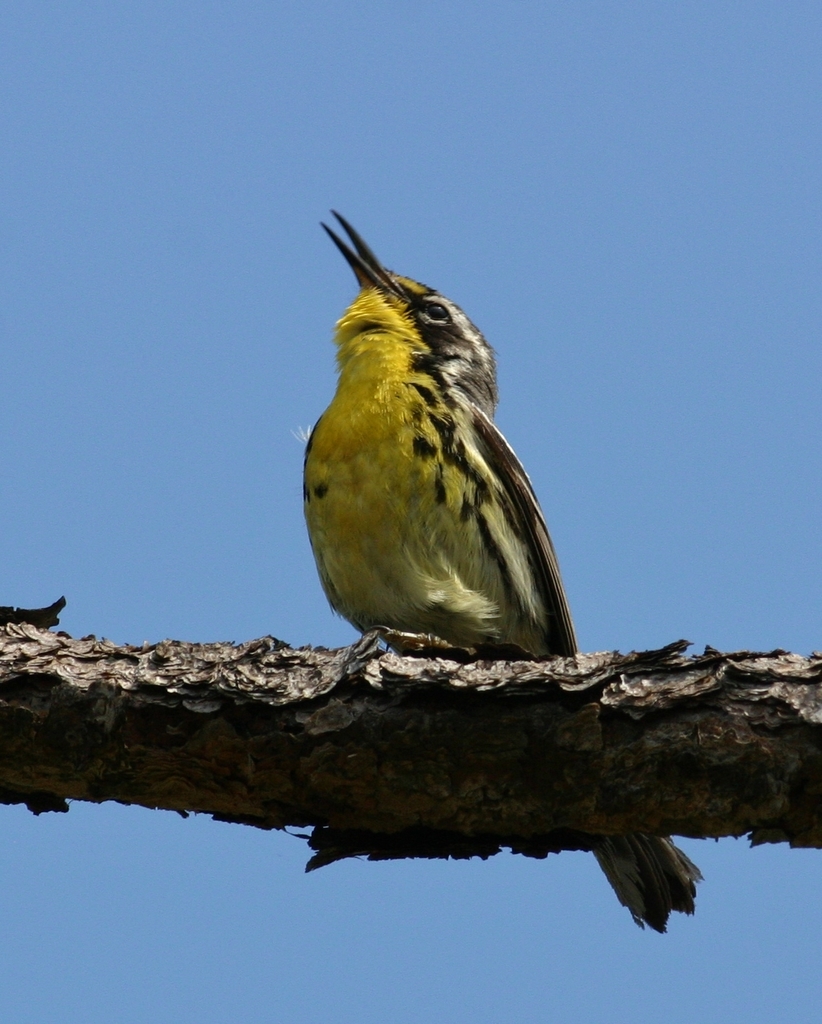
Bahama Warbler
Live sightings near you, the range map, bar charts of when it is seen, and Macaulay Library photos and recordings.
Bahama Warbler
Setophaga flavescens
The Bahama warbler (Setophaga flavescens) is an Endangered species of bird in the family Parulidae, the New World warblers. It is endemic to The Bahamas.
From the article Bahama warbler on Wikipedia (CC BY-SA), quoted section by section
Description
The Bahama warbler is 13 to 14 cm (5.1 to 5.5 in) long and weighs about 10 g (0.35 oz). Adult males have a gray forehead and forecrown, jet black lores and ear coverts, a long bright white supercilium with black streaks above it, a bright yellow spot in front of the eye, and a white arc below the eye. Their hindcrown, nape, and upperparts are grayish with a touch of brown. Their wing's lesser coverts are gray with black centers and their median and greater coverts are dusky gray with black centers and wide white tips that show as two wing bars. Their flight feathers are dusky with black centers and gray edges. Their tail feathers are dusky with black centers, gray edges, and large white patches on the outer three or four pairs. Their throat and upper breast are bright lemon yellow and their belly and flanks are slightly paler and buffier. They have distinct black streaks from the ear coverts along the sides of the breast and flanks. Adult females have a similar pattern to male's but are overall not as bright. They have a gray forehead and forecrown, dark gray to blackish lores and ear coverts, a supercilium like the male's, a pale yellow spot in front of the eye, and the same white arc below the eye as males. Their hindcrown, nape, and upperparts are grayish with a noticeable brown tinge. Their wings and tail are mostly like the male's but do not have the black centers. …
Range & habitat
The Bahama warbler was originally found on Grand Bahama, Little Abaco, and Great Abaco islands, and recent lists include all three islands. However, the Cornell Lab of Ornithology's Birds of the World account (2025) states that following Hurricane Dorian's landfall the species has not been found on Grand Bahama. It inhabits (or inhabited) the Bahamian pineyards, an ecosystem dominated by Pinus caribaea bahamensis that has a mostly open canopy and limited woody understory. In contrast, the yellow-throated warbler, a winter migrant to the Bahamas, uses almost all available types of wooded landscapes.
Wikipedia: “Distribution and habitat”
What it does
The Bahama warbler feeds on insects and other invertebrates. It takes prey by gleaning from pine trees, especially from bark crevices and also the bark surface, twigs, and needles. The bark-probing is very unusual among the other warblers found in the Bahamas. It takes food from tree's trunks and canopy and in the forest understory. Individuals have been observed at the flowers of century plants (Agave braceana) but it is not known if they were seeking insects or nectar.
Wikipedia: “Feeding”
Listen
Looking for field recordings…
Where it lives
Recorded sightings
—
geo-referenced records in GBIF, from museums, herbaria and field observers.
Drag the globe to turn it. Dots are where records exist, not a range map; darker means more records.
In the stacks
Searching the stacks…
Every page naming Setophaga flavescens in the Biodiversity Heritage Library →
This page is assembled live from iNaturalist, GBIF, Wikipedia, the Source Library and the Internet Archive. It is not yet part of the hand-edited codex. iNaturalist taxon 145247.