On eBird ↗
Olive-capped Warbler
Live sightings near you, the range map, bar charts of when it is seen, and Macaulay Library photos and recordings.
Olive-capped Warbler
Setophaga pityophila
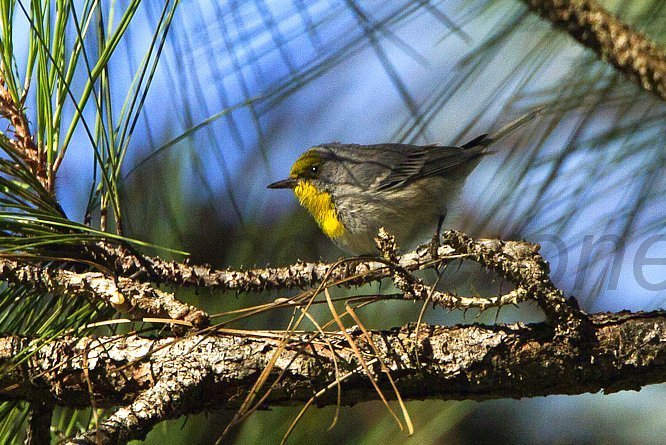
The olive-capped warbler (Setophaga pityophila) is a species of New World warbler that is native to the western and eastern ends of Cuba as well as Grand Bahama and the Abaco Islands in the Bahamas. Its natural habitat is pine forests and occasionally adjacent mixed forests.
From the article Olive-capped warbler on Wikipedia (CC BY-SA), quoted section by section
Description
The olive-capped warbler is about 12.5 to 13 cm (4.9 to 5.1 in) long and weighs 7.2 to 8.7 g (0.25 to 0.31 oz). The sexes have the same plumage except that males' average brighter than females'. Adults have a yellowish olive crown, black lores, and a thin yellow line above the lores that extends to the top of the eye on an otherwise slate-gray to plumbeous face. Their upperparts are also slate-gray to plumbeous. Their wings are slate-gray to plumbeous with white tips on the greater and median coverts that show as two wing bars. Their tail is slate-gray to plumbeous with some white on the outer two pairs of feathers. Their throat and breast are yellow and their belly and undertail coverts white. The sides of their breast have some irregular black streaks and their flanks have a brownish-olive to grayish tinge. Both sexes have a dark iris, a blackish bill, and blackish brown legs and feet. Juveniles have a brownish head and upperparts, indistinct wing bars, and paler underparts than adults.
Range & habitat
The olive-capped warbler is found in two areas of Cuba, Pinar del Río Province on the far western end of the island and Holguín, Santiago de Cuba, and Guantánamo provinces at the eastern end. It is also found in the Bahamas on Grand Bahama, Little Abaco, and Great Abaco islands. Though the IUCN states that it also is found in the Turks and Caicos Islands, no other source includes that archipelago. True to its original English name, it almost exclusively inhabits pine forest. It occasionally can also be found in adjacent mixed pine-hardwood forest. In elevation it ranges from sea level to 2,000 m (6,600 ft).
Wikipedia: “Distribution and habitat”
What it does
The olive-capped warbler's diet has not been studied; it is assumed to be mostly insects and other arthropods. In the Bahamas it has been noted at the flowers of century plants (Agave braceana) but it is not known if they were seeking insects or nectar.
Wikipedia: “Feeding”
Listen
Looking for field recordings…
Where it lives
Recorded sightings
—
geo-referenced records in GBIF, from museums, herbaria and field observers.
Drag the globe to turn it. Dots are where records exist, not a range map; darker means more records.
In the stacks
Searching the stacks…
Every page naming Setophaga pityophila in the Biodiversity Heritage Library →
This page is assembled live from iNaturalist, GBIF, Wikipedia, the Source Library and the Internet Archive. It is not yet part of the hand-edited codex. iNaturalist taxon 145243.