On eBird ↗
Cape May Warbler
Live sightings near you, the range map, bar charts of when it is seen, and Macaulay Library photos and recordings.
Cape May Warbler
Setophaga tigrina
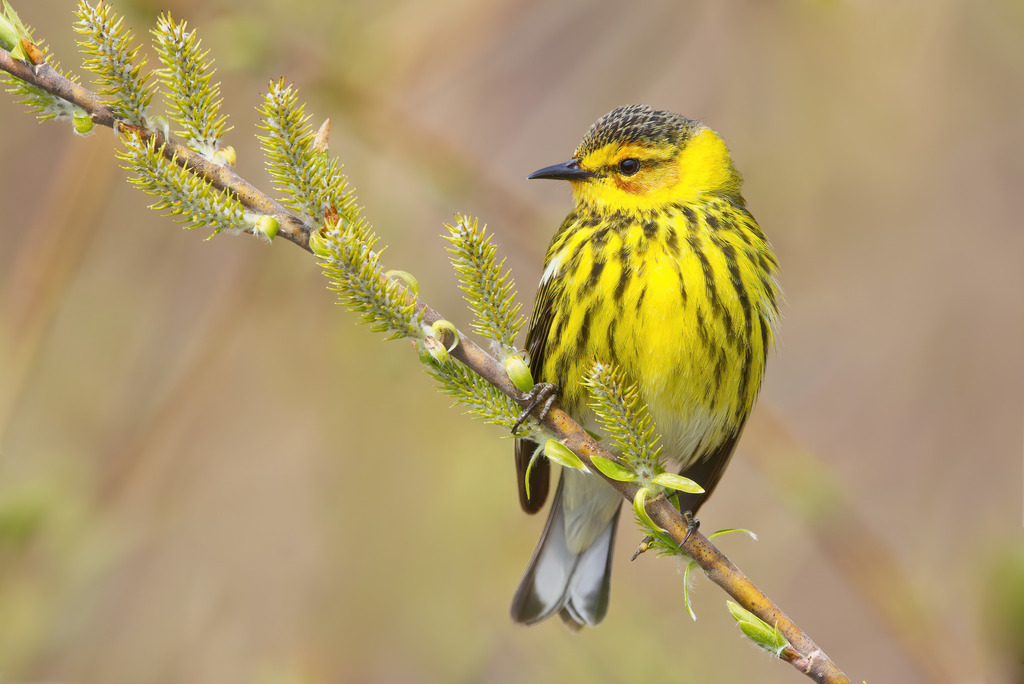
The Cape May warbler (Setophaga tigrina) is a species of New World warbler. It breeds in northern North America. Its breeding range spans all but the westernmost parts of southern Canada, the Great Lakes region, and New England. It is migratory, wintering in the West Indies. This species is a very rare vagrant to western Europe, with two records in Britain as of October 2013. The English name refers to Cape May, New Jersey, where George Ord collected the specimen that was later described by Alexander Wilson.
From the article Cape May warbler on Wikipedia (CC BY-SA), quoted section by section
Description
This bird is a small passerine and is a mid-sized New World warbler. Length can vary from 12–14 cm (4.7–5.5 in), wingspan is 19–22 cm (7.5–8.7 in), and body mass can range from 9–17.3 g (0.32–0.61 oz). Among standard measurements, the wing chord is 6.1–7.3 cm (2.4–2.9 in), the tail is 4.3–5 cm (1.7–2.0 in), the bill is 0.9–1.2 cm (0.35–0.47 in) and the tarsus is 1.7–1.9 cm (0.67–0.75 in). The adult male Cape May warbler has a brown back, yellowish rump and dark brown crown. The underparts are yellow streaked with black, giving rise to the bird's scientific name. The throat and nape are bright yellow and the face has a striking chestnut patch framed in yellow with a black eyestripe. There is a narrow white wing bar. Plumages of the female and immature male resemble washed-out versions of the adult male, lacking the strong head pattern. The yellowish rump, and at least indications of the white wing bar, are always present.
Listen
Looking for field recordings…
Where it lives
Recorded sightings
—
geo-referenced records in GBIF, from museums, herbaria and field observers.
Drag the globe to turn it. Dots are where records exist, not a range map; darker means more records.
In the stacks
Searching the stacks…
Every page naming Setophaga tigrina in the Biodiversity Heritage Library →
This page is assembled live from iNaturalist, GBIF, Wikipedia, the Source Library and the Internet Archive. It is not yet part of the hand-edited codex. iNaturalist taxon 145231.