On eBird ↗
Palestine Sunbird
Live sightings near you, the range map, bar charts of when it is seen, and Macaulay Library photos and recordings.
Palestine Sunbird
Cinnyris osea
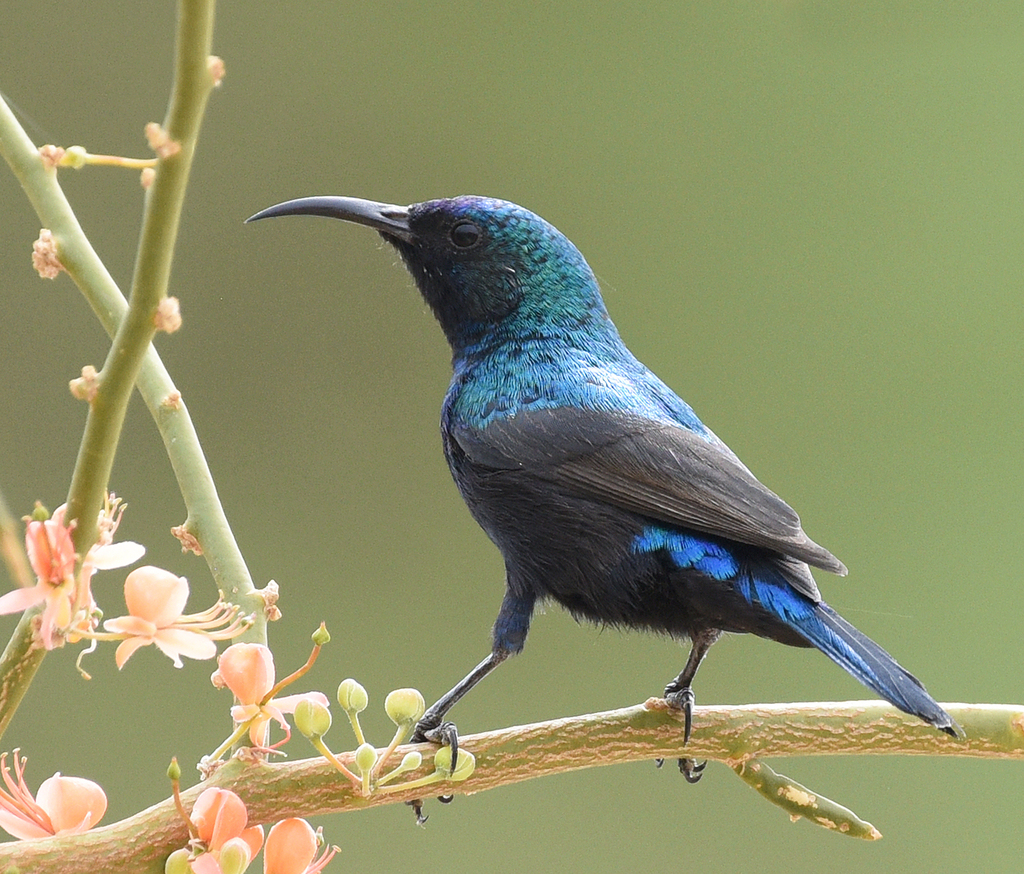
The Palestine sunbird (Cinnyris osea) is a small passerine bird of the sunbird family, Nectariniidae. Found in parts of the Middle East and sub-Saharan Africa, it is also known as the northern orange-tufted sunbird. However, the name "orange-tufted sunbird" refers to another species, found further south in Africa. In 2015 the Palestinian Authority adopted the species as a national bird, after it lost in Israel's national bird public vote in 2008 in favor of the hoopoe. The specific name osea is derived from Ancient Greek ὁσια (hosia, "holy").
From the article Palestine sunbird on Wikipedia (CC BY-SA), quoted section by section
Description
The Palestine sunbird is 8 to 12 cm long with a wingspan of 14 to 16 cm. Males have an average weight of 7.6 g and females weigh around 6.8 g. The bill is fairly long, black and curves downwards. The plumage of breeding males is mostly dark but appears glossy blue or green in the light. There are orange tufts at the sides of the breast which are hard to see except at close range. Females and juveniles are grey-brown above with pale underparts. Non-breeding males are similar but may retain some dark feathers. It has a high, fast, jingling song and various calls including a harsh alarm call.
Range & habitat
It occurs in areas with high temperatures and dry climate from sea level up to an altitude of 3200 m. It inhabits dry woodland, scrub, wadis, savannas, orchards and gardens. It is common in towns in some areas. The Middle Eastern subspecies C. o. osea breeds from Israel, Palestine and Jordan in the north, down through western Saudi Arabia to Yemen and Oman in the south. The expansion of Israeli cities, towns and villages over the last century played a significant role in the spread of the Palestine sunbird throughout the region, with cultivated tropical plants becoming more common in urban gardening. In recent decades it has colonized the Sinai Peninsula in Egypt. It has been observed breeding in Lebanon and regularly winters in both Lebanon and Syria. The African subspecies C. o. decorsei is found very locally in parts of Sudan, north-west Uganda, the Central African Republic, north-east Democratic Republic of Congo and northern Cameroon.
Wikipedia: “Habitat and range”
What it does
The diet consists mainly of insects and nectar. The tongue is long and brush-tipped to extract nectar from flowers.
Wikipedia: “Feeding”
Listen
Looking for field recordings…
Where it lives
Recorded sightings
—
geo-referenced records in GBIF, from museums, herbaria and field observers.
Drag the globe to turn it. Dots are where records exist, not a range map; darker means more records.
In the stacks
Searching the stacks…
Every page naming Cinnyris osea in the Biodiversity Heritage Library →
This page is assembled live from iNaturalist, GBIF, Wikipedia, the Source Library and the Internet Archive. It is not yet part of the hand-edited codex. iNaturalist taxon 145180.