On eBird ↗
Pemba Sunbird
Live sightings near you, the range map, bar charts of when it is seen, and Macaulay Library photos and recordings.
Pemba Sunbird
Cinnyris pembae
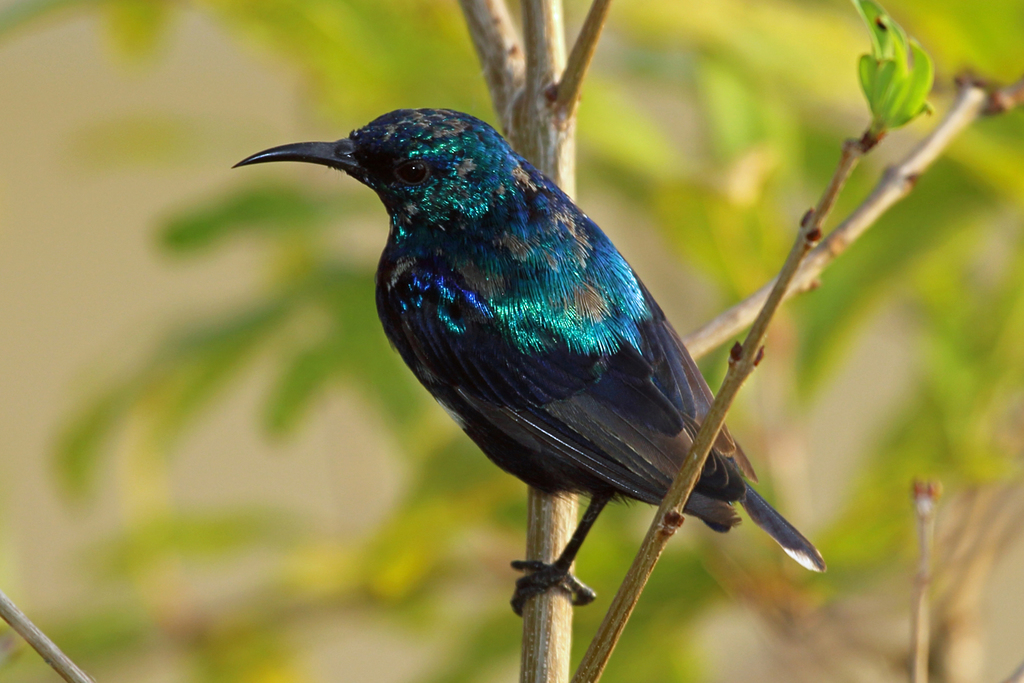
The Pemba sunbird (Cinnyris pembae) is a species of bird in the sunbird family. It is endemic to Pemba Island, in Tanzania.
From the article Pemba sunbird on Wikipedia (CC BY-SA), quoted section by section
Description
Males have a wingspan of 51.5-53 mm, while females have a wingspan of 47.5-50 mm. Adult males display iridescent blue-green coloration on their head and throat with bluish violet coloration on their wings and across their breast. Females have a gray-brown coloration on their head and wings, a pale yellow underside with blurry streaking and a small pale yellow lateral streak posterior to the eye. Juveniles resemble adult females with darker chin and throat, broad whitish malar stripe, and mottled grey underparts.
What it does
Pemba sunbirds consume nectar and fruits. They have been observed nesting in Wellingtonia trees and consuming the trees' nectar. Other favored foods include the white berries of Flueggea virosa, into which the Pemba sunbird jabs its beak, while smaller berries are eaten whole. Breeding takes place throughout the year with a noted lull between the months of January and April, inclusive. Males exhibit aggression to each other during breeding season. Nesting takes place approximately from July through December. Greenish-white eggs with brown streaks are laid in a "bag or purse-shaped nest suspended 1-2 m up from shrub or amongst foliage." The Pemba sunbird is known for a repetitive tslink-tslink-tslink call which is unlike that of its relatives on the mainland. It can be found in a wide variety of habitats on Pemba Island.
Wikipedia: “Behavior”
Listen
Looking for field recordings…
Where it lives
Recorded sightings
—
geo-referenced records in GBIF, from museums, herbaria and field observers.
Drag the globe to turn it. Dots are where records exist, not a range map; darker means more records.
In the stacks
Searching the stacks…
Every page naming Cinnyris pembae in the Biodiversity Heritage Library →
This page is assembled live from iNaturalist, GBIF, Wikipedia, the Source Library and the Internet Archive. It is not yet part of the hand-edited codex. iNaturalist taxon 145178.