On eBird ↗
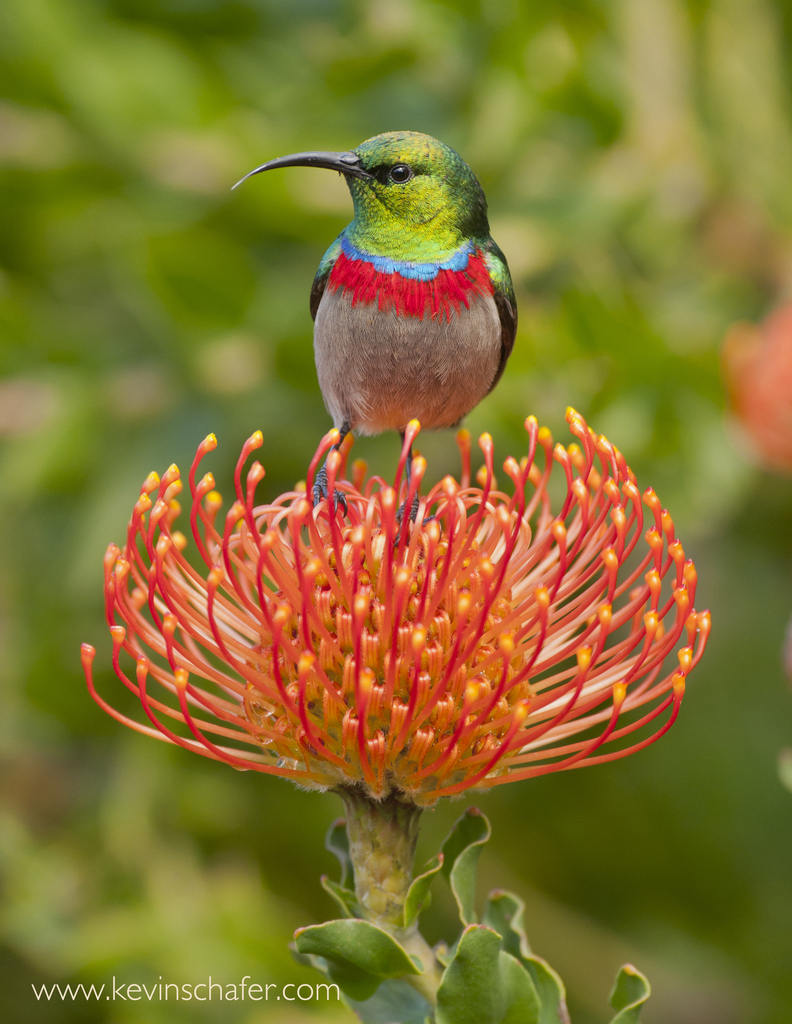
Southern Double-collared Sunbird
Live sightings near you, the range map, bar charts of when it is seen, and Macaulay Library photos and recordings.
Southern Double-collared Sunbird
Cinnyris chalybeus
The southern double-collared sunbird or lesser double-collared sunbird (Cinnyris chalybeus) (formerly placed in the genus Nectarinia), is a small passerine bird which breeds in southern Africa. It is mainly resident, but partially migratory in the north-east of its range.
From the article Southern double-collared sunbird on Wikipedia (CC BY-SA), quoted section by section
Range & habitat
This sunbird is common in gardens, fynbos, forests and coastal scrub. The southern double-collared sunbird breeds from April to December, depending on region. The closed oval nest is constructed from grass, lichen and other plant material, bound together with spider webs. It has a side entrance which sometimes has a porch, and is lined with wool, plant down and feathers.
Wikipedia: “Habitat”
What it does
The southern double-collared sunbird is usually seen singly or in small groups. Its flight is fast and direct on short wings. It lives mainly on nectar from flowers, but takes some fruit, and, especially when feeding young, insects and spiders. It can take nectar by hovering like a hummingbird, but usually perches to feed most of the time.
The call is a hard chee-chee, and the song is high pitched jumble of tinkling notes, rising and falling in pitch and tempo for 3–5 seconds or more.
Wikipedia: “Behaviour”
Listen
Looking for field recordings…
Where it lives
Recorded sightings
—
geo-referenced records in GBIF, from museums, herbaria and field observers.
Drag the globe to turn it. Dots are where records exist, not a range map; darker means more records.
In the stacks
Searching the stacks…
Every page naming Cinnyris chalybeus in the Biodiversity Heritage Library →
This page is assembled live from iNaturalist, GBIF, Wikipedia, the Source Library and the Internet Archive. It is not yet part of the hand-edited codex. iNaturalist taxon 145157.