On eBird ↗
Olive Sunbird
Live sightings near you, the range map, bar charts of when it is seen, and Macaulay Library photos and recordings.
Olive Sunbird
Cyanomitra olivacea
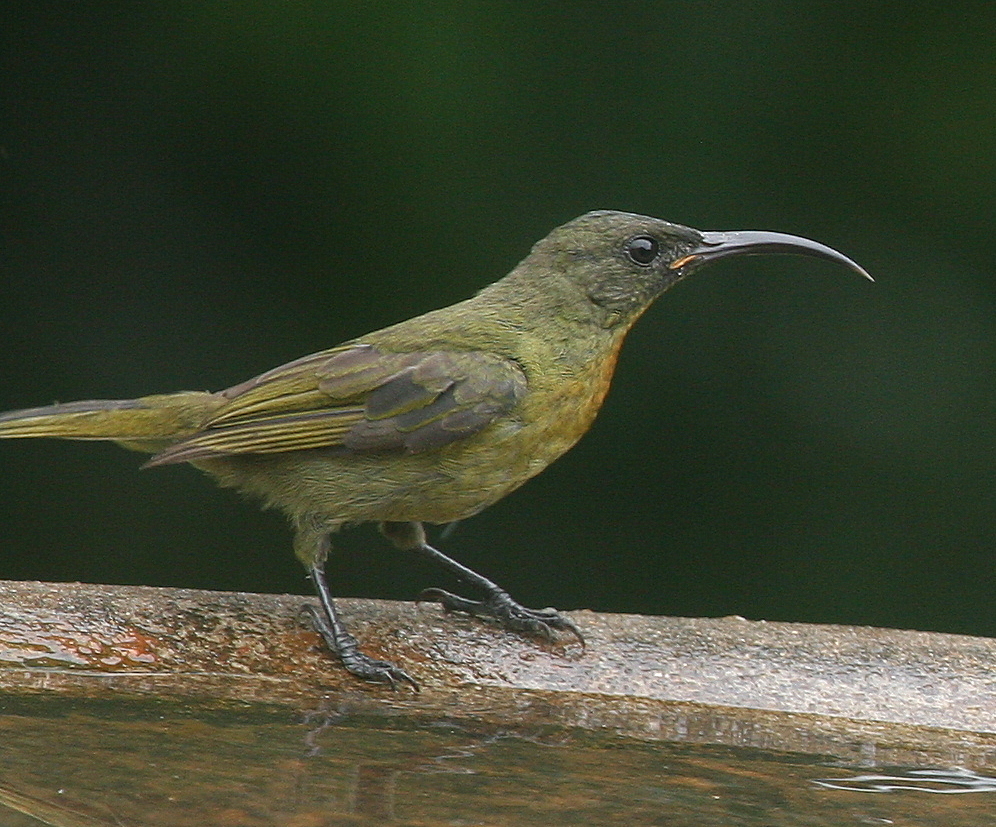
The olive sunbird (Cyanomitra olivacea) is a large African species of sunbird belonging to the family Nectariniidae which encompasses species of sunbirds, spiderhunters, and flowerpeckers, and sugarbirds.
It has a large distribution that spans across central Africa from western countries including Senegal, Guinea, and Angola towards eastern countries including Ethiopia, Kenya, and Mozambique. This range also extends to southern African countries including South Africa and Zimbabwe. It is mainly nectarivorous and lives in a variety of forest, scrubland, and modified habitats.
From the article Olive sunbird on Wikipedia (CC BY-SA), quoted section by section
Description
The olive sunbird is a large sunbird that ranges from 6.2-15 g in mass, 50–73 mm in wing length, 20–29 mm in bill length, 35–66 mm in tail length, and 12–15 cm in overall body size depending on the subspecies and sex. Its body colouration can vary from fully dark-olive to dull-olive with a paler olive-yellow or olive-grey underside. It has a long beak that curves downward and varies in colour from solid black to mottled grey, beige, and yellow-orange depending on the subspecies. Yellowish-orange pectoral tufts can be present in the males and females found in eastern subspecies while only males bear these tufts in western subspecies. Olive sunbirds show morphological differences between forest-savanna boundaries despite minimal genetic variation. Adult males from forest-savanna boundary habitats had longer wings, legs, and bills than adult males found in forest habitats.
Range & habitat
Olive sunbirds occur in a variety of habitats including coastal and montane scrublands, woodlands, bushy and coastal thickets, and western mangroves. They are found throughout primary and secondary forests at all heights but especially prefer the understories. They also occupy modified habitats such as agricultural lands, forest clearings, gardens, urban areas, bushes around villages, and active or abandoned eucalyptus, banana, and coffee plantations. Their altitudinal distribution ranges from sea level to 3000 m above sea level but they tend to stay within 2300 m. Despite being primarily sedentary, they have been shown to partially migrate to lower elevations during cold seasons and higher elevations during warm seasons. Potential explanations for this behaviour include compensating for seasonal temperature change, females seeking out cooler environments to satisfy optimal breeding conditions, or high movement capability. Moreover, olive sunbirds are highly motile and can traverse across forest gaps as well as navigate between fragmented forest patches and eucalyptus plantations.
Wikipedia: “Habitat and movement”
What it does
Olive sunbirds feed on nectar, insects, spiders, fruits, berries, seeds, pollen, and banana pulp. They extract nectar by hovering in front of flowers and catch arthropods through gleaning, hawking, poking, and hovering in front of vegetation. They often pursue flowers that contain high volumes of nectar. Dominant males are highly territorial and secure productive flowering sites with sufficient nectar yield. They have been shown to deter other sunbirds and even bees that are competing within their territory. However, honeybees (Apis mellifera) that are competing for Tecoma stans also chase away sunbirds by swarming their faces. Olive sunbirds mainly forage in the understory of the forest but can extend their range towards both canopy and floor.
Plant species in diet. Known plant species from which the different subspecies forage include:
Achyrospermum carvalhi Aframomum sp. Agelanthus kraussianus Antidesema venosum Burchellia sp. Carica papaya Ceiba pentandra Cephaelis mannii Dracaena flagrans Englerina woodfordiodes Erythrina sp. Eugenia malacensis Fuchsia sp. Gardenia tigrina Grevillea banksii Halleria lucida Hibiscus tiliaceus Ipomoea sp. Jacaranda sp. Kigelia africanca Leonotis leonurus Leonotis mollissima unidentified Loranthaceae Macrorungia pubinervia Macaranga assas Macaranga barteri Musa sp. Musanga cecropioides Mimusops caffra Oxyanthus troupini Passiflora sp. Schot …
Wikipedia: “Diet”
Listen
Looking for field recordings…
Where it lives
Recorded sightings
—
geo-referenced records in GBIF, from museums, herbaria and field observers.
Drag the globe to turn it. Dots are where records exist, not a range map; darker means more records.
In the stacks
Searching the stacks…
Every page naming Cyanomitra olivacea in the Biodiversity Heritage Library →
This page is assembled live from iNaturalist, GBIF, Wikipedia, the Source Library and the Internet Archive. It is not yet part of the hand-edited codex. iNaturalist taxon 145136.