On eBird ↗
Cameroon Sunbird
Live sightings near you, the range map, bar charts of when it is seen, and Macaulay Library photos and recordings.
Cameroon Sunbird
Cyanomitra oritis
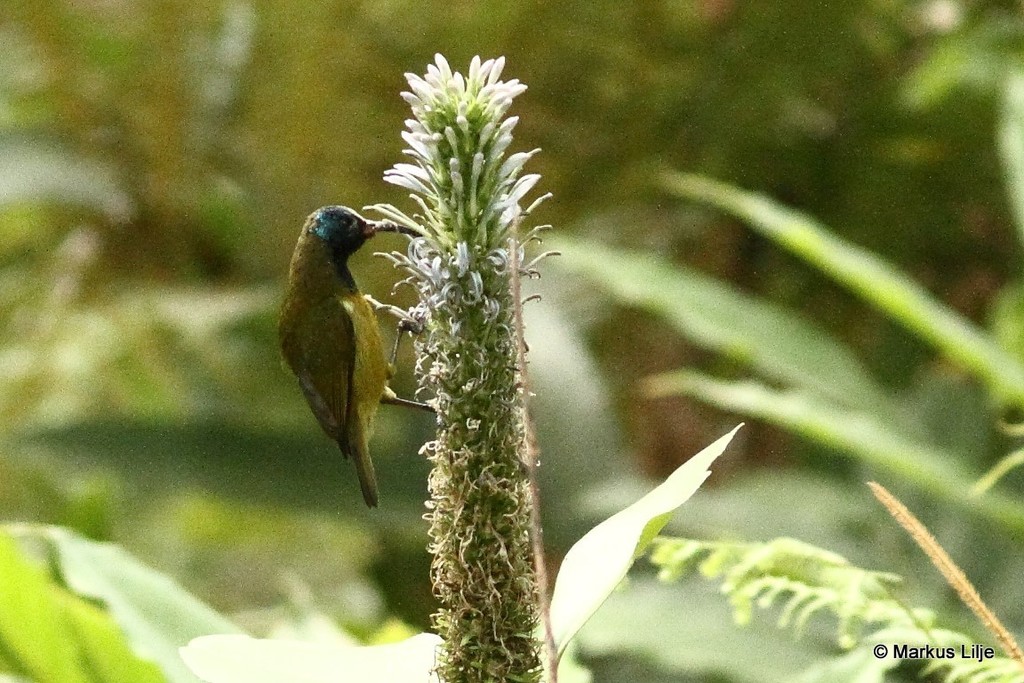
The Cameroon sunbird (Cyanomitra oritis) is a species of bird in the family Nectariniidae. It is native to montane forests of Cameroon, Nigeria, and Equatorial Guinea, including the island of Bioko. It inhabits high-altitude forests and feeds primarily on nectar and insects. The species shows marked sexual dimorphism, with males displaying a metallic blue breast and duller females, and is known to make seasonal altitudinal movements. The species is classified as Least Concern by the International Union for Conservation of Nature (IUCN), although its population trend is decreasing due to habitat loss.
From the article Cameroon sunbird on Wikipedia (CC BY-SA), quoted section by section
Range & habitat
The Cameroon sunbird occurs in montane forests of Cameroon, Nigeria and Equatorial Guinea, including the island of Bioko. Montane forests are "high-altitude, biodiversity-rich cloud forests found above 1,600m on volcanic peaks, characterized by a dense, humid canopy" of many different species of trees. This bird primarily feeds on small insects and nectar. They forage individually or in pairs, and occasionally in large groups near flowering trees.
Wikipedia: “Diet/Habitat”
What it does
The vocalization of the Cameroon sunbird consists of a 'sequence of rapid, well spaced whistles described as "tiu tiu tiwu tiwu tiu tiu.'" Breeding has been recorded that eggs are laid from March-April and then from November-December. They build pear-shaped nests that are made from grass, moss, rootlets lined with fibre, silk-cotton, and dry grass. Cameroon sunbirds are considered non-migratory but make altitude movements. On Mount Cameroon, individuals have been observed descending to lower elevations between June and September.
Wikipedia: “Behavior-Call/Vocalization, Breeding, Migration”
Listen
Looking for field recordings…
Where it lives
Recorded sightings
—
geo-referenced records in GBIF, from museums, herbaria and field observers.
Drag the globe to turn it. Dots are where records exist, not a range map; darker means more records.
In the stacks
Searching the stacks…
Every page naming Cyanomitra oritis in the Biodiversity Heritage Library →
This page is assembled live from iNaturalist, GBIF, Wikipedia, the Source Library and the Internet Archive. It is not yet part of the hand-edited codex. iNaturalist taxon 145134.