On eBird ↗
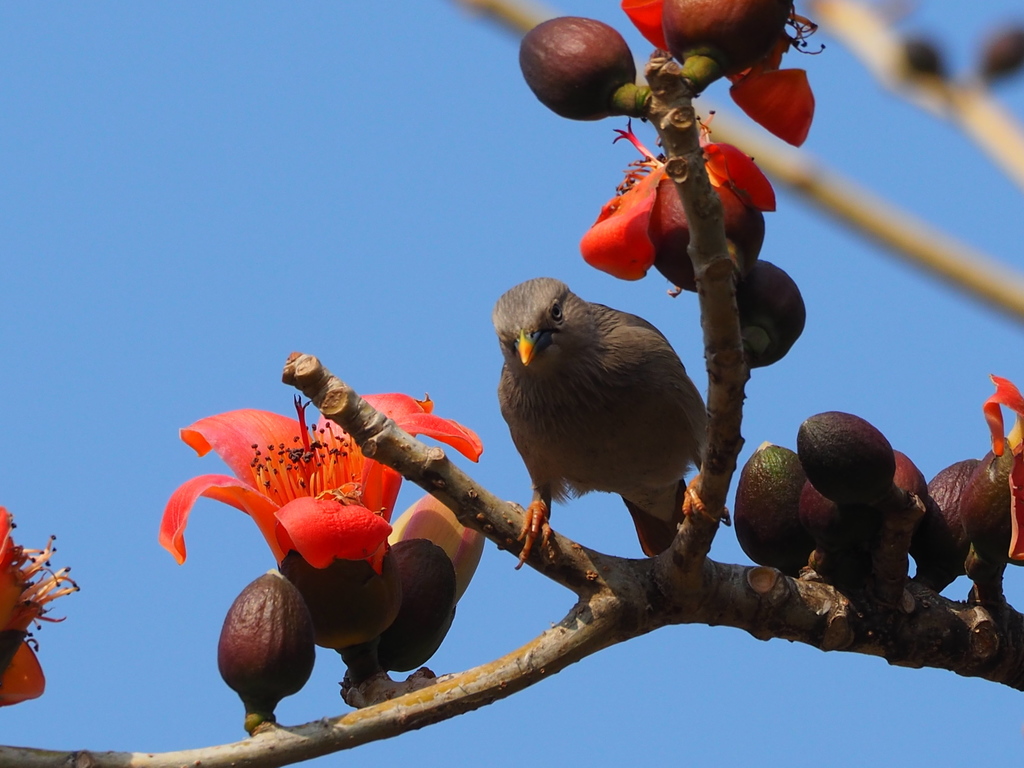
Chestnut-tailed Starling
Live sightings near you, the range map, bar charts of when it is seen, and Macaulay Library photos and recordings.
Chestnut-tailed Starling
Sturnia malabarica
The chestnut-tailed starling (Sturnia malabarica), also called grey-headed starling and grey-headed myna is a member of the starling family. It is a resident or partially migratory species found in wooded habitats in India and Southeast Asia. The species name is after the distribution of a former subspecies in the Malabar region. While the chestnut-tailed starling is a winter visitor to peninsular India, the closely related resident breeding population with a white head is now treated as a full species, the Malabar starling (Sturnia blythii).
From the article Chestnut-tailed starling on Wikipedia (CC BY-SA), quoted section by section
Description
The adults have a total length of approximately 20 cm (7.9 in). They have grey upperparts and blackish remiges, but the colour of the remaining plumage depends on the subspecies. In the nominate subspecies and blythii, the underparts (incl. undertail) are rufous, but in nemoricola the underparts are whitish tinged rufous, especially on the flanks and crissum (the undertail coverts surrounding the cloaca). The nominate and nemoricola have a light grey head with whitish streaking (especially on crown and collar region). Both subspecies have white irises and a yellow bill with a pale blue base. The sexes are similar, but juveniles have whitish underparts and just chestnut tips to the tail feathers.
What it does
The chestnut-tailed starling's nest is typically found in open woodland and cultivation, and it builds a nest in an old barbet or woodpecker hole in a tree-trunk, 3–12 m (9.8–39.4 ft) up. The normal clutch is 3-5 eggs, pale blue, unmarked. The nesting season is usually March to June. Like most starlings, it is fairly omnivorous, eating fruit, nectar and insects. They fly in tight flocks and often rapidly change directions with great synchrony.
Wikipedia: “Behaviour”
Listen
Looking for field recordings…
Where it lives
Recorded sightings
—
geo-referenced records in GBIF, from museums, herbaria and field observers.
Drag the globe to turn it. Dots are where records exist, not a range map; darker means more records.
In the stacks
Searching the stacks…
Every page naming Sturnia malabarica in the Biodiversity Heritage Library →
This page is assembled live from iNaturalist, GBIF, Wikipedia, the Source Library and the Internet Archive. It is not yet part of the hand-edited codex. iNaturalist taxon 145103.