- Animals
- ›Chordates
- ›Vertebrates
- ›Birds
- ›Perching Birds
- ›Old World Flycatchers, Robins, and Chats
- ›Calliope
On eBird ↗
Siberian Rubythroat
Live sightings near you, the range map, bar charts of when it is seen, and Macaulay Library photos and recordings.
Siberian Rubythroat
Calliope calliope
The Siberian rubythroat (Calliope calliope) is a small passerine bird first described by Peter Simon Pallas in 1776. It was formerly classed as a member of the thrush family, Turdidae, but is now more generally considered to be an Old World flycatcher of the family Muscicapidae. The Siberian rubythroat and similar small European species are often called chats.
From the article Siberian rubythroat on Wikipedia (CC BY-SA), quoted section by section
Description
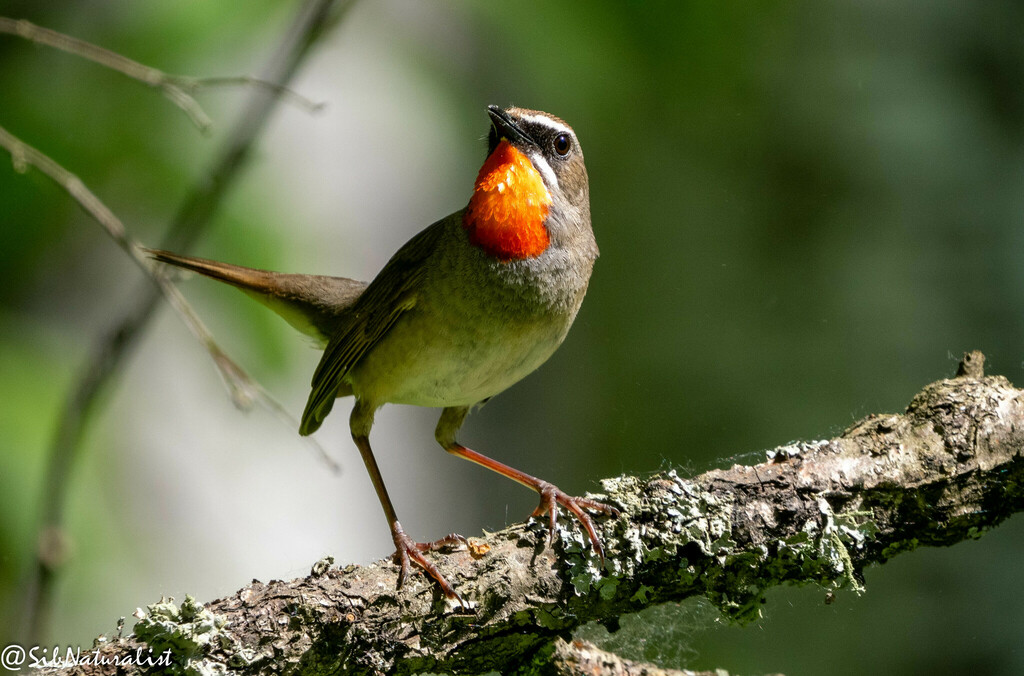
This species is slightly larger than the European robin. It is plain brown above except for the distinctive black tail with red side patches. It has a strong white supercilium. The male has a red throat edged with a narrow black and then a broad white border. Females lack the brightly coloured throat and borders. The male has a song similar to a harder version of the garden warbler.
What it does
The Siberian rubythroat is a migratory insectivorous species breeding in mixed coniferous forests with undergrowth in Siberia. It nests near the ground. It winters in Thailand, India, Indonesia and Bangladesh. It is an extremely rare vagrant to Western Europe, having occurred on a very few occasions as far west as Britain. It is also an extremely rare vagrant to the Aleutian Islands, most notably on Attu Island.
Wikipedia: “Ecology”
Listen
Looking for field recordings…
Where it lives
Recorded sightings
—
geo-referenced records in GBIF, from museums, herbaria and field observers.
Drag the globe to turn it. Dots are where records exist, not a range map; darker means more records.
In the stacks
Searching the stacks…
Every page naming Calliope calliope in the Biodiversity Heritage Library →
This page is assembled live from iNaturalist, GBIF, Wikipedia, the Source Library and the Internet Archive. It is not yet part of the hand-edited codex. iNaturalist taxon 145064.