- Animals
- ›Chordates
- ›Vertebrates
- ›Birds
- ›Perching Birds
- ›Old World Flycatchers, Robins, and Chats
- ›Larvivora
On eBird ↗
Indian Blue Robin
Live sightings near you, the range map, bar charts of when it is seen, and Macaulay Library photos and recordings.
Indian Blue Robin
Larvivora brunnea
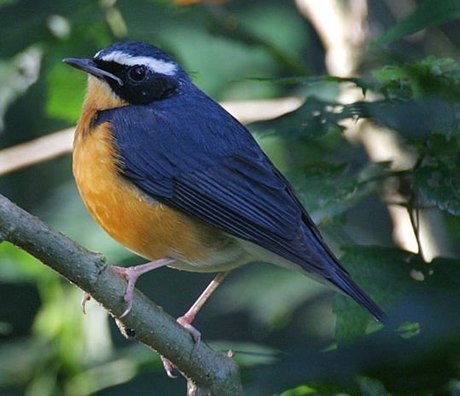
The Indian blue robin (Larvivora brunnea) is a small bird found in the Indian subcontinent. Formerly considered a thrush, it is now considered one of the Old World flycatchers in the family Muscicapidae. It was earlier also called the Indian blue chat. It is migratory, breeding in the forests along the Himalayas of Nepal, India, Myanmar and Bangladesh. They winter in the hill forests of the Western Ghats of India and in Sri Lanka.
From the article Indian blue robin on Wikipedia (CC BY-SA), quoted section by section
Description
The Indian blue robin is similar in size to the related bluethroat at 15 cm long. The adult male has blue upperparts and rufous underparts. A bright white supercilium contrasts with a black mask that continues down the neck. The lower belly and undertail are also whitish. The female is olive brown above and buff below with a light eye-ring and rufescent rump. The breast and flanks are buffy. Young birds are dark brown with buff spots.
Range & habitat
The nominate race breeds from Eastern Afghanistan to the eastern Himalayas. Race wickhami (Stuart Baker, 1916) breeds in the Chin Hills of western Myanmar and is said to be non-migratory.
Wikipedia: “Distribution”
What it does
The Indian blue robin is insectivorous and feeds mainly on the ground. It skulks in undergrowth and hops on the ground, frequently flicking and fanning its tail. The breeding season is May to July and the nest is a large cup of vegetation placed on the ground between the roots of large fir tree or in depression. The nest is lined with roots, hair and down. The usual clutch is 4 light blue eggs. Only the female is believed to incubate but both sexes take part feeding the young. The cuckoo Cuculus canorus has been recorded in old literature as a brood parasite of the species. These birds arrive in the Himalayan breeding grounds in May and leave in September. Southward migration begins in August. During the migratory season they may be found as passage migrants all over peninsular India. In winter they are found mainly in the hill forests of southern India, the Western Ghats and in Sri Lanka. They arrive in mid-September and leave the winter quarters in mid-April. Males appeared to be commoner than females in a survey conducted in the Nilgiris suggesting either differences in the timing of migration of males and females or variation in wintering areas. …
Wikipedia: “Behaviour and ecology”
Listen
Looking for field recordings…
Where it lives
Recorded sightings
—
geo-referenced records in GBIF, from museums, herbaria and field observers.
Drag the globe to turn it. Dots are where records exist, not a range map; darker means more records.
In the stacks
Searching the stacks…
Every page naming Larvivora brunnea in the Biodiversity Heritage Library →
This page is assembled live from iNaturalist, GBIF, Wikipedia, the Source Library and the Internet Archive. It is not yet part of the hand-edited codex. iNaturalist taxon 145059.