On eBird ↗
Western Bowerbird
Live sightings near you, the range map, bar charts of when it is seen, and Macaulay Library photos and recordings.
Western Bowerbird
Chlamydera guttata
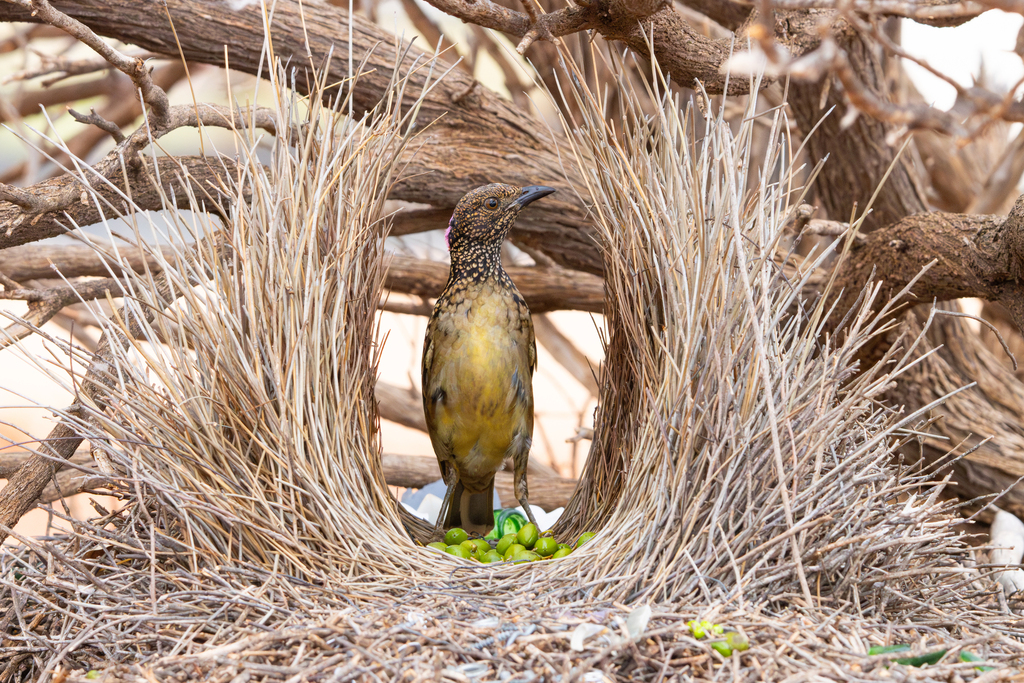
The western bowerbird (Chlamydera guttata) is a species of bird in the bowerbird family. The species is a common endemic of Australia. It has a disjunct distribution, occurring in Central Australia and the Pilbara region of Western Australia. There are two subspecies, the nominate, which occupies most of its range, and P. g. cateri, which occurs only the North West Cape in Western Australia. The species was first collected in 1861 by the explorer Francis Gregory,...
From the article Western bowerbird on Wikipedia (CC BY-SA), quoted section by section
Description
The western bowerbird is smaller than the other bowerbird it shares its range with, the great bowerbird. It measures 24–28 cm (9.4–11.0 in) in length and weighs 120–150 g (4.2–5.3 oz). Both sexes are similar in size and dimensions, except that the tail of the female is slightly longer. The plumage is brown with reddish or buff spots over the throat, chest, neck, back, head and wings, with a pink erectile crest on the nape. The tail is brown and the undersides are buff. The plumage of the female is similar to the male but more spotted on the throat.
What it does
The western bowerbird feeds on fruits, particularly those of the rock fig (Ficus platypoda), sandalwood, snake gourd (Trichosanthes cucumerina) and mistletoes. They also enter farms to feed on cultivated fruits. Other items taken in the diet include nectar, flowers, insects (e.g. ants, moths, beetles and grasshoppers), and spiders. They need to drink regularly and are rarely found far from water.
Wikipedia: “Diet”
Listen
Looking for field recordings…
Where it lives
Recorded sightings
—
geo-referenced records in GBIF, from museums, herbaria and field observers.
Drag the globe to turn it. Dots are where records exist, not a range map; darker means more records.
In the stacks
Searching the stacks…
Every page naming Chlamydera guttata in the Biodiversity Heritage Library →
This page is assembled live from iNaturalist, GBIF, Wikipedia, the Source Library and the Internet Archive. It is not yet part of the hand-edited codex. iNaturalist taxon 14497.