On eBird ↗
Oriental Reed Warbler
Live sightings near you, the range map, bar charts of when it is seen, and Macaulay Library photos and recordings.
Oriental Reed Warbler
Acrocephalus orientalis
The Oriental reed warbler (Acrocephalus orientalis) is a passerine bird of eastern Asia belonging to the reed warbler genus Acrocephalus. It was formerly classified as a subspecies of the great reed warbler (A. arundinaceus) of the western Palearctic.
From the article Oriental reed warbler on Wikipedia (CC BY-SA), quoted section by section
Description
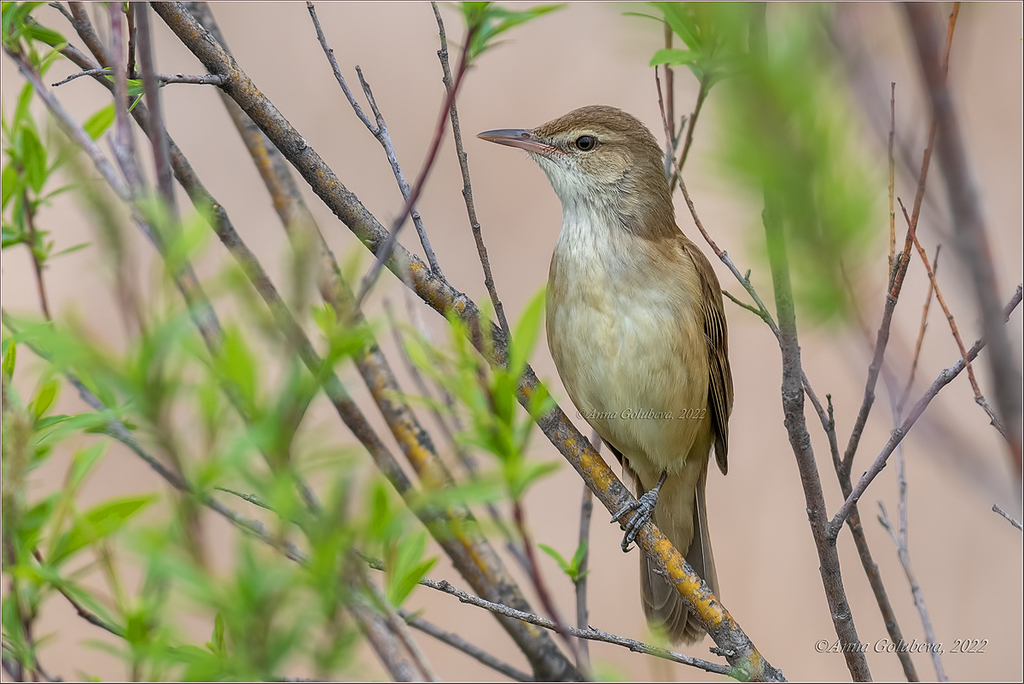
It is a large warbler, 18–20 cm long with a wingspan of 23–26 cm. The plumage is brown above with a paler rump and whitish tips to the tail feathers. The underparts are whitish below, browner on the flanks and undertail-coverts. There are narrow greyish streaks on the throat and breast. It has a dark eyestripe and a whitish stripe above the eye. The fairly long, heavy bill is brownish above and pink below with a bright orange gape. The feet are grey. It is slightly smaller, slenderer and shorter-winged than the great reed warbler. Its tail is shorter and more square-ended than that of the clamorous reed warbler (A. stentoreus) and it has a slightly longer primary projection and a slightly shorter and thicker bill. The pale tip to the tail separates it from both species. The song is a mixture of warbling phrases and guttural, croaking notes. It is given from a prominent perch such as the top of a reed stem or bush. The bird also has a loud, harsh chack call.
Range & habitat
The breeding range covers southern Siberia, Mongolia, northern, central and eastern China, Korea and Japan. It winters in north-east India and across South-east Asia to the Philippines and Indonesia, occasionally reaching New Guinea and Australia. It has occurred as a vagrant in Israel and Kuwait. It breeds mainly in reedbeds and can also be found in marshes, paddy fields, grassland and scrub where it forages for insects and other invertebrates.
Wikipedia: “Distribution and habitat”
What it does
Oriental reed warblers have small breeding territories and can achieve high population densities. The nest is built 1–1.5 metres above the ground among reed stems. Two to six eggs are laid and are incubated for 12 to 14 days. The young birds fledge after 10 to 15 days. Major predators at the nest include the Siberian weasel, cats and snakes of the genus Elaphe.
Wikipedia: “Reproduction”
Listen
Looking for field recordings…
Where it lives
Recorded sightings
—
geo-referenced records in GBIF, from museums, herbaria and field observers.
Drag the globe to turn it. Dots are where records exist, not a range map; darker means more records.
In the stacks
Searching the stacks…
Every page naming Acrocephalus orientalis in the Biodiversity Heritage Library →
This page is assembled live from iNaturalist, GBIF, Wikipedia, the Source Library and the Internet Archive. It is not yet part of the hand-edited codex. iNaturalist taxon 144928.