On eBird ↗
Long-billed Wren
Live sightings near you, the range map, bar charts of when it is seen, and Macaulay Library photos and recordings.
Long-billed Wren
Cantorchilus longirostris
The long-billed wren (Cantorchilus longirostris) is a species of bird in the family Troglodytidae. It is endemic to Brazil. Its natural habitats are subtropical or tropical dry forest, subtropical or tropical moist lowland forest, subtropical or tropical dry shrubland, and heavily degraded former forest.
From the article Long-billed wren on Wikipedia (CC BY-SA), quoted section by section
Description
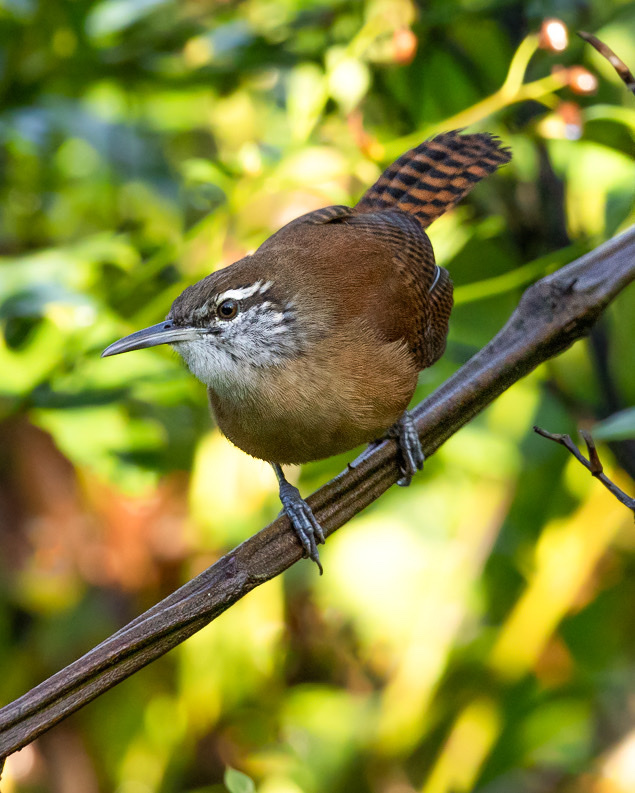
The long-billed wren is 19 to 21.5 cm (7.5 to 8.5 in) long and weighs 20 to 21 g (0.71 to 0.74 oz). The crown and nape of adults of the nominate subspecies are rich dark brown that becomes progressively more reddish to the rump; the lower back has obscure bars. Their tail is reddish brown with darker bars. They have an off-white supercilium, a darkish brown eyestripe, cheeks mottled off-white and dark gray, and a blackish malar stripe. Their throat color ranges from whitish to pale buff; their chest is reddish buff and the belly a deep rich buff. Juveniles are almost the same but their facial markings are not as distinct. C. l. bahiae is paler overall than the nominate, with the underparts' colors being much less saturated.
Range & habitat
C. l. bahiae is the more northerly subspecies of long-billed wren; it is found in the "bulge" of eastern Brazil from Piauí south to Minas Gerais and east to the Atlantic coast. C. l. longirostris is found in a narrower coastal band from Bahia south to eastern Santa Catarina. The species inhabits secondary forest, the edges and shrubby clearings of primary forest, mangroves, caatinga, and restinga. In elevation it ranges from sea level to 900 m (3,000 ft).
Wikipedia: “Distribution and habitat”
What it does
The long-billed wren's diet has not been studied, and its foraging habits are not well known. It probably forages singly or in pairs, usually within 2 m (6.6 ft) of the ground but sometimes as high as 5 m (16 ft).
Wikipedia: “Feeding”
Listen
Looking for field recordings…
Where it lives
Recorded sightings
—
geo-referenced records in GBIF, from museums, herbaria and field observers.
Drag the globe to turn it. Dots are where records exist, not a range map; darker means more records.
In the stacks
Searching the stacks…
Every page naming Cantorchilus longirostris in the Biodiversity Heritage Library →
This page is assembled live from iNaturalist, GBIF, Wikipedia, the Source Library and the Internet Archive. It is not yet part of the hand-edited codex. iNaturalist taxon 144879.