On eBird ↗
Beesley's Lark
Live sightings near you, the range map, bar charts of when it is seen, and Macaulay Library photos and recordings.
Beesley's Lark
Chersomanes beesleyi
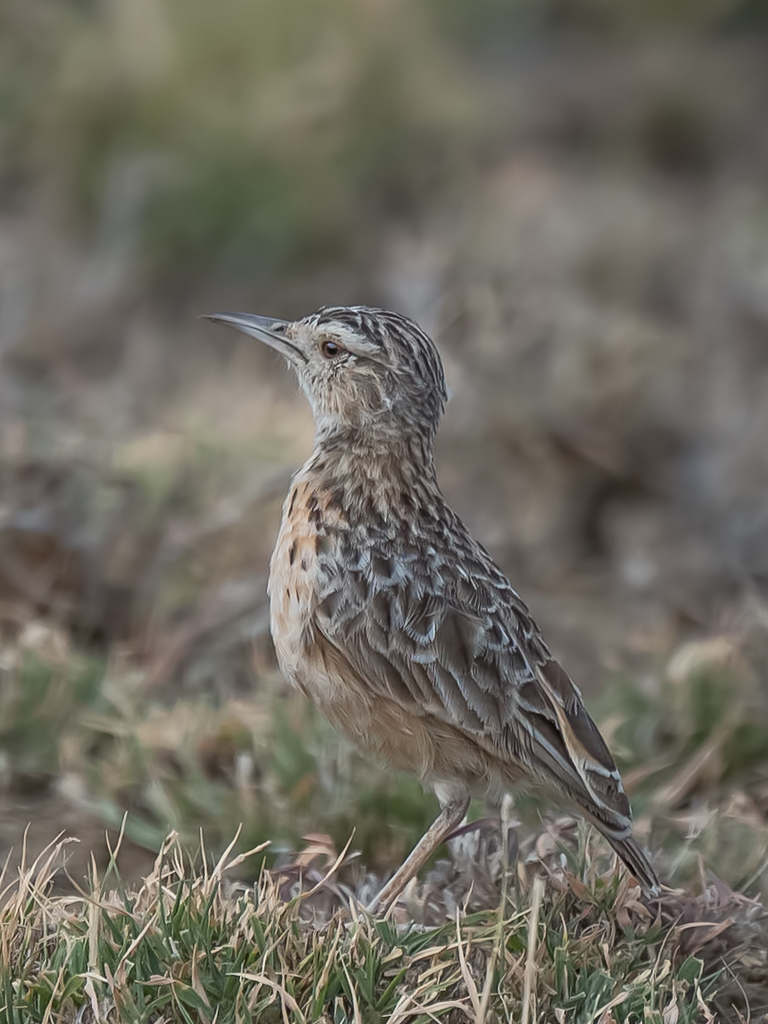
Beesley's Lark (Chersomanes beesleyi) is a species of lark in the family Alaudidae. It was formerly considered to be a subspecies of the Spike-heeled Lark.
The Beesley's Lark is found in Northern Tanzania, in some very restricted patches of Afrotropical grassland, mainly composed of Sporobolus ioclados and Digitaria macroblephara on volcanic soil. This species has adapted to arid areas with no tree coverage, thus evolving a specific cryptic plumage. Chersomanes beesleyi is a granivorous bird, meaning it feeds on seeds, but individuals are habitually seen feeding on insects too, like beetles, caterpillars and centipedes, occasionally preying on small reptiles as well.
From the article Beesley's lark on Wikipedia (CC BY-SA), quoted section by section
Description
Beesley’s Larks show some slender, decurved bills, and can be identified by their whitish napes, general structure and size, but also by their vocalizations and behavior. They have some white-fringed, scalloped upperwing coverts, and a very short tail, sporting some white-tipped rectrices and a rufuous rump. The species is sexually dimorphic, and individuals of different sexes can be told apart in the field: adult female Beesley’s Larks have bolder breast streaks in comparison to males, a darker-orange belly, and they are smaller in size. In adults, in which the males are also more heavily-billed, the upperparts show blackish-brown coloration if fresh, and they turn pale gray once heavily abraded. In fresh plumage, the males also tend to display a supercilium much thicker than the females'. They breed during the long and short rains; which range between the months of October through December, and from March through April. Their nesting sites are on the ground, and they are built like a small cup. The birds line each nest with dry grass and also cow dung, and two to three eggs are laid therein.
What it does
The Beesley’s Larks reside in Northern Tanzania year-round with no migrations. Very sociable, they associate in groups of 3-6 (singletons are moderately rare, especially during the breeding season) and their calls consist of a quivering trill “Trrrri-trrri-trrri-trrriii”, quite resemblant of some shorebirds' in-flight alarm calls. When vocalizing together, males and females have the same interaction vocabulary, contact and alarm calls. They are unresponsive to any recorded calls of C. albofasciata, no matter the race, with agitation as the only outcome. Beesley’s Larks have the tendency of running through their habitiat, and if strictly necessary, they can perform some low, bobbing, flappy flights, usually travelling short distances, only for suddenly dropping to the ground and hiding behind grass tussocks. They usually soar higher for intraspecific interactions or for territorial defense only; Beesley's Larks are highly unlikely to attack their kin, but they can be very efficiently aggressive against other species, as the Capped and the Isabelline Wheaters, or other larks, as the locally common Red-capped Lark.
Wikipedia: “Behaviors”
Listen
Looking for field recordings…
Where it lives
Recorded sightings
—
geo-referenced records in GBIF, from museums, herbaria and field observers.
Drag the globe to turn it. Dots are where records exist, not a range map; darker means more records.
In the stacks
Searching the stacks…
Every page naming Chersomanes beesleyi in the Biodiversity Heritage Library →
This page is assembled live from iNaturalist, GBIF, Wikipedia, the Source Library and the Internet Archive. It is not yet part of the hand-edited codex. iNaturalist taxon 144772.