On eBird ↗
Black-backed Antshrike
Live sightings near you, the range map, bar charts of when it is seen, and Macaulay Library photos and recordings.
Black-backed Antshrike
Thamnophilus melanonotus
The black-backed antshrike (Thamnophilus melanonotus) is a species of bird in the family Thamnophilidae. It is found in Colombia and Venezuela, where its natural habitat is subtropical or tropical dry forests.
From the article Black-backed antshrike on Wikipedia (CC BY-SA), quoted section by section
Description
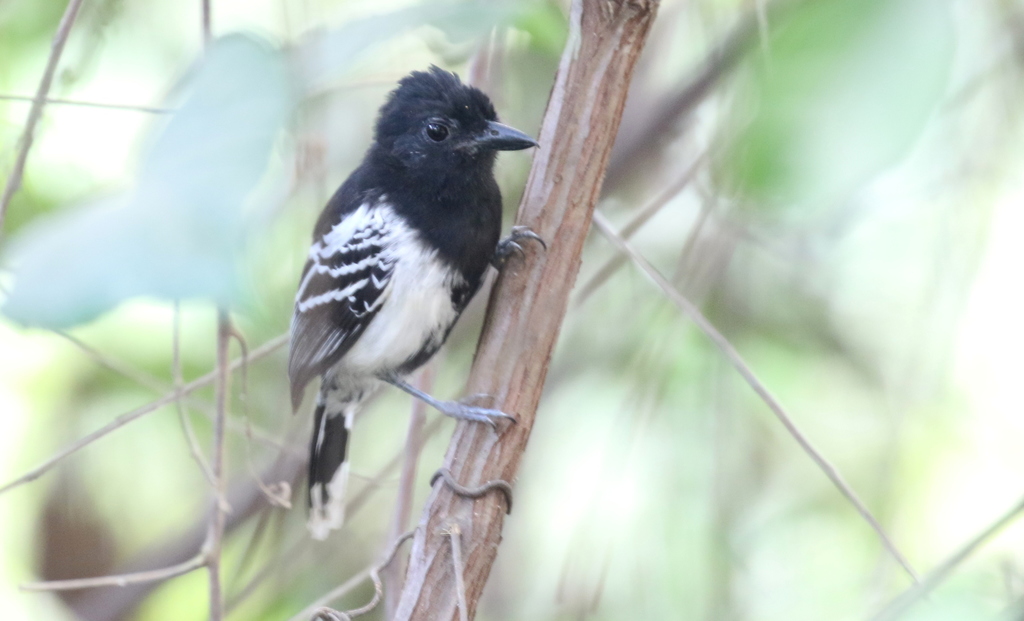
The black-backed antshrike is 15 to 16 cm (5.9 to 6.3 in) long. Members of genus Thamnophilus are largish members of the antbird family; all have stout bills with a hook like those of true shrikes. Adult males have a black to blackish brown head and back with white edges on the scapulars and a hidden white patch between them. Their lower back and rump are light gray. Their wings are black with wide white tips on the coverts and white edges on the flight feathers. Their tail is black with white tips on the feathers and white edges on the outermost pair. Their throat and breast are black and their flanks, belly, and crissum are white. Adult females have a dark brown crown with cinnamon edges to the feathers. Their face is buff. Their upperparts are brown with dark centers to the feathers. Their wings and wing coverts are brownish black with pale buff edges and tips. Their tail is rufous-brown with whitish tips and edges to the feathers. Their underparts are buff that is somewhat whiter on the belly. Subadult males resemble adult females with some black feathers beginning to show.
Range & habitat
The black-backed antshrike has a disjunct distribution. It is found on the Caribbean slope from northern Colombia as far south as northern Bolívar Department and east into northwestern Venezuela as far as Miranda state. A second population is found in the Zulia River valley in Colombia's Norte de Santander Department and the adjacent Cordillera de Mérida in western Venezuela. The species inhabits the understorey to mid-storey of dry deciduous forest, where it favors areas with dense vine thickets. In elevation it ranges from sea level to 1,000 m (3,300 ft) in Colombia and to 1,300 m (4,300 ft) in Venezuela, though in the latter country it is mostly found below 500 m (1,600 ft).
Wikipedia: “Distribution and habitat”
What it does
The black-backed antshrike's diet is primarily insects and probably also includes other small arthropods. It forages rather lethargically, mostly singly or in pairs and seldom as part of a mixed-species feeding flock. It forages mostly on and near the ground up to about 6 m (20 ft) above it, and especially in vine tangles. It feeds by gleaning, with short upward jumps, and by pouncing to the ground. It occasionally follows army ant swarms.
Wikipedia: “Feeding”
Listen
Looking for field recordings…
Where it lives
Recorded sightings
—
geo-referenced records in GBIF, from museums, herbaria and field observers.
Drag the globe to turn it. Dots are where records exist, not a range map; darker means more records.
In the stacks
Searching the stacks…
Every page naming Thamnophilus melanonotus in the Biodiversity Heritage Library →
This page is assembled live from iNaturalist, GBIF, Wikipedia, the Source Library and the Internet Archive. It is not yet part of the hand-edited codex. iNaturalist taxon 144696.